

Recently a news was circulated in whatsapp groups that a bank employee passed away due to heart attack suffered during a meeting. He was rushed to hospital but. Sad news. However, the discussion that took the center stage needs our attention.
“According to the reported bankers, What pains even more than the loss itself is the way the news was handled. Half of the RBO staff remained unaware of his passing until late in the evening. Regular office work, meetings, and calls continued throughout the day, as if nothing had happened. Those who came to know had little time, or perhaps little platform, to inform the others. Colleagues say the situation reflects the ultimate height of insensitivity.”
-comment in one news site.
I posed a question mark that if half of the staff remain unaware, is it the fault of the organisation or person sitting at the next desk of the deceased employee. The reply I got from one of the person is
“Organization has made such work culture where people don’t care to show empathy”
Let us discuss this matter as to what and where there should be line for organizations responsibility and individual’s behaviour.
There are 3 serious points in the above statements:
- Half of Office Staff remain unaware.
- Work continued throughout the day.
- Organization has made this work culture.
Half of Office staff remain unaware:
Can we attribute the employee’s unawareness about fellow colleague who works in the same office to Organisation apathy and culture? Answer can be both yes and no. We can say Yes as an Organisation is supposed to set the pace among the interpersonal relationships and bonding among the employees. If the organisation talks and cares only about targets and treat its employees as machines who give output through an input of salary and perks then there are large possibilities that employees remain engaged and focussed in their daily tasks without bothering about surroundings. However, it may also be the case that people in that specific unit are not in a decent cohesion due their own egos, preferences, competitions etc and that may be the reason for them remaining unaware of the incident.
Work continued throughout the day:
It seems to be organisation’s effectiveness and its employee’s commitment to work that they continued and did not allow the work to suffer. As any disruption in work will directly affect the customers transactions and at any cost that need to be avoided.
Organisation has made this work culture:
This is direct attack on the work culture of the organisation. However, as far as individual response to an event is concerned it is the result of many factors and not just organisation’s culture or Organisation’s behaviour. The behaviour of an individual or group of individuals (as in this case) can be attributed to multiple factors rather than brushing it only as Organisation’s culture. Following equation explains the dependency of a response to an event
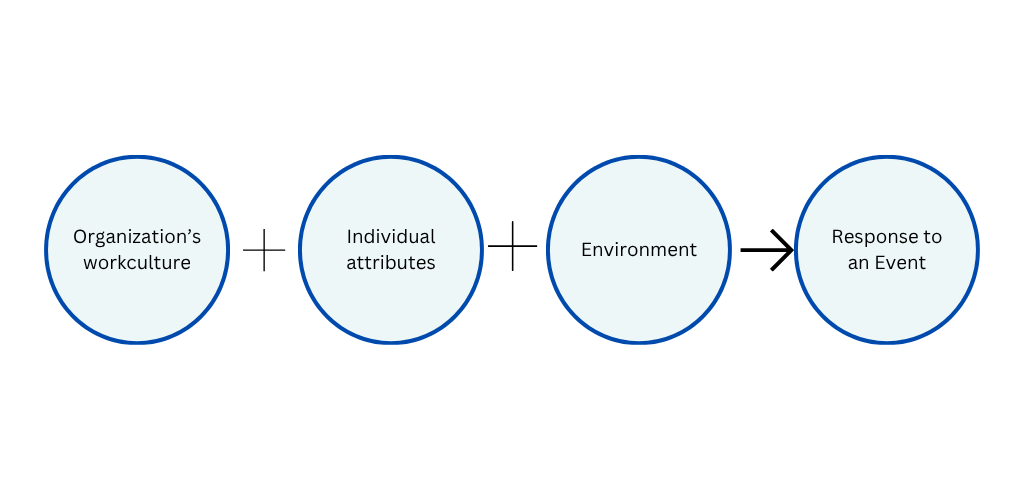
In the present case of death of the employee too these three factors will impact the action of the office staff who did not know about the event and continued to work as usual. Organisation may not be encouraging the E-E relationships (Employee to Employee) and may be focussing on the organisational objectives related to growth, performance etc. There may not be informal gatherings among the employees resulting into unempathetic behaviour of employees towards one another. Individual characteristics of the employees are also responsible for a response. The employee who passed away may not be a person who mingles too much with colleagues and hence his absence was not noticed by others. Alternatively, most employees in the office may be self-cantered and hence even those who know about the incident choose to keep silence. Thirdly, and that I feel the most important is the environment in that office itself. If people in that particular office do not communicate with each other and work in silos may also result in such a happening or sometimes the leader is too engaged in his job and could not find time to see if interpersonal relations are working fine.
Whichever factor is more prominent in this case, the result of the combination of these three has caused an unpleasant situation in the office.
Though we cannot propose the response to the problem as we are not in a position to know the real issue on the ground, please ponder upon these 3 questions:
- What organisation should do to enhance the E-E relationships?
- What the local office/s should do to ensure better communication and belongingness among the employees?
- Should employees rethink about their own behaviour at workplace?
Your responses will multiply our understanding of the issue and may also help people to handle such situations in a better way.
READ THINK COMMENT SHARE SUBSCRIBE ENJOY SILLYPOINT
About the author: The author of the Blog, Sayed Azhar Hasan, is a CFA (ICFAI), MBA, PGDIBF (Islamic Banking and Finance), ex banker with 29 years of banking experience and a management educator.
On social media:
LinkedIn : Sayed Azhar Hasan | LinkedIn
You Tube: Sayed Azhar Hasan – YouTube
Disclaimer: The information provided in this blog is for educational and informational purposes only and does not constitute professional financial, legal, or regulatory advice. The views expressed are those of the author and do not necessarily reflect the official policy of any institution or regulatory body.
Discover more from At Silly Point
Subscribe to get the latest posts sent to your email.
Great efforts in making nice presentation sir..
Keep rocking sir👍
Thank you.
CORPORATE- THE MURDERER
They say employees are “self-centered.” That silence in the office is because people don’t talk, or don’t “rethink their behaviour.” Cute. That’s insulting. People don’t go quiet because they hate their colleagues. They go quiet because they’re exhausted.
Because they’re drowning. Working 12-hour days. Answering emails at midnight. Watching their weekends vanish into deadlines. Family dinners replaced with conference calls. Birthdays skipped because the boss “just needs one more update.”
And the system? It celebrates this. Big names love glorifying exhaustion. Narayana Murthy once suggested young professionals could work 70-hour weeks, recalling how he himself worked 85-90 hours. Other big shots brag about 80, 100, even 120-hour weeks. They survive. Others collapse. People aren’t selfish. They’re just human. And the consequences are deadly.
Anna Sebastian:- 26, gone within months of starting her job at a top firm. Her family said she was under unbearable workload and stress.
A bank officer:- in Hyderabad, early 30s, died from relentless pressure and workload.
Karoshi :- Japan’s word for death by overwork exists for a reason. Heart attacks, strokes, mental breakdowns, suicides. People dropping like flies because the system worships output over life.
Stop pretending it’s about “communication.” Stop telling employees to “rethink themselves.” That’s cowardice. The real problem is corporate culture — bosses obsessed with KPIs, managers who stack impossible workloads, and a system that treats human limits as optional.
If companies want to fix this, stop with workshops and team-building games. None of that matters when people are dying. Respect weekends. Shut off emails after hours. Treat human lives as more important than quarterly reports.
“When people die from work, that’s not bad luck. That’s blood on corporate hands.”
Silence in the office isn’t selfishness. It’s exhaustion, it’s fear, it’s a system that kills. And until corporate culture stops glorifying burnout, nothing will change
I have posed 3 questions in the blog. The above content is not the answer of any of them. We are not chest beating pessimists. We are here to search for the solutions. You can find even more sharp and blood thirsty contents then the above but spreading that will complicate, it will not solve. If you desire that things are to be changed then think of solutions instead of repeating one sided problems.
I do have replied even if Keywords are not mentioned out there so i will outline it for you them here only,
1. Stop treating people like machine. Relationship can’t grow under constant pressure and stress. + realistic worload so that people can collaborate and work together.
2. Be respectful toward their employees. Respecting their time. No emails after work. No overtime. If doing overtime for any emergency then should be paid accordingly more.
3. Sure, self-awareness is good, but let’s be honest: employees aren’t the problem here. Exhaustion, fear, and impossible demands drive most poor communication.
understood your point of view. its not very different from mine. still dear learn balancing. no problem in the world is one sided. reverse the coin u will see other side too.
The reason I didn’t particularly answer your questions is just because I don’t align with the idea of your post. I am sorry to say but your article let these company off the hook very easily.
ok dear.
This is a nice article, the questions asked above are very valid.
New age offices are adopting friendly infrastructure viz. common areas, coworking rooms etc.
And even though personal growth and career building holds great importance, it should not be tough for someone to take a look and listen to the HUMAN working beside them.