

BLOG 21/2025 DATED 15TH OCTOBER 2025
Initial Public Offers attract investments from all types of investors in India. Some invest in IPOs with an objective to sell the share on listing while some have long term strategy of hold and watch. Recent launch of LG Electronics IPO saw a 48% return on the day 1 of listing, a phenomenal return making the market cap of Indian subsidiary of LG more than the Korean parent company. Let us see the performance of the biggest IPOs launched in India and their performance.
| Name | Issue size (Rs in cr) | Subscription (times) | Date of Listing | First day gain | Present return |
| Hyundai Motors | 27858 | 2.40 | 22/10/2024 | -7.16% | 23% |
| LIC | 20557 | 3.00 | 17/05/2022 | -7.77% | -5% |
| Paytm | 18300 | 2.00 | 18/11/2021 | -27.40% | -42.10% |
| Tata Capital | 15512 | 1.95 | 13/10/2025 | 1.40% | -1.90% |
| Coal India | 15475 | 15.00 | 4/11/2010 | 39.80% | 55.50% |
| HDB Fin | 12500 | 16.70 | 2/07/2025 | 13.60% | 0.00% |
| Reliance Power | 11700 | 73.00 | 11/2/2008 | -17.30% | -84% |
| LG Elect India | 11602 | 54.00 | 14/10/2025 | 48.20% | 48.20% |
| GIC RE | 11373 | 1.35 | 25/10/2017 | -4.10% | -17.30% |
| Swiggy | 11329 | 3.6 | 13/11/2024 | 16.90% | 12.90% |
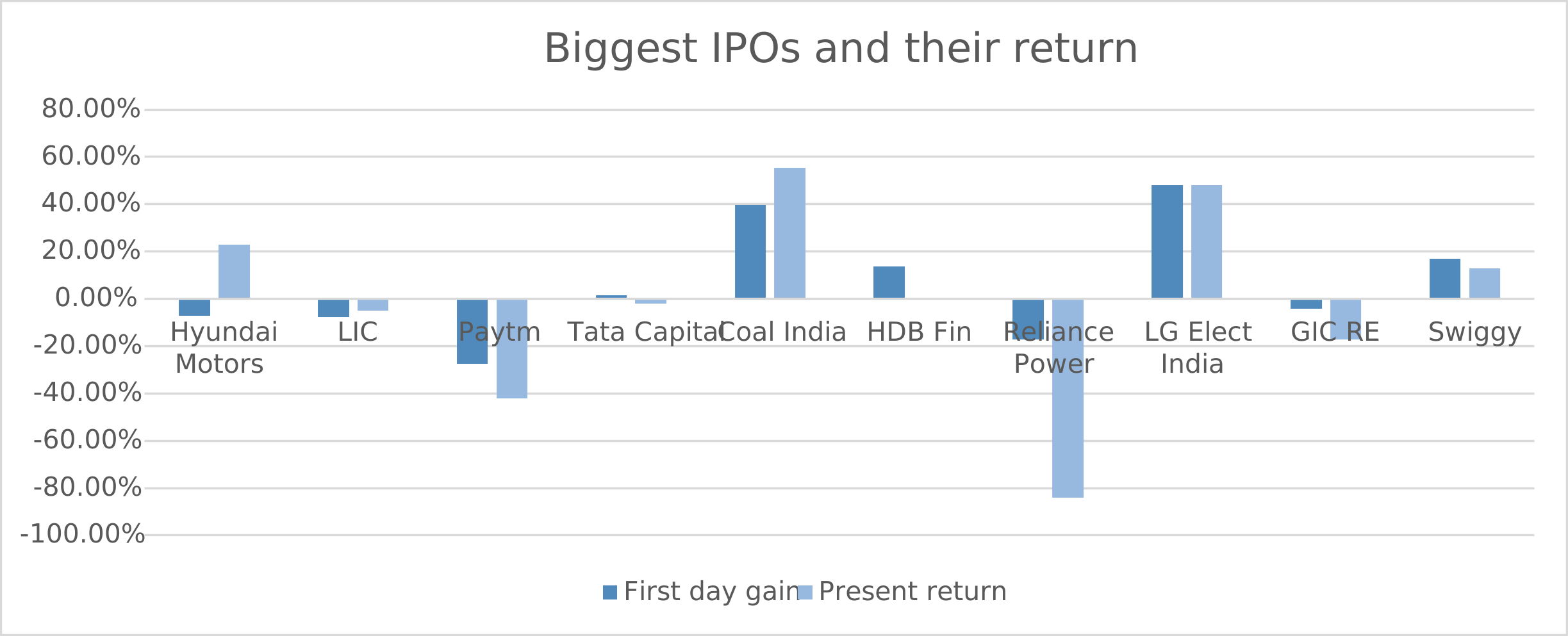
Here we can observe that out of the 10 biggest IPOs that has come to Indian market only 4 are giving positive returns while 5 are giving negative returns while 1 is almost on the same price. On opening day also 5 have given positive return and 5 negatives. Hence this remain unconclusive that IPO is a good way to invest in shares or not. Therefore, investors who blindly go for IPOs or big IPOs need to revisit their strategy.
The biggest disaster out of the big IPOs is Reliance Power. Initial listing was a premium of 17% on the opening day but closed 17% down on day one itself. Stock went down to the extent of 84% by now and investors losing their money. Issue was 73 times oversubscribed, shows the hype that was built around the issue. There were a few reasons why stock fell so terribly:
- From 2003 to end of 2007 Sensex saw a jump from 3000 levels to as high as 20000, a return of more than 6 times in 5 years. Such exponential growth gave a belief that equity can give returns at any price.
- Reliance has always been big name, backed by heavy marketing resulted in 73 times oversubscription. Market crashed due to sub-prime crisis and Reliance also bear the load of that.
- The overconfidence can also be seen from the fact that at the time of IPO Reliance Power had no operational plant.
Paytm was another horror in the IPO market with 27% loss on day one itself. Paytm also could not generate the results as expected and later was caught into various regulatory issues.
IPOs in 2025:
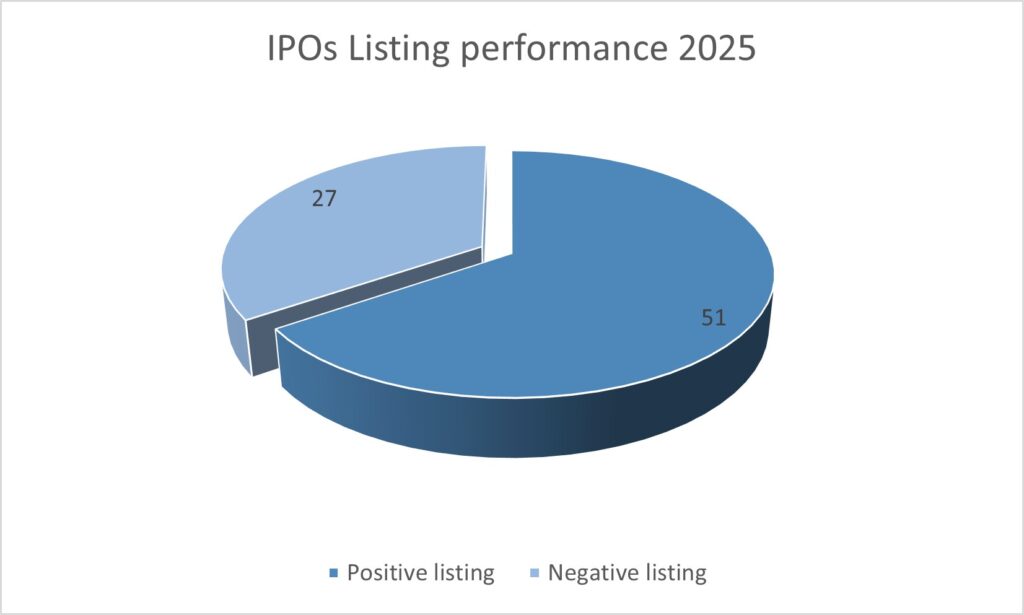
Total number of IPOs in 2025 : 78
Positive listing : 51
Negative listing : 27
Highest listing return was by Highway Infrastructure i.e 72%. However, it has come down to around 13% at present.
Though there is no formula for success of IPOs, there are a few points that can be considered as a matter of caution:
- Promoters of the Company: It should be seen that promoters track record is clear and they are not involved in too many litigations.
- Sudden jump in performance: Check 3-4 years financials, company should be consistent in performance. Only one-year improved performance may be ignored.
- Purpose of the issue: There are broadly 3 purposes a) Fresh issue of shares b) To repay the debts c) Offer for sale. Fresh issue is always better as the entire money will go to fund the business and should result in growth. In offer for sale the investment goes into the pocket of those who are selling and it may not result in the growth of the company. In offer for sale too, if company is doing well an investment can be made. Repayment of debt will reduce debt burden and may result in improved performance.
- Price to Book Value: Price to Book Value should be lesser than or at par with the industry. In case of LG 48% premium listing, this factor has worked as they brought the shares at price where valuations were attractive.
- Past performance of Index should not be given much weightage in deciding on an IPO investment. In Reliance Power case, past performance of Index lured the investors to subscribe at a high price.
- Go through the Risk factors given in the offer and make an informed decision.
- Do not get overwhelmed by the size of IPO as many times smaller size IPOs give better returns than a big size IPO.
- Preferably invest in the last day after understanding the market and demand of the IPO.
There are many IPOs lined up and coming shortly. Invest wisely and enjoy the profits.
FREQUENTLY ASKED QUESTIONS
IPO means Initial Public Offer. When a Company issues its shares to public for the first time it is called Initial Public Offer or IPO.
When the shares are issued by the Company and subscribed by investors by paying money to the Company, it is called Primary Market.
When shares are bought and sold in the market after the issuance it is called trading in Secondary Market.
An Equity share is the share of an investor in the capital of the Company. Equity shares represent the ownership of the investor in the Company. An equity shareholder has right to vote in company Annual General Meeting. The holder of equity share holder gets dividend out of the profit of the Company.
Equity share represents ownership while Bond does not represent ownership. Bonds typically have a coupon/interest/attached return while Equity share does not attach any periodic return. Interest on bonds and repayment of Principal amount is to be made before any return to the equity shareholder.
Equity shareholder gets return by way of Dividend and also by way of selling the shares in secondary market.
Open an Account with broker. Broker will link your demat account and savings account. Place the order to broker to sell the shares, now a days, it can be done online through your broker’s app. Quote a price at which you want to sell or you can sell on market price as well. Shares will be sold if your quoted price is matched and money will come to your account. It is pretty easy once you have a broker account.
About the author: The author of the Blog, Sayed Azhar Hasan, is a CFA (ICFAI), MBA, PGDIBF (Islamic Banking and Finance), ex banker with 29 years of banking experience and a management educator.
On social media:
LinkedIn : Sayed Azhar Hasan | LinkedIn
You Tube: Sayed Azhar Hasan – YouTube
Disclaimer: The information provided in this blog is for educational and informational purposes only and does not constitute professional financial, legal, or regulatory advice. While efforts have been made to ensure accuracy based on the publicly available information, readers should consult professional advisors before making business or investment decisions. The views expressed are those of the author and do not necessarily reflect the official policy of any institution or regulatory body.
Discover more from At Silly Point
Subscribe to get the latest posts sent to your email.
Difficult to bear loss of pain in SME IPOs though we can manage or hold amount of 14k-15k but when 1.5 lakhs investment listed in loss. So dangerous
Yes 1.5 lakh is a big amount and investment should be made after some study.
Appreciate it for this post, I am a big big fan of this web site would like to keep updated.