

BLOG 25/2026 DATED 12TH APRIL 2026 updates on 19th August 2026
In today’s virtual world, all of us are dependent on digital devices and the life runs on mobiles and other e gadgets. In recent years, there have been numerous incidents of digital arrest scams where individuals are threatened via phone calls, WhatsApp, or other social media platforms and coerced into following the instructions that result in transferring large sums of money. Such incidences are termed as Digital Arrest.
Digital Arrest has no legal sanctity anywhere in the world to the best of knowledge available to the author and any arrest has to be executed by the assigned authorities and all arrests are to be done physically, not digitally. Hence it must be noted that all such attempts to digitally arrest a person are illegal and part of a larger scam.
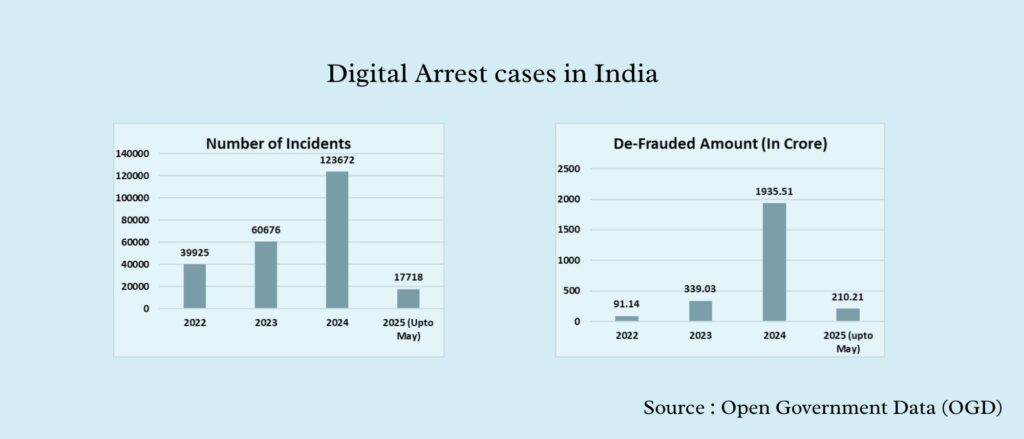
India has witnessed a large number of such scams involving huge amounts. As per Government Open data platform the digital arrest scams have grown as under:
Modus Operandi:
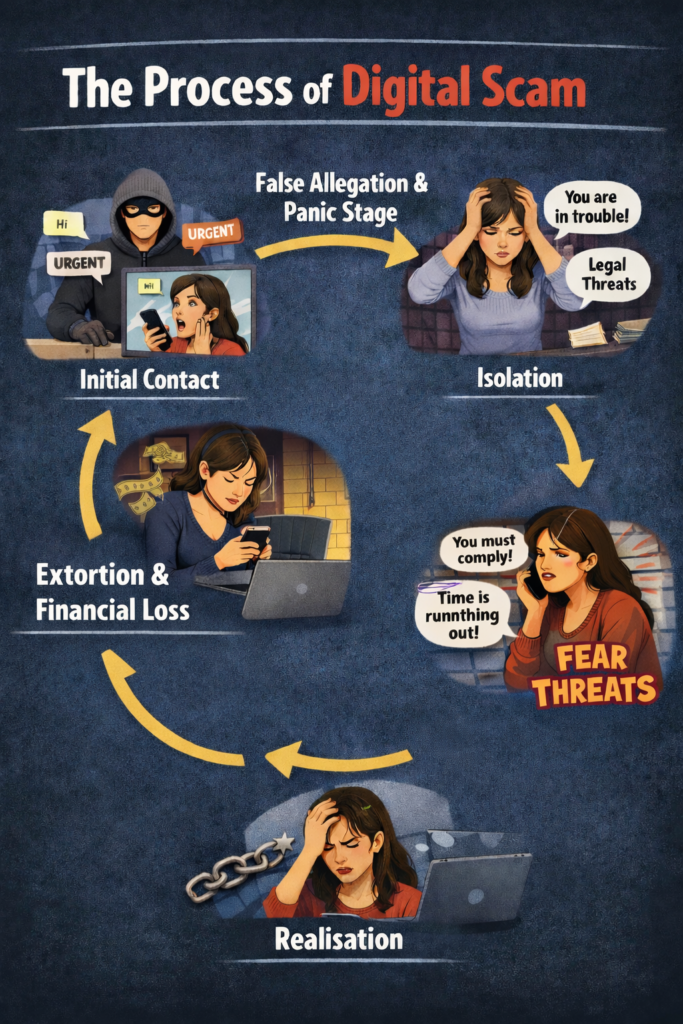
- The victim receives a call on mobile, sometimes a WhatsApp call.
- The caller introduces himself as Police officer or some other investigative agency.
- Some more callers join him sometimes as bankers or other agencies.
- Callers inform the personal details etc. to victims to make him believe that they are serious.
- They inform that victim’s documents are scanned for fraudulent or terrorist activities and he is expected to cooperate if he is not the guilty.
- Victim is instructed that he is not expected to connect to anybody else and is kept under interrogation for hours and sometimes days.
- They often set up a fake police station as well and threaten physical arrest.
- Once the fraudsters are sure that the victim is totally under their control, they ask him for money in form of Security deposit for bail or for any other legal look a-like purpose.
- Once victim transfers the money the fraudsters are out of the scene and the victim realizes that he/she has been scammed.
Identification of Victim:
In normal course the victim is identified by fraudsters as a person who is senior, not so tech savvy and rich. These group of people are vulnerable specially in cities where they live alone for most time and do not get opportunity to share with others.
The fraudsters:
The fraudsters can be from any place but they are highly aware about the details of the victim. They act in a team and sometime appear in group as well on a video call before the victim. CBI has found through multiple investigations that Hongkong, Myanmar, Cambodia and China are the hubs for masterminding such scams.
A few examples:
- A 73 years old, retired banker was duped for Rs. 23 crore is South Delhi. CBI filed chargesheet against the accused Sagnik Roy a Siliguri based businessman.
- A retired women in Gujarat was kept in digital arrest for 10 days and duped for Rs.78 lakh. She received call from an individual claiming from telecom dept who informed her that her sim card has been used to distribute obscene content leading to a complain. Subsequently fake CBI came into picture and the ordeal continued for 10 days. She was also blamed to be involved in cybercrime cases. The incident came to light when she informed her family about the incident, however she had already paid Rs. 78 lakh to the scammers by that time. Police is investigating the case.
- A 60 years old Hithesh Dholkia a retired employee received a call from the scammers pretending as Bank officials asking him to update his KYC through a link sent by them. Once the link, an APK file (Android Package Kit) was downloaded by him, his mobile was taken control by the callers and they manipulated his account and diverted the funds to multiple account. Amount involved 5.66 lakh.
- Police arrested 2 persons from Hyderabad (Telangana) for duping an 81 years old businessperson for Rs. 15.45 crore in a digital arrest scam.
There are numerous such cases where innocent citizens are duped with large amounts with a fake digital arrest.
What should you do:
- Once anyone receive such a call, DO NOT PANIC as you must know that Police do not charge or arrests anyone over phone.
- Do not involve in a discussion, and disconnect the call.
- Block the number from where such calls are coming.
- Inform your family members and friends.
- Report the incident to the Police or help line 112.
- Report at National Cybercrime https://www.cybercrime.gov.in/
- You can also report at sancharsaathi.gov.in/sfc.
- Help line for such reports in India 1930
Final Thoughts:
Digital arrest scams are not just financial frauds—they are psychological attacks designed to exploit fear and authority.
👉 The best defense is awareness and quick action.
Update: Concerns by Chief Justice of India – An article in Business Standard on 21st April 2026
Stay alert, stay safe
Subscribe Share and Support the blogs
About the author: The author of the Blog, Sayed Azhar Hasan, is a CFA (ICFAI), MBA, PGDIBF (Islamic Banking and Finance), ex banker with 29 years of banking experience and a management educator.
On social media:
LinkedIn : Sayed Azhar Hasan | LinkedIn
You Tube: Sayed Azhar Hasan – YouTube
Disclaimer: The information provided in this blog is for educational and informational purposes only and does not constitute professional financial, legal, or regulatory advice. The views expressed are those of the author and do not necessarily reflect the official policy of any banking institution or regulatory body.
Discover more from At Silly Point
Subscribe to get the latest posts sent to your email.