
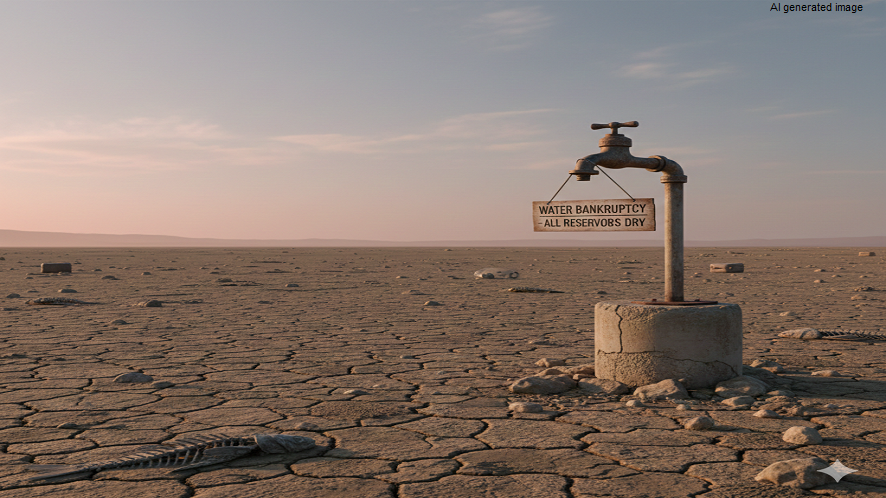
BLOG 12/2026 DATED 12TH FEBRUARY 2026
“The planet has entered the Global Water Bankruptcy era. In many basins and aquifers, long-term water use has exceeded renewable inflows and safe depletion limits, and parts of the water and natural capital—rivers, lakes, aquifers, wetlands, soils, and glaciers—have been damaged beyond realistic prospects of full recovery.”
-United Nations University, Institute of Water, Environment and Health
United Nations University has come out with an alarming report on the status of water shortage globally. This report declares that the world has already entered the era of Global Water Bankruptcy. This is not a distant threat but a present reality: many human–water systems are now in a post-crisis failure state where past baselines can no longer be restored.
According to the report the world has crossed the levels of Water stress and water crisis. It is now beyond crisis. It is at a level from where restoration to past levels is no longer achievable. It defines the Global Water Bankruptcy as under:
Global Water Bankruptcy is defined as a persistent post-crisis state of failure. In this state, long-term water use and pollution have exceeded renewable inflows and safe depletion limits, and key parts of the water system can no longer realistically be brought back to previous levels of supply and ecosystem function.
“Water stress” and “water crisis” are no longer sufficient descriptions of the world’s new water realities. Many rivers, lakes, aquifers, wetlands and glaciers have been pushed beyond tipping points and cannot “bounce back” to past baselines, meaning that the language of temporary crisis is no longer accurate in many regions.
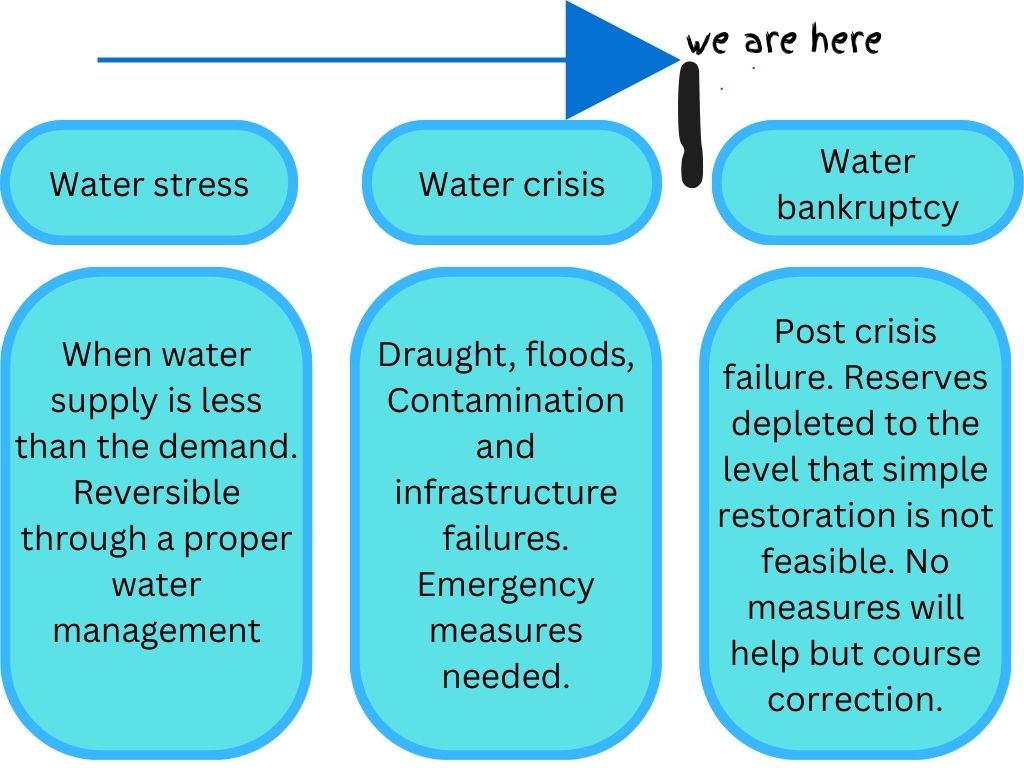
The report further summarises:
Billions of people are living with chronic water insecurity. Almost three-quarters of the world’s population live in countries classified as water-insecure or critically water insecure.
Groundwater depletion and land subsidence show that hidden reserves are being exhausted. Around 70% of the world’s major aquifers show long-term declines.
Since 1970, the world has already lost more than 30% of its glacier mass in several locations; some mountain ranges risk losing functional glaciers within decades, undermining water security for hundreds of millions who depend on glacier- and snowmelt-fed rivers.
Both drinking water and food production now depend heavily on aquifers that are being depleted faster than they can recharge.
Global food production is increasingly exposed to water decline and degradation. About 3 billion people and more than half of global food production are concentrated in areas where total water storage is already declining or unstable.
Global Water Bankruptcy is also a challenge to justice, security and political economy. Without a deliberate focus on equity, the costs of adjustment will fall disproportionately on farmers, rural communities, Indigenous People, informal urban residents, women, youth and other vulnerable groups, increasing the risk of social unrest and conflict.
Governments need to urgently shift from crisis management to bankruptcy management. The report calls for an urgent transition from short-term emergency responses to a deliberate strategy.
Water can be a bridge in a fragmented world. Because every country, sector and community depend on water. Investing in managing water bankruptcy is also an investment in climate stability, biodiversity protection, land restoration, food security, employment and peace—offering common ground for cooperation between the nations.
Do we have any role?
These are the suggestions and warnings that UN report is presenting for the nations of the world to think. HOWEVER, DO YOU THINK THAT PRESENT WORLD LEADERSHIP WILL GIVE ANY VALUE TO THESE SUGGESTIONS?
Answers to this question can be anything but can WE the people play any role in this situation of water bankruptcy? Off course yes.
- Can we use bucket water for taking bath rather than showers?
- Can we slow down our water taps while washing hands?
- Can we close our water taps in between the usage?
- Can we find some novel methods in our houses to spend less water?
You can very well laugh at these sillypoints but please know that a drop of water saved by us is providing a fresh drop to our children and grandchildren. We can expect thousand things from the government and administration but can we save a drop?
“Do not waste water even if you are at a running stream” – Prophet Muhammad (pbuh)
Global_Water_Bankruptcy_Report__2026_.pdf
About the author: The author of the Blog, Sayed Azhar Hasan, is a CFA (ICFAI), MBA, PGDIBF (Islamic Banking and Finance), ex banker with 29 years of banking experience and a management educator.
On social media:
LinkedIn : Sayed Azhar Hasan | LinkedIn
You Tube: Sayed Azhar Hasan – YouTube
Disclaimer: The information provided in this blog is for educational and informational purposes only and does not constitute professional financial, legal, or regulatory advice. The views expressed are those of the author and do not necessarily reflect the official policy of any institution or regulatory body.
Discover more from At Silly Point
Subscribe to get the latest posts sent to your email.
So is it now about surviving and not about winning?? Hmm if so, we as people should follow above sillypoints mentioned and government with their measures should also start awareness camps about water bankruptcy.
I hope that Earth heals itself because it is no more in our hands!
Earth will surely heal itself provided we allow it to do so.
A really good blog and me back again.
Pingback: E20 Petrol in India: The Real Issue Isn’t Mileage—It’s Food and Water Security - At Silly Point