
BLOG 45/2026 DATED 14TH JULY 2026
E 20 petrol in India has arrived i.e blending of 20% ethanol in the fuel and 80% traditional petrol. Media is dominated with views and counter views. Government projecting the step as a leap forward on energy independent India, opposition & social media started screaming about the mileage and compatibility issues. Both firing at each other as always with only few addressing the real issue. Well, there is a bit of truth in everybody’s claim. Still are we approaching the issue in its totality? There is no doubt that India depends very heavily on crude oil imports for its energy needs. Around 85% of the crude oil demand is met through imports that impact our balance of trade position and also value of our currency. Needless to say, that any international disturbance like US-Iran conflict always put us in deep trouble. There is a definite case for searching for an alternate energy source. Let us examine in this blog, the two sides of stories and arrive at the real issue.
Ethanol Blending in India:
The efforts for Ethanol blending had started way back in 2001 and since then India has moved ahead to achieve this. A bird eye view on the timeline is hereunder:
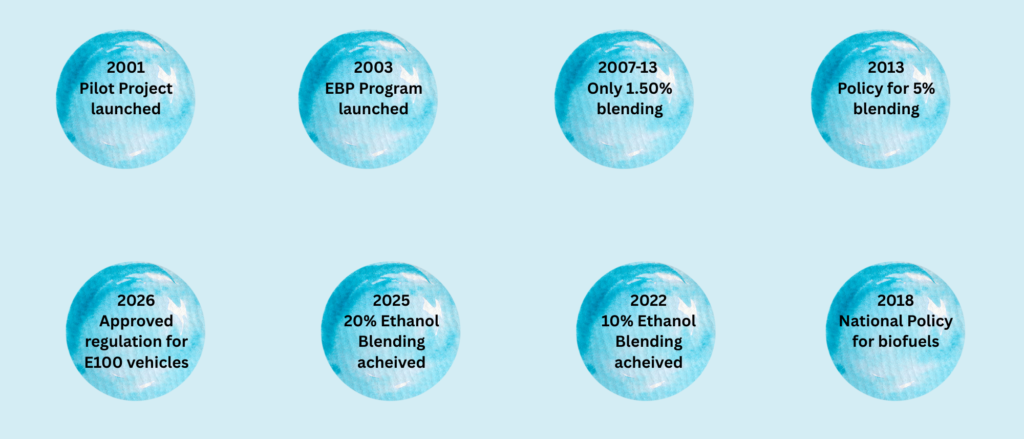
EBP – Ethanol Blended Petrol
We have achieved E20 sooner than expected and paved the way for E 100 as well. E100 means the fuel with meagre amount of petrol. It is not 100% ethanol but around 95% may be ethanol and petrol may be just around 5%.
Advantages:
Government of India has cited many benefits in its reply to the criticism of E 20 blended petrol. This can be summed up as:
Reduced crude oil imports:
As said in the opening para, crude oil is a major import bill for India. In addition to import bill, it also increases our dependency on other countries. Every litre of ethanol blended into petrol replaces imported fuel. The Government estimates that large-scale ethanol blending can save billions of dollars in foreign exchange annually. In order to cement the energy position, Government has also started preparation of progressing to E100 where requirement of crude oil will be further reduced.
Better income for farmers:
Ethanol is fully domestic production. It is a farm product. Major inputs that are used in production of ethanol are broken rice, Sugarcane, Maize, Molasses etc. If ethanol is produced on a large scale, it gives farmers another avenue to earn and enhances their income. Oil Marketing Companies purchase these products from farmers at a fixed price and converts them into ethanol and blend with petrol to give E20. This process has opened an entirely fresh gateway of income to the farmers.
Lower Carbon emission:
E 20 or other ethanol blended petrol products emit lesser carbon than traditional petrol. Specially vehicle pollution will be under control with higher usage of ethanol. However, environmentalists argue against this fact as they say that production of ethanol itself is highly pollutant process and if not controlled can affect the environment badly. Still vehicle pollution, especially air pollution can be controlled through use of ethanol. This also looks as a solution for air pollution problem in metros like Delhi or Mumbai.
Disadvantages:
Vehicle non compatibility:
Old vehicles are not compatible with E20 blended petrol. This has created confusion and a state of fear in public mind that their vehicle parts may get damaged because of the usage of E 20.
Low Mileage:
This is another complain. Government has also accepted loss of mileage by 3-5%. However, it has been reported that Ethanol affects the mileage by around 30%. Presently the mix of ethanol is only 20% and hence loss in mileage may be to the extent of 6% (30% X 20% ). It is the burden on the pocket of common man.
Pollution:
Ethanol production process is highly pollutant and the claim of low carbon emission gets negated largely by the pollutants emitted in its production process.
Food security:
India has come a long way in becoming world’s one of the largest food producing country, second only to China. Still India ranks 105th in the Global Hunger Index that shows the masses still suffer from food insecurity. India also supplies subsidised food grains to around 800 million people, the world’s largest. In such circumstances, if non food consumption of food items is increased, this may affect the food security system of the country. Increased usage of Ethanol certainly threatens already a delicate system. If not managed properly production of ethanol has potential to leave millions in hunger. A threat that Government must not ignore before taking another step in the direction of ethanol production.
Water security:
Last but not the least, Water security is probably the most damaging aspect of this entire exercise. Ethanol consumes water like a devil. We are already a water scare country. As per a report from Niti Aayog, 21 major Indian cities may face zero groundwater levels by 2030, including cities like Delhi and Bengaluru. We are already dependent excessively on Monsoon to produce agriculture goods. One bad monsoon results in massive disruption to agriculture economy. Further as per Water Today, just one litre production of Ethanol require huge amount of water. On the basis of the ethanol base the usage of water varies:
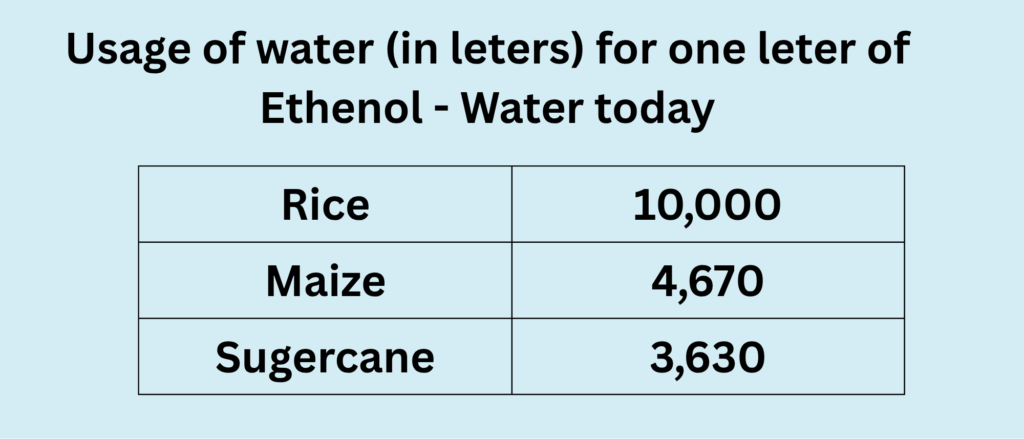
If such is the situation, we must address this before making a plan to use ethanol as replacement of petrol. Even 20% mix i.e E20 may become unbearable on water resources in time to come. Why should we depend upon a depleted renewable source of energy? Probably, the world could not progress much on ethanol blending due to this major factor. Why do we want to do it, without a resolution to water problem?
Conclusion:
India needs to reduce energy dependency on other countries specially on crude oil import. Production of Ethanol is seen as an alternative and resource to achieve that. However, we can-not depend upon water as an energy source that is already deficient in the country and without argument more important than Petrol. In such circumstances,
- Government must arrive at a detailed plan to secure water first, through advanced water conservation techniques.
- Food security must be ensured and a strict plan to be given that ethanol production will remain secondary to food demands.
- Give a few years time to auto industry to confirm that most vehicle are flexi fuel with due process of conversion of present vehicles to flexi fuel vehicles at a very low cost
After ensuring these steps we can expect a smooth transition to EBP (Ethanol Blended Petrol). In absence of that we might head towards a bigger problem of water, food and financial burden on public than the problem of forex, import or energy issue.
Note: Readers can also refer to the other related blogs in sillypoint such as E100 Fuel vs Petrol: Can Ethanol Completely Replace Petrol in India? – At Silly Point , International Crude Oil vs Petrol Prices in India: The Hidden Truth Behind Rising Fuel Costs (2005–2026) – At Silly Point and – Water Bankruptcy so as to have a broader view on the problem of Water scarcity and Ethanol progress.
References:
https://www.pib.gov.in/PressReleasePage.aspx?PRID=2283376®=3&lang=1
Frequently Asked Questions:
About the author: The author of the Blog, Sayed Azhar Hasan, is a CFA (ICFAI), MBA, PGDIBF (Islamic Banking and Finance), ex banker with 29 years of banking experience and a management educator & Corporate trainer. To know more about the author of the blog, visit About us – At Silly Point
On social media:
LinkedIn : Sayed Azhar Hasan | LinkedIn
You Tube: Sayed Azhar Hasan – YouTube
Disclaimer: The information provided in this blog is for educational and informational purposes only and does not constitute professional financial, legal, or regulatory advice. While efforts have been made to ensure accuracy based on the publicly available records, the views expressed are those of the author and do not necessarily reflect the official policy of any institution or regulatory body.
Discover more from At Silly Point
Subscribe to get the latest posts sent to your email.