

BLOG 44/2026 DATED 7TH JULY 2026
A head of risk department of a large profitable bank got an instruction from the Board of Directors to restrict the carbon emission that the bank is causing. Oh what is this new risk?, was the first impression of most in the risk team. That was a flashback of a few years back. Things have changed dramatically and the world is now taking things seriously or at least pretending to take things seriously, I doubt. In India the regulator, Reserve Bank of India has issued guidelines and major banks have already formed teams to comply those regulations. Still, the threat perception has not gone down the line. Even a person of reasonable intelligence still considers this as a flashy thing and do not feel affecting his work or life, bankers are no exception. Reality is far from this. In this blog we will try to know the basics of Climate Risk and to what extent are we ready to combat the risk that is open and is increasing by each passing day.
What is Climate Risk:
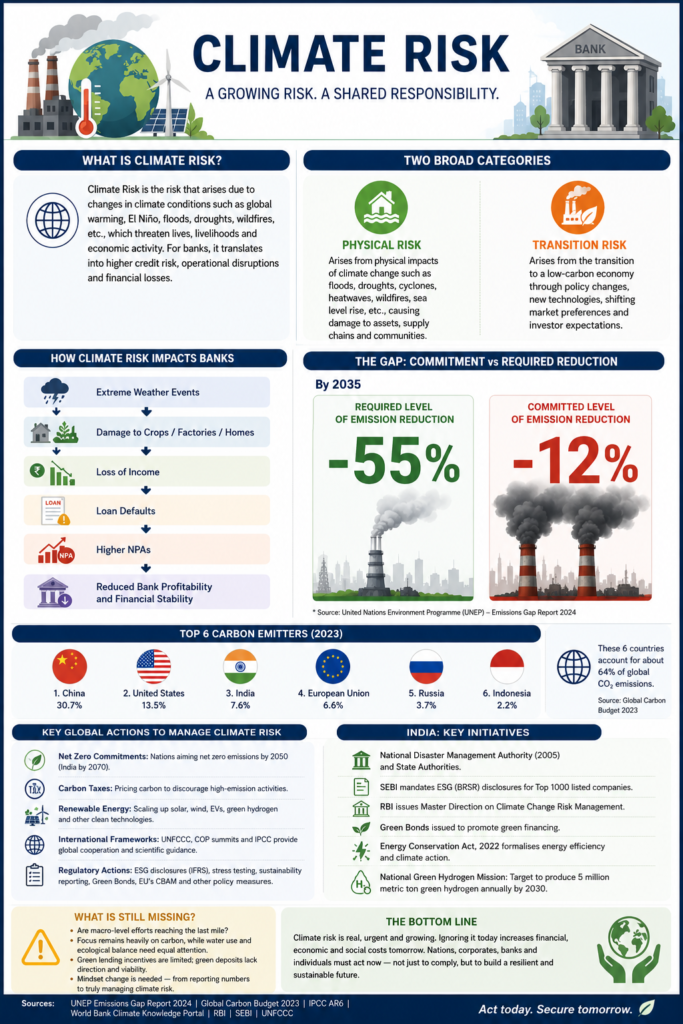
Climate Risk is the Risk that arises due to change in climate conditions that include Global Warming, EL Nino or any other phenomenon that brings risk to the economy and more importantly to lives and earnings of the people at large. An industry as large as Banking is a certain target for any such risk.
Climate Risk is Broadly categorised into 2 categories, Physical Risk and Transition Risk.
Physical Risk:
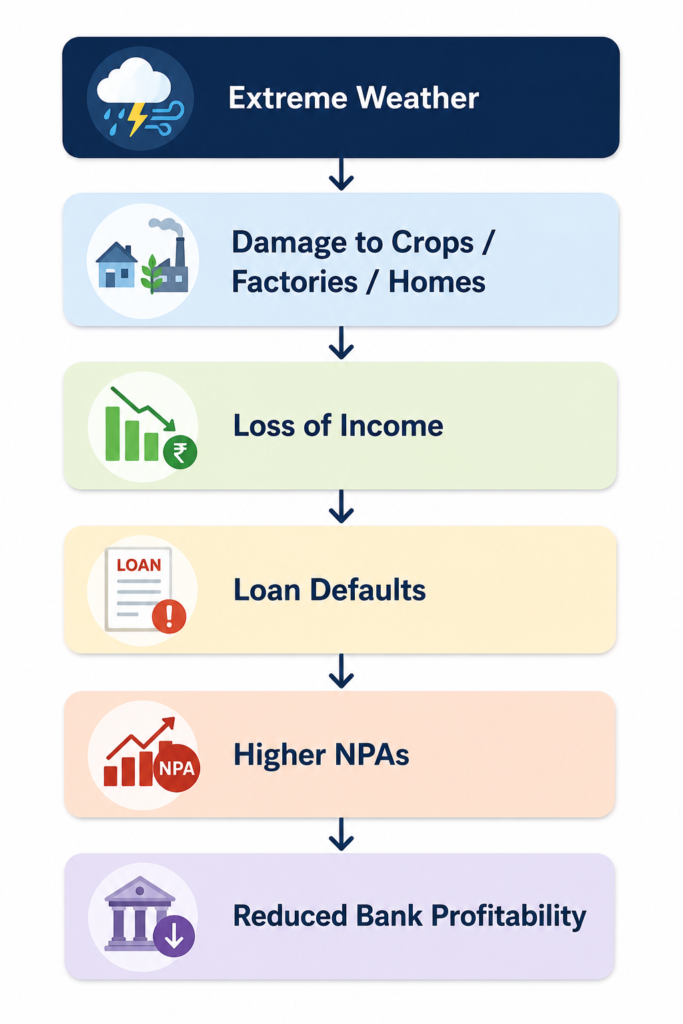
This risk arises due to massive environmental changes causing floods, droughts, wildfires etc. Such events result in direct harm to the people, society and economy at large. We have seen agriculture being destroyed due to drought or floods, city life at halt due to floods, forest fires destroying the entire ecosystem etc. Physical risk does not require any reasoning to understand that any such event will definitely affect the business where banks have exposure. This will result into increase in stressed assets. This risk increases when change in climate is abrupt and without a defined cycle. Sometimes it does not give enough time to the business or the banker to create a safeguard.
Transition Risk:
This risk arises as Governments, Businesses and people makes changes in laws, priorities and choices. Due to his adjustment, the exposure of banking industry comes under pressure. For example, most Governments are working to achieve ‘Net Zero Carbon Emission.’ This will deviate the priorities from carbon intensive to non- carbon intensive sectors. An exposure to coal industry may come under stress due to such transition. This type of risk can be proved catastrophic when decisions are taken suddenly and the risk is invisible also.
In addition to the above, investors around the world have become cautious and started demanding for sustainable policies and climate related risk mitigation from the corporates. This results into pressure on the cost. Governments around the world are taking a few steps to counter the climate risk and the effort produces transition risk for the banking industry.
Steps taken to manage climate risk:
Net Zero:
“Net zero means cutting carbon emissions to a small amount of residual emissions that can be absorbed and durably stored by nature and other carbon dioxide removal measures, leaving zero in the atmosphere”. – United Nations.
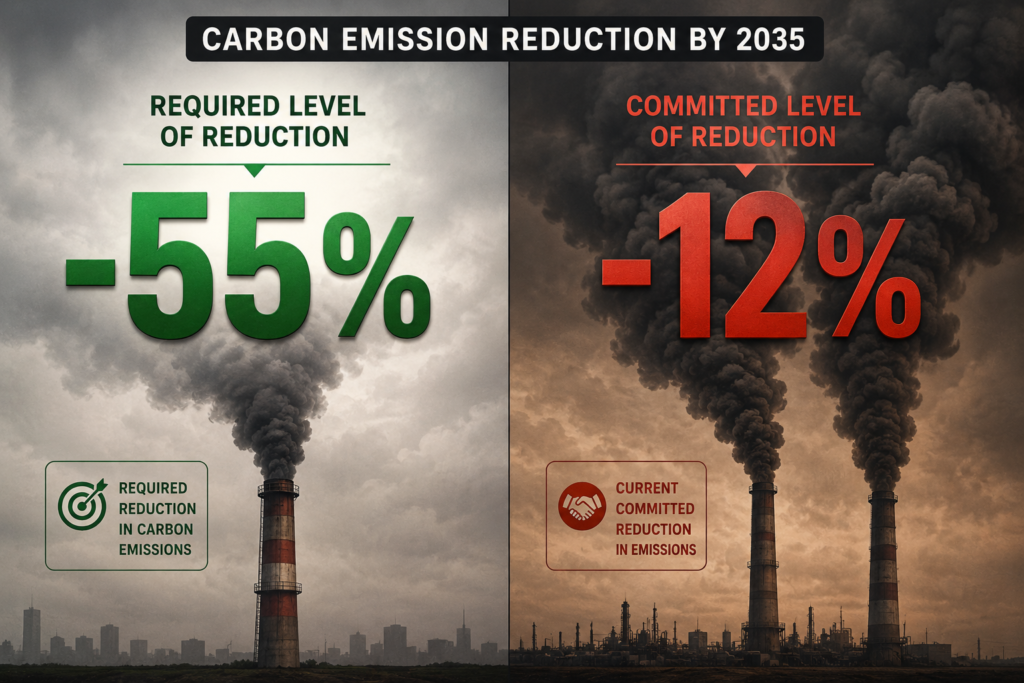
As per United Nations report, Net zero is to be achieved by 2050. India has targeted to achieve Net Zero by 2070. Developed countries viz US,UK, EU, Australia etc have committed net zero by 2050, while China the highest emitter has targeted year 2060. Most nations are way behind their targets for net zero. As per the commitments, nations reduce only 12% carbon emission by 2035 as against the requirement of 55%.
A UN report says, 6 top emitters are 1. China 2. US 3. India 4. European Union 5. Russia 6. Indonesia.
Carbon Taxes:
Some countries have resorted to imposing a Carbon tax on corporates so as to discourage them to use obsolete technologies that emit extra carbon. India has not yet imposed any carbon tax however, while deciding GST rates, carbon emissions are also considered before deciding the final slab.
Renewable Energy resources:
Renewable energy resources are another step that the countries have taken world over. Solar, EV, Ethenol etc are being used now to replace carbon emitting energy resources like Petrol, Coal etc.
International planning:
At broader level regulations have been introduced. Under the aggies of United Nations many countries have taken efforts to combat climate risk. The UNFCCC (United Nations Framework Convention on Climate Change) provides the architecture for multilateral climate negotiations. Annual Conference of the Parties (COP) summits are used to evaluate progress, enforce stricter environmental targets, and formulate global climate agendas. Intergovernmental Panel on Climate Change (IPCC) is a scientific body under UN that studies the technical and economic issues on the subject.
Regulatory efforts:
Creating a taxonomy (see FAQ) and regulatory structure is another effort that has been taken to combat climate risk. ESG related disclosures have been made mandatory under the IFRS standards. European Union is a forerunner in enhancing regulatory efforts by imposing Carbon Border Adjustment Mechanism (CBAM) that imposes levy on carbon imports. In addition to that stress testing, sustainability reporting were the other regulatory steps in the direction of climate risk mitigation. Green Bonds are also being issued with a purpose to encourage green financing.
Climate Risk and India:
India is well aware about its climate risk. Even if there is no global warming, India is largely exposed to climate risk. The reason is the dependency of agriculture on monsoon and also both public and governance apathy towards environment. Indian metro cities have become concrete jungles with least open spaces and mounting air, sound, water pollutions. Huge population pressure makes it even a more difficult thing to manage. Over and above, global warming and other geographical phenomenon like El Nino affect our ecology, industry and finally the financial hubs viz banks, stock markets etc.
We have already seen that India is the third largest emitter of carbon and the net zero expectation is also by 2070, late by at least 20 years from the UN expectation. A few efforts have been taken to address the climate risk in India.
- In 2005 India established National Disaster Management Authority headed by the PM and State Disaster Managements Authorities headed by the respective Chief Ministers.
- SEBI has made it mandatory for top 1000 listed companies to disclose comprehensive ESG matrix under BRSR (Business Responsibility and Sustainability Reporting).
- RBI has also issued master direction on management on climate change risk.
- Green Bonds have been issued to encourage the green financing and investment in climate friendly ventures.
- Energy Conservation Act 2022 formalizes the roadmap for conserving energy and dealing with climate change.
- India has also started National Green Hydrogen Mission to produce 5mn metric ton green hydrogen every year by 2030.
What is missing:
Are the efforts at macro level trickling down to bottom? We are not sure. A larger question that remains unanswered is that climate risk management is largely focusing about the carbon emission management. The replacement technologies are highly water consuming, we do not seem to have answer to that. As per another UN study, the world is heading towards a water catastrophe, then why are we promoting water based renewable energies? Though regulations and reporting are in place, still are we in a mindset to manage climate risk before managing the numbers of our balance sheet? We need to ask ourselves.
Conclusion:
To conclude, there is an urgency that people at large need to understand the seriousness of climate risk management. At present this is being done at regulatory levels. European Union has taken lead and probably is in a better position to handle this future risk. India, though has taken several steps, it is nowhere in the priorities at national level or at institutional level. Once again coming to banks, there is hardly any incentive to green lending. Green deposits are a sort of non-starters due to lack of direction and profit efficiency. If we make beautiful reports on climate risk and carbon emission and ignore the missing links, we are heading towards the disaster with our eyes wide open, let it be Nations, Corporates, Banks or public at large. Am I exaggerating? Use comments column to give your point of view.
References:
GIZ_NIDM_Climate RiskManagementFramework.pdf
Net Zero Coalition | United Nations
Update on 7th Sept 2026: For related blog at sillypoint read : Not Your Charity, Our Right: How the Nepal Himalayan Crisis Is Redefining Climate Risk – At Silly Point
Frequently Asked questions:
About the author: The author of the Blog, Sayed Azhar Hasan, is a CFA (ICFAI), MBA, PGDIBF (Islamic Banking and Finance), ex banker with 29 years of banking experience and a management educator & Corporate trainer.
On social media:
LinkedIn : Sayed Azhar Hasan | LinkedIn
You Tube: Sayed Azhar Hasan – YouTube
Disclaimer: The information provided in this blog is for educational and informational purposes only and does not constitute professional financial, legal, or regulatory advice. While efforts have been made to ensure accuracy based on the publicly available records, the views expressed are those of the author and do not necessarily reflect the official policy of any institution or regulatory body.
Discover more from At Silly Point
Subscribe to get the latest posts sent to your email.
Keep writing on climate risk and spread awareness. It’s need of the hour.