
BLOG 43/2026 DATED 1st JULY 2026
In this document we have covered the select RBI notifications and directives issued during June 2026 and produced a gist of it. For detailed and full study, readers may refer to the links provided below the gist.
1. Foreign Portfolio Investors limits modified and eased
FPI (Foreign Portfolio Investors) limits have been eased now. The sub limits such as short- term investment limits, security wise limit and investment limits have been removed. The fresh limits specified for FY 2026-27 are as under:
Rs. In crore
| Period | Central Govt Securities | State Govt Securities |
| HY 1 | 4,62,490 | 1,53,043 |
| HY 2 | 4,77,006 | 1,64,242 |
Link to RBI notification: NT9752AB8622AD294C368E271246D72D678F.PDF
Author’s note: Removal of multiple sub limit for foreign portfolio investors will bring the required capital for Indian businesses and help in strengthening country’s forex position and exchange rate.
2. SWAP facility for FCNR (B) Deposits:
- The swap facility will be available to the AD Category I banks for fresh FCNR(B) deposits mobilized in any freely convertible currency, including deposits that are renewed upon maturity, for a tenor of 3 -5 years. However, the swap facility with RBI will be available in US Dollars only.
- The tenor of the swap will be in alignment with the tenor of the underlying deposits.
- Banks would be free to price these deposits as per their internal policy.
- For FCNR (B) deposits mobilized in other than US Dollar, the value of the currency is to be arrived at equivalent USD amount for the purpose of SWAP.
- A bank can avail of the swap facility only once in a week. During any week, the maximum amount of US Dollars eligible for SWAP will be equal to eligible FCNR(B) deposits mobilized in equivalent US Dollar terms during the preceding week(s) for which the facility has not been availed earlier.
- Under the swap arrangement, a bank can sell US Dollars in multiples of USD one million to RBI and simultaneously agree to buy the same amount of US Dollars at the end of the swap period. In the first leg of the transaction, the bank will sell US Dollars to RBI at FBIL Reference Rate. The settlement of the first leg of the swap will take place on spot basis from the date of transaction. The second leg of the swap will take place at the same rate as the first leg. The swap will be undertaken at par.
- The underlying deposits will have a lock-in period of one year. The banks may at their discretion allow premature withdrawal of such deposits after one year, as per their internal policy. However, swaps undertaken with RBI cannot be cancelled.
- The Swap Facility comes into effect immediately and will remain open up to October 16, 2026 for deposits mobilized upto September 30, 2026.
- The FCNR (B) deposits mobilized during the period of the Swap Facility shall be undertaken as per the extant guidelines applicable to such deposits. However, the provisions under para 402 of the Reserve Bank of India (Commercial Banks – Credit Facilities) Directions, 2025 dated November 28, 2025 will not be applicable to such deposits.
- Banks are not required to enter into any ISDA agreement with RBI for this purpose.
Additional guidance
- Such FCNR deposits will be exempted from CRR and SLR requirements.
- There shall be no interest rate ceiling on FCNR (B) 3 to 5 years deposit.
A detailed analysis on FCNR SWAP, its benefits and risks involved have been discussed in the following blog. Readers may go through it for details.
https://atsillypoint.com/rbi-fcnrb-guidelines-2026/
Link to RBI notifications:
99NT1723C9DF80134A538854DA7B2DA84F37.PDF
NT1024C4A00A8DEAD4EEE9ED05758379655B7.PDF
NT138CDAB6A6976234223BDB306B27B958D8C.PDF
NT14484C8480AA43A4A199EE98FD684E7BC84.PDF
3. SWAP facility for External Commercial Borrowings & Overseas Foreign Currency Borrowings
- The Swap Facility will be available to the PSU ECB borrowers through their AD Category-I banks for eligible ECBs and eligible OFCBs raised by the AD Category I banks, raised in any currency. However, the Swap Facility with RBI will be available in US Dollars only.
- The maximum tenor of swap will be coterminous with the repayment schedule / maturity of the ECB/ OFCB, subject to maximum period of 5 years.
- During any week, the maximum amount of US Dollars that a bank would be eligible to swap with RBI would be equal to the eligible ECB/ OFCB inflows raised in equivalent US Dollar terms during the preceding week(s).
- The swap will be undertaken at a fixed rate of 1.5 per cent per annum compounded semi-annually. In the first leg of the transaction, the bank will sell US Dollars to RBI at the FBIL Reference Rate. The settlement of the first leg of the swap will take place on spot basis. In the reverse leg of the swap transaction, Rupee funds will have to be returned to RBI along with the swap premium to obtain the US Dollars back.
- The Swap Facility comes into effect immediately (8th June 2026) and will remain open up to January 15, 2027 for eligible ECB drawdowns made and OFCB flows received up to December 31, 2026.
- Banks are not required to enter into any ISDA agreement with RBI.
Link to RBI notification:
NOTI100C5CEAED4D95F444CA98447B5B98150F3.PDF
NT14484C8480AA43A4A199EE98FD684E7BC84.PDF
4. Lending to Real Estate Investment Trusts (REIT)/InvIT
- Banks shall be permitted to lend to REITs/InvIT which are registered with and regulated by SEBI.
- A bank shall strictly monitor the end use of funds lent to REITs/InvIT.
- A bank may lend only to a REIT/InvIT which satisfies the following conditions:
(i)) The REIT/InvIT is listed;
(ii) The REIT/InvIT has at least 80 per cent of its underlying assets generating positive cashflows from operations for a period of not less than one year.
- The bank shall ensure that lending to a REIT/InvIT is not used to fund its SPVs having existing loans from REs and which are facing financial difficulty.
- The credit facilities extended by a bank to a REIT/INvIT shall not involve bullet or ballooning repayment structures so as to ensure that a disproportionate portion of principal repayment is not concentrated in the terminal phase of the loan tenure. However, this shall not preclude structuring the repayment schedule in line with projected cash flows. Provided that, the above restriction shall not be applicable to exposures of a bank to a REIT/InvIT through its investment portfolio in the form of bonds, debentures, and commercial paper.
- The aggregate exposure of all banks to a borrowing REIT/InvIT, together with its underlying SPVs/ holding companies, shall not exceed 49 per cent of the value of the REIT/InvIT assets, or such lower limit as may be decided by the bank’s Board.
- Bank financing to a REIT/InvIT shall be fully secured inter alia by charge over the underlying immovable property, an assignment of rental cash flows and receivables and / or such other legally enforceable security interests as may be applicable.
Additional directions:
- Exposures to Real Estate Investment Trusts (REITs) shall be treated as Commercial Real Estate (CRE) exposures and shall attract a risk weight of 100%. However, if such exposures qualify as capital market exposures the applicable risk weight shall be 125% .Lending to REITs undertaken by overseas branches of an Indian bank shall attract a risk weight of 150%.”
These directions are applicable from 1st Oct 2026.
Link to RBI notifications:
NT109CBS10062026BFAD4D317A2B4CB2829E86026A8F1694.PDF
NT111B28BD500C4CA4A6E87ADAA3A22B98B67.PDF
5. Responsible Business Conduct – some definitions
- Compulsory bundling
The practice by a bank of making availment of one product / service by a customer conditional upon availment of another product / service, whether own or third-party, offered by the bank.
- Dark pattern
Any practice or deceptive design pattern using user interface or user experience interactions on any platform that is designed to mislead or trick users to do something they originally did not intend or want to do, by subverting or impairing the consumer autonomy, decision making or choice, amounting to misleading advertisement or unfair trade practice or violation of consumer rights.
Type of Dark patterns:
1. False Urgency: Falsely stating or implying the sense of urgency or scarcity so as to mislead a user into making an immediate purchase or taking an immediate action, which may lead to a purchase.
2. Basket Sneaking: Inclusion of additional items such as products / services, payments to charity or donation at the time of checkout from a platform, without the consent of the user, such that the total amount payable by the user is more than the amount payable for the product / service chosen by the user.
3. Confirm Shaming: Using a phrase, video, audio or any other means to create a sense of fear or shame or ridicule or guilt in the mind of the user so as to nudge the user to act in a certain way that results in the user purchasing a product / service from the platform or continuing a subscription of a service, primarily for the purpose of making commercial gains by subverting consumer choice.
4. Forced Action: Forcing a user into taking an action that would require the user to buy an additional product or subscribe or sign up for an unrelated service or share personal information in order to buy or subscribe to the product / service originally intended by the user.
5. Subscription Trap: The process of – (i) making cancellation of a paid subscription impossible or a complex and lengthy process; or (ii) hiding the cancellation option of a subscription; or (iii) forcing a user to provide payment details or authorisation for auto debits for availing a free subscription; or (iv) making the instructions related to cancellation of subscription ambiguous, latent, confusing and cumbersome.
6. Interface Interference: A design element that manipulates the user interface in ways that (i) highlights certain specific information; and (ii) obscures other relevant information relative to the other information, to misdirect a user from taking an action as desired.
7. Bait and Switch: The practice of advertising a particular outcome based on the user’s action but deceptively serving an alternate outcome.
8. Drip Pricing: A practice whereby – (i) elements of prices are not revealed or (ii) revealing the price post-confirmation of purchase i.e., charging an amount higher than the amount disclosed at the time of checkout; or (iii) a product or service is advertised as free without appropriate disclosure of the fact that the continuation of use requires in-app purchase; or (iv) a user is prevented from availing a service which is already paid for unless something additional is purchased.
9. Disguised Advertisement: A practice of posing, masking advertisements as other types of content such as user generated content or new articles or false advertisements, which are designed to blend in with the rest of an interface in order to trick customers into clicking on them.
10. Nagging: A dark pattern practice due to which a user is disrupted and annoyed by repeated and persistent interactions, in the form of requests, information, options, or interruptions, to effectuate a transaction and make some commercial gains, unless specifically permitted by the user.
11. Trick Wording: Deliberate use of confusing or vague language like confusing wording, double negatives, or other similar tricks, in order to misguide or misdirect a user from taking desired action or leading consumer to take a specific response or action.
- Mis-selling
sale of a financial product / service, whether own or third party, in the following cases:
(i) Sale of a product / service, which is neither suitable nor appropriate in view of the customer’s profile evaluated at the time of sale, notwithstanding her / his explicit consent; or
(ii) Sale of a product / service without providing correct or complete information or by giving misleading information; or
(iii) Sale of a product / service without customer’s explicit consent; or
(iv) Compulsory bundling of another product / service with sale of the requested product / service; or (v) Sale of a product / service involving any other element defined by the financial sector regulator concerned as mis-selling.”
Link to RBI notification:
1NOTI1159FE64C67CBFC4483828513EE93480433.PDF
NT16738E653AADCEC4217BEFFA92C050F69AD.PDF
Author’s Note: It is very welcome that RBI has recorded these terms under responsible business conduct, however it is to be seen how strict the regulator is in implementing these terms. In the Annual Financial Inspection, the RBI officials must scrupulously check, if any such activity has been carried out by the RE through advertisements, marketing efforts etc.
6. Risk Weights on ECLGS 5.0 exposures
“Exposures guaranteed under the Emergency Credit Line Guarantee Scheme (ECLGS) 5.0 shall attract risk weight of zero percent to the extent of 75% of the guaranteed portion, i.e., to the extent of guaranteed portion wherein the settlement amount is expected to be received within thirty days from the date of invocation. The remaining exposure shall attract risk weight as per the extant guidelines.
Link to RBI notifications: NT1320BC17589FFD542D19ECE251222A0B6EB.PDF
POLICY RATES (As per MPC dated 5th June 2026 – rates unchanged)
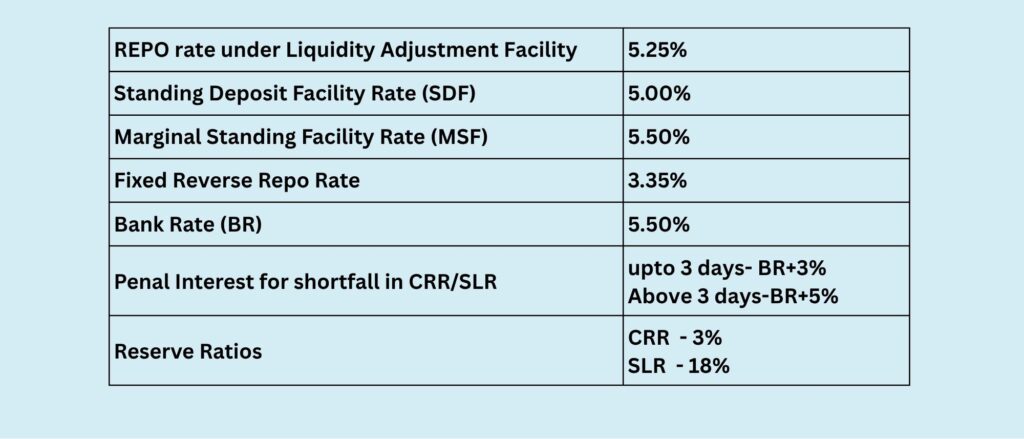
Authors Note: For shortfall in CRR and SLR of 3 days or less a rate of Bank Rate + 3% is charged by RBI while for shortfall of above 3 days a of Bank Rate + 5% is charged.
FREQUENTLY ASKED QUESTIONS
About the author: The author of the Blog, Sayed Azhar Hasan, is a CFA (ICFAI), MBA, PGDIBF (Islamic Banking and Finance), ex banker with 29 years of banking experience and a management educator & Corporate trainer.
On social media:
LinkedIn : Sayed Azhar Hasan | LinkedIn
You Tube: Sayed Azhar Hasan – YouTube
Disclaimer: The information provided in this blog is for educational and informational purposes only and does not constitute professional financial, legal, or regulatory advice. While efforts have been made to ensure accuracy based on the RBI circulars, readers should consult official Reserve Bank of India (RBI) guidelines and professional advisors before making business or investment decisions. The views expressed are those of the author and do not necessarily reflect the official policy of any banking institution or regulatory body.
Discover more from At Silly Point
Subscribe to get the latest posts sent to your email.
Pingback: RBI CIRCULARS UPDATE AUGUST 2026 (Responsible Business Conduct) - At Silly Point