
BLOG 40/2026 DATED 26TH JUNE 2026
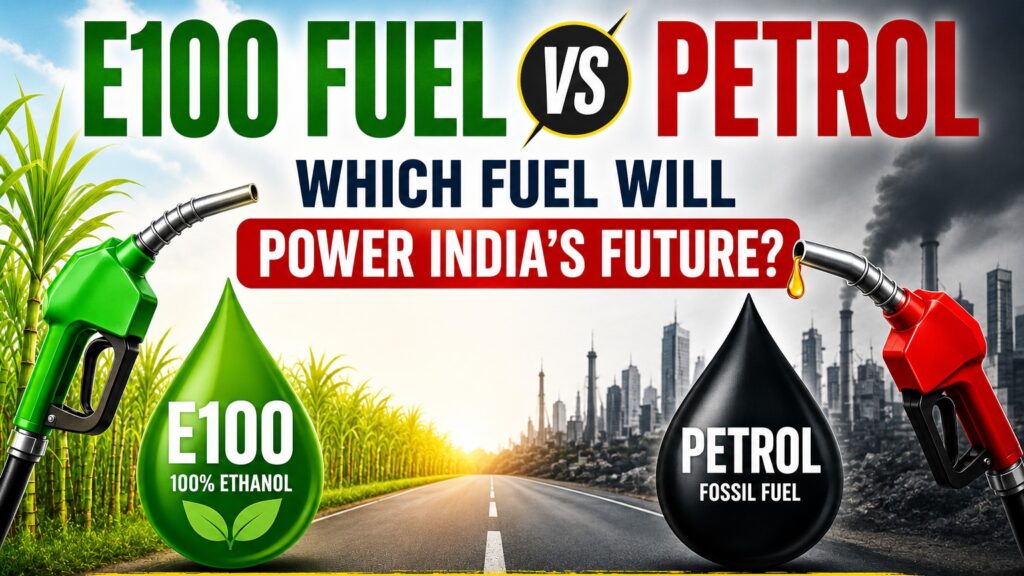
India is the third-largest consumer of crude oil globally, after USA and China. The nation’s severe reliance on crude oil imports has long been both an economic vulnerability and also an environmental challenge. Government has been always looking for alternate in the form of alternate energy solution viz solar, electric, hydro etc. However, no one could effectively replace petrol. However, a potential and environment friendly option has been worked out in the form of Ethanol. With the government aggressively piloting and bracing the infrastructure for E100 (pure fuel-grade ethanol), India is signaling a massive paradigm shift toward agricultural-led energy independence. But what exactly is E100, how is it generated, and is it capable to phase out conventional petrol altogether?
Annual Ethanol Production by country (2024):
| Country | Production (million US gallons per year) | % |
| USA | 16214 | 52% |
| Brazil | 8780 | 28% |
| India | 1630 | 5% |
| European Union | 1440 | 5% |
| China | 1200 | 4% |
| Rest of the world | 1946 | 6% |
| Total | 31210 | 100% |
What India has approved?
- Union ministry of Road and Transport has approved regulations regarding E100 capable vehicles.
- The move clears a legal and technical pathway for flex-fuel and high ethanol vehicles in India
- Automakers can now plan future launches with greater clarity.
Understanding Ethanol-Based Fuel
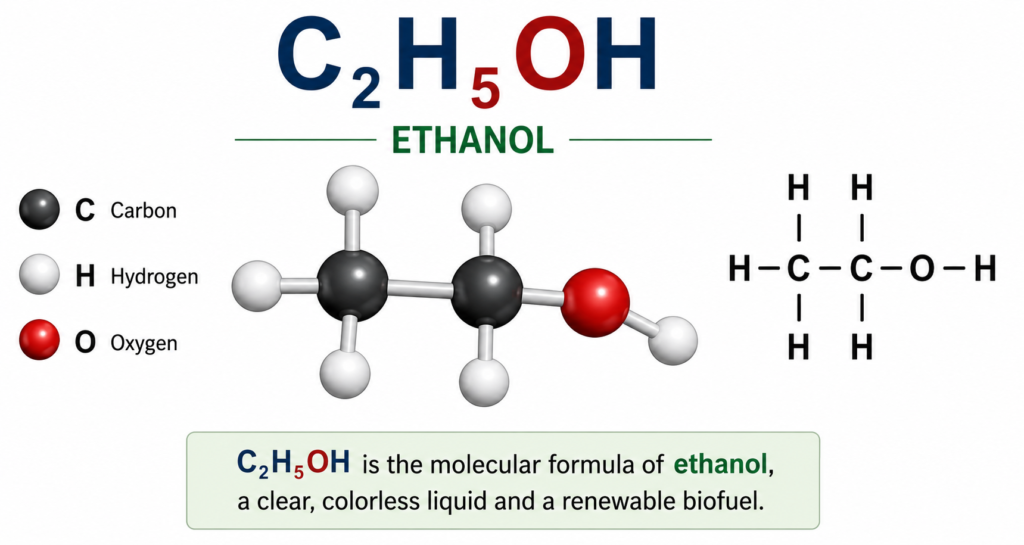
Ethanol (C2 H5 OH) is a clear, colourless organic compound. When deployed as an automotive fuel, it significantly improvs combustion efficiency and lowers dangerous tailpipe emissions. Unlike petrol, which is refined from ancient, finite crude oil deposits, ethanol is a renewable biofuel synthesized from contemporary agri-biomass.
There are 2 generations of fuel-grade ethanol that is produced based on the feedstocks:
- First Generation (1G) Ethanol: This is currently the primary driver of production in India. It is generated from food crops containing high volumes of sugar and starch—primarily sugarcane juice, damaged food grains, maize etc. However, this method diverts the food resources to fuel resource, creating a burden and risk of food security.
- Second Generation (2G) Ethanol: To circumvent the highly debated “food vs. fuel” conflict, India is rapidly commercializing 2G technologies. This process utilizes non-edible agricultural residues like paddy straw (rice straw), wheat straw, bagasse etc to convert into fuel. This simultaneously helps curb the environmental menace of stubble burning in northern India. However, this needs more resources and is costlier than the 1G.
The Ethanol Spectrum: Blending Variants
Ethanol is rarely introduced overnight as a standalone fuel; instead, nations utilize a phased blending spectrum. The letter ‘E’ indicates the percentage volume of ethanol blended into petrol, with the remainder being conventional fossil fuel:
E10 : 10% Ethanol 90% Petrol
E20 ; 20% Ethanol 80% petrol
E85 : 85% Ethanol 15% Petrol
E100: around 95% ethanol and rest petrol and related products.
Technical Comparison: Petrol vs. E100
To evaluate whether E100 can act as a direct replacement for petrol, it is crucial to analyse their fundamental physical and chemical characteristics:
| Feature | Petrol | E100 | Winner |
| Octane Rating | 91 – 95 | 108 – 110 | E100 |
| Energy density | 31-34 MJ/L | 21 – 22 MJ/L | Petrol |
| Mileage | Standard | 20% to 30% lower | Petrol |
| Corrosiveness | Non corrosive | Highly corrosive | Petrol |
| Water absorption | Low | High | Petrol |
MJ – Megajules.
The high-octane rating of E100 is its premier advantage, resulting in superior engine thermal efficiency and immediate throttle response. However, on all other technical capabilities petrol looks superior the E100. Hence technically, Petrol looks a better fuel than E100.
Economic comparison: Petrol vs. E100
| Feature | Petrol | E100 | Winner |
| Price sensitivity | High due to dependency on imports & FX rates | Relatively less | E100 |
| Mileage cost | Standard | Require 20% to 30% more fillups | Petrol |
| Upfront Vehicle Cost | Standard manufacturing price | Needs enhancement in steel and rubber quality hence more cost. | Petrol |
| National Trade Balance | Drain of Foreign Exchange | Retains capital within the country | E100 |
| Environment | High pollutant | Low pollutant | E100 |
On economic front E100 looks to outsmart petrol purely on account of savings on foreign exchange and better environment as it is less polluted and looks as the ultimate destination for absolute carbon neutrality in transport.
Pros and Cons of Embracing E100
The Advantages (Pros)
- Substantial Foreign Exchange Savings: India imports over 85% of its crude oil requirements. Scaling indigenous E100 production directly slashes import bills, stabilizing the fiscal deficit and shielding the economy from volatile geopolitical oil shocks. Higher the usage of ethanol based fuel stronger is the balance of trade and foreign exchange position of the country.
- Empowerment of the Agrarian Economy: Ethanol production channels massive revenue directly back into the rural sectors, providing sugarcane, maize, and grain farmers with predictable, structured income security. This can give a reason for rural population to stay in fields instead of running to towns for employment.
- Deep Decarbonization: Tailpipe emissions drop dramatically with E100. When powered by 2G agricultural waste, the lifecycle carbon footprint considerably in comparison to petrol. One of the biggest problem of cities like Delhi, Mumbai, Bangalore, Chennai, Kolkata etc, non-availability of clean air, gets a solution
The Disadvantages & Challenges (Cons)
- The Mileage Penalty: Consumers face lower mileage per litre due to ethanol’s lower energy density, increasing the total frequency and operational cost of refuels unless subsidized heavily. Government has to find ways not to burden the public at large.
- High Initial Vehicle Costs: Manufacturers must invest heavily in specialized engines, and corrosion-resistant materials, making vehicles more expensive for the end consumer. Once again the cost has gone to the shoulders of common man.
- Intense Water Footprint: Sugarcane is a notoriously water-intensive crop. Over-reliance on 1G production could severely deplete groundwater tables in critical agricultural belts if sustainable crop rotation isn’t enforced. Water is already in critical stage and adopting technologies that increase water absorption can prove dangerous to catastrophic levels.
- Food vs Fuel: Over dependency on agri-products may exert pressure on food products and that may disturb our economic status for food security. It goes without saying that ways are to be found to ensure the food production cycle is not disturbed in process of generating clean fuel.
Conclusion:
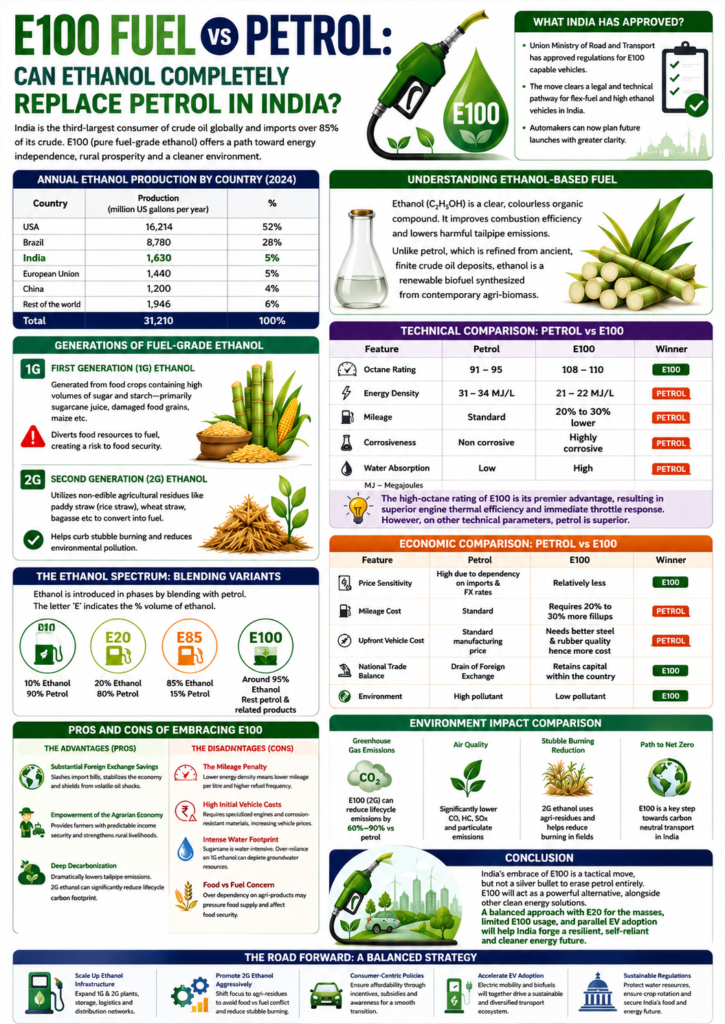
India’s embrace of E100 is a tactical move, but it is not a silver bullet meant to erase petrol entirely. As per a Niti Ayog report of 2021, 98% of the transport fuel is met by fossil fuel and 2% by bio fuels. In these circumstances, E100 will act as an alternative like any other energy alternative viz solar, electric, hydro etc. By running a balanced strategy of nationwide, E20 for the masses, limited E100 usage, and parallel electric vehicle (EV) adoption, India can forge a resilient and profoundly cleaner energy future.
References:
EthanolBlendingInIndia_compressed.pdf
India Clears E100 Fuel Regulations: What the Move Means for Cars, Consumers and the Ethanol Economy
Readers can also refer to blog at sillypoint on Crude oil Vs Petrol prices in the following link
FREQUENTLY ASKED QUESTIONS
About the Auhor: The author of the Blog, Sayed Azhar Hasan, is a CFA (ICFAI), MBA, PGDIBF (Islamic Banking and Finance), ex banker with 29 years of banking experience and a management educator.
On social media:
LinkedIn : Sayed Azhar Hasan | LinkedIn
You Tube: Sayed Azhar Hasan – YouTube
Disclaimer: This blog is for informational and educational purposes only. The data and information is obtained from market available sources. This content does not constitute financial, investment, or legal advice. Readers should conduct their own research or consult a certified professional before making any decisions.
Discover more from At Silly Point
Subscribe to get the latest posts sent to your email.
Great content! Keep up the good work!
Pingback: E20 Petrol in India: The Real Issue Isn’t Mileage—It’s Food and Water Security - At Silly Point