
BLOG 39/2026 DATED 12TH JUNE 2026
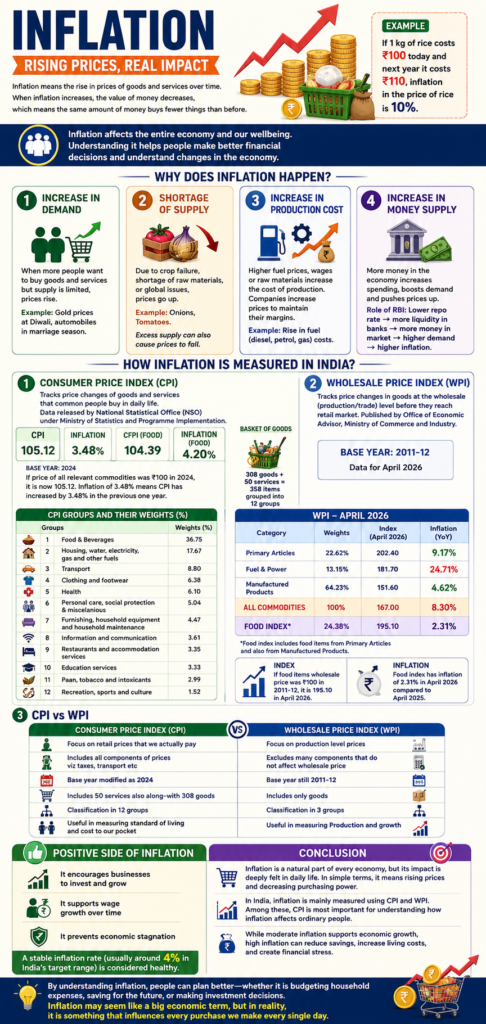
Inflation is one of the most commonly used terms in economics, in simple words, inflation means the rise in prices of goods and services over time. When inflation increases, the value of money decreases, which means the same amount of money buys fewer things than before.
For example, if a kg of rice costs ₹100 today and next year it costs ₹110, we will say that inflation in the price of rice is 10%. The entire economy and our wellbeing surrounds around inflation as it affects all of us. Understanding the inflation, helps people make better financial decisions and understand changes in the economy.
Why Does Inflation Happen?
Inflation happens due to several reasons. The most common ones are:
1. Increase in Demand
When more people want to buy goods and services but supply is limited, prices rise. We witness such inflation in the prices of gold at Diwali time or prices of automobiles and electronic goods when there is season of marriage in India.
2. Shortage of supply
When supply of goods is low due to crop failure, shortage of raw materials, or global issues, prices go up. Food products specially Onions and Tomatos are example of inflation due to supply side shortages. Not only shortage, sometimes oversupplies in food products results in sudden fall in prices. These is hardly any change in demand of these products but supply shortage as well as excess affects the prices.
3. Increase in Production Cost
If it becomes more expensive to produce goods (like higher fuel prices, wages, or raw materials), companies increase prices. This type of inflation is very much on cards now as there is increase in fuel cost. A producer has to spend more on diesel, petrol and gas costs and hence there will be no other option left to them but to increase the price.
4. Increase in Money Supply
If more money flows into the economy, people spend more, which can increase demand and prices. Here the role of Reserve Bank of India is very important. If it reduces the repo rate, banks liquidity increases and that in turn increase the supply of money in the market. While money comes immediately, the production cycle take time in completing and it increases the demand. Increase in demand in turn increase the prices and hence inflation.
How Inflation is Measured in India?
Inflation is measured by tracking the change in prices of a selected set of goods and services over time. In India, two main indicators are used.
1. Consumer Price Index (CPI)
CPI is the most widely used measure of inflation in India. It tracks the price changes of goods and services that common people buy in their daily life. The CPI data is measured and released by National Statistical Office (NSO) under Ministry of Statistics and Programme Implementation. As on April 2026 the CPI data is as under:
| CPI | Inflation | CFPI (Consumer Food Price Index) | Inflation (Food) |
| 105.12 | 3.48% | 104.39 | 4.20% |
BASE YEAR: 2024.
Here 105.12 means, if price of all relevant commodities was Rs. 100 in 2024, it is now 105.12. Inflation of 3.48% means in previous one year CPI has increase by 3.48%. Same explanation is applied on CFPI as well. The CPI is considered very important because it directly reflects the impact of inflation on ordinary people.
Basket of Goods:
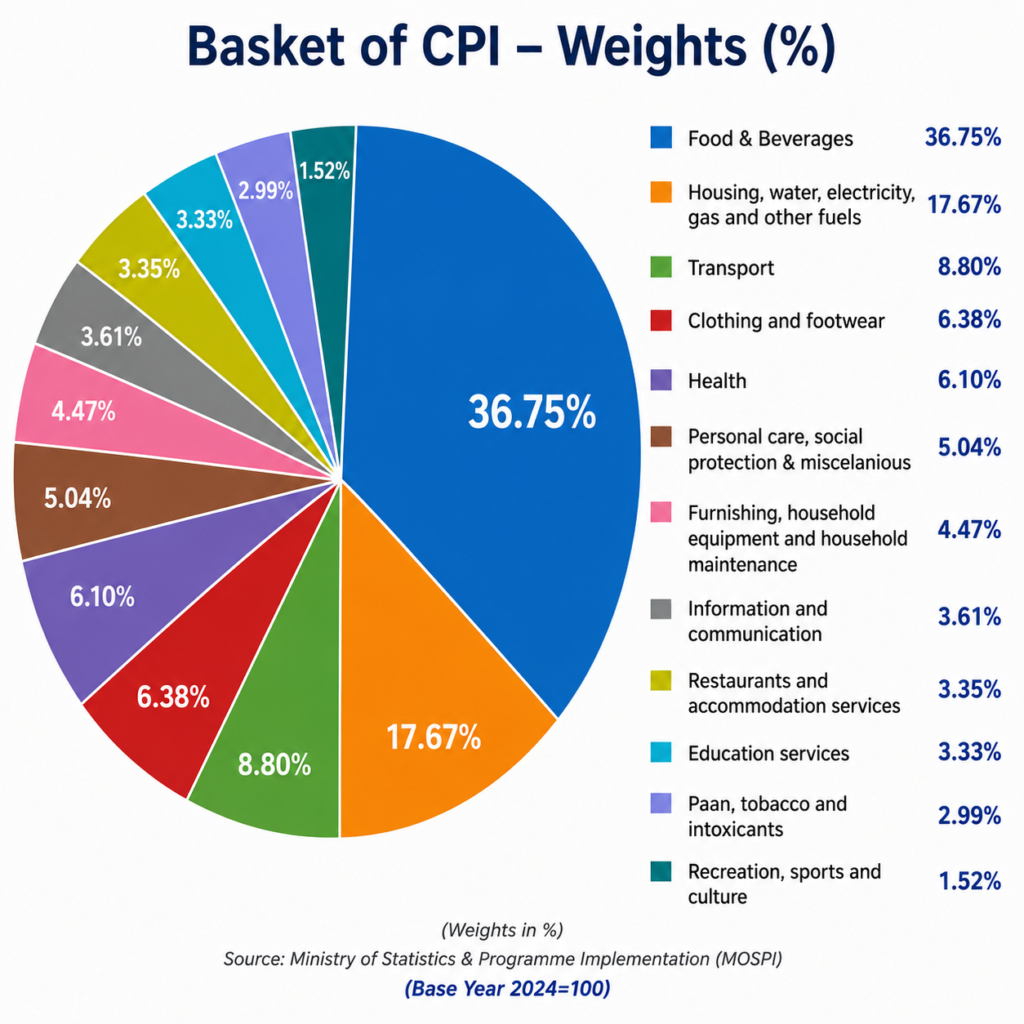
In India total 308 goods and 50 services are included in the Basket of goods. It is the change in these commodities that determines the CPI or inflation. These 358 goods and services are clubbed into 12 groups. The groups and their weights are as under:
| Groups | Weights |
| Food & Beverages | 36.75 |
| Housing, water, electricity, gas and other fuels | 17.67 |
| Transport | 8.80 |
| Clothing and footwear | 6.38 |
| Health | 6.10 |
| Personal care, social protection & miscelanious | 5.04 |
| Furnishing, household equipment and household maintenance | 4.47 |
| Information and communication | 3.61 |
| Restaurants and accommodation services | 3.35 |
| Education services | 3.33 |
| Paan, tobacco and intoxicants | 2.99 |
| Recreation, sports and culture | 1.52 |
2. Wholesale Price Index (WPI)
WPI measures inflation at the wholesale level. This means it tracks price changes in goods before they reach the retail market. WPI is more useful for businesses and policymakers because it reflects cost changes in production and trade. However, WPI does not directly show the prices paid by consumers, so it is less relevant for understanding household expenses. WPI data is published monthly by Office of Economic Advisor, Ministry of Commerce and Industry.
Base year : 2011-12
Base year changed to 2022-23 w.e.f 15th June 2026 – update
Data published by the Ministry for April 2026
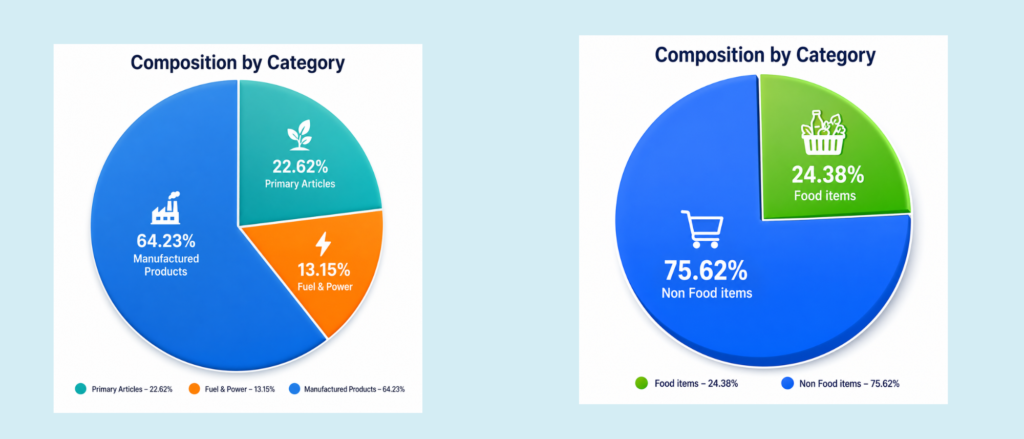
| All Commodities | Weights | Index | Inflation |
| Primary Articles | 22.62% | 202.40 | 9.17 |
| Fuel & Power | 13.15% | 181.70 | 24.71% |
| Manufactured Products | 64.23% | 151.60 | 4.62% |
| All Commodities | 100% | 167 | 8.30% |
| Food Index* | 24.38% | 195.10 | 2.31% |
*Food index includes food items from Primary Articles and also from Manufactured Products.
Index refers to the prices in April 2026 as compared to 2011-12. In means if food items wholesale price was Rs. 100 in 2011-12, it is 195.10 in April 2026. Inflation represents increase in one year. Food index has inflation of 2.31% in April 2026 compared to April 2025.
3. CPI vs WPI
| Consumer Price Index | Wholesale Price Index |
| Focus on retail prices that we actually pay | Focus on production level prices |
| Includes all components of prices viz taxes, transport etc | Excludes many components that do not affect wholesale price |
| Base year modified as 2024 | Base year still 2011-12 (2022-23 w.e.f. 15th June 2026) |
| Includes 50 services also along-with 308 goods | Includes only goods |
| Classification in 12 groups | Classification in 3 groups |
| Useful in measuring standard of living and cost to our pocket | Useful in measuring Production and growth. |
Conclusion
Inflation is a natural part of every economy, but its impact is deeply felt in daily life. In simple terms, it means rising prices and decreasing purchasing power. In India, inflation is mainly measured using CPI and WPI. Among these, CPI is most important for understanding how inflation affects ordinary people. While moderate inflation supports economic growth, high inflation can reduce savings, increase living costs, and create financial stress. By understanding inflation, we can plan better—whether it is budgeting household expenses, saving for the future, or making investment decisions.
Inflation may seem like a big economic term, but in reality, it is something that influences every purchase we make every single day.
References:
Ministry of Statistics and Program Implementation | Government Of India
You may also refer to blog at sillypoint on Monatery Policy where Repo Rates and its impact are explained at :
RBI’s Monetary Policy and your pocket – At Silly Point
FREQUENTLY ASKED QUESTIONS
About the Auhor: The author of the Blog, Sayed Azhar Hasan, is a CFA (ICFAI), MBA, PGDIBF (Islamic Banking and Finance), ex banker with 29 years of banking experience and a management educator.
On social media:
LinkedIn : Sayed Azhar Hasan | LinkedIn
You Tube: Sayed Azhar Hasan – YouTube
Disclaimer: This blog is for informational and educational purposes only. The data regarding inflation is obtained from market available sources. This content does not constitute financial, investment, or legal advice. Readers should conduct their own research or consult a certified professional before making any decisions.
Discover more from At Silly Point
Subscribe to get the latest posts sent to your email.