
BLOG 41/2026 DATED 22ND JUNE 2026
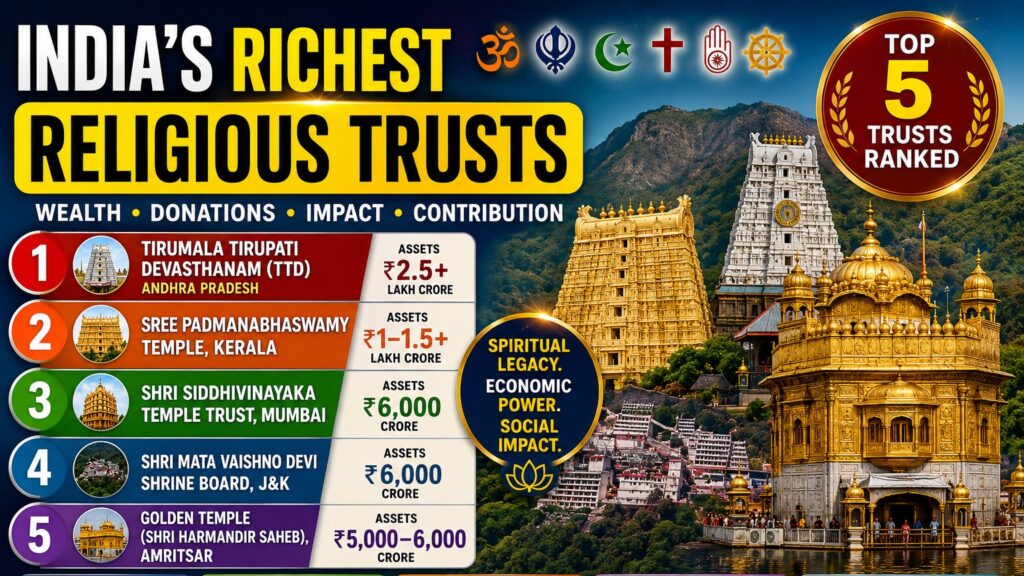
India is an ancient land full of religious activities and religious fervor. It contains the largest Hindu population in the world and also the second largest Muslim population. Christians, Sikhs, Jains, Buddhas also reside here along with the people of other faiths. These religious people have their temples, mosques, churches etc spread all over the country. These religious houses are managed by their respective trusts. Some of these trusts are extremely rich in wealth and they receive sumptuous donations from their devotees. In this blog, we will see the top 5 richest religious trusts in India, in terms of wealth that they possess and not in terms of their spiritual value. We will also have a look on the financial aspects of this wealth and will try to explore an idea, if these can be managed in a way that can serve the national priorities as well, along with their own community building and spiritual awakening.
No 5: Golden Temple (Shri Harmandir Saheb):
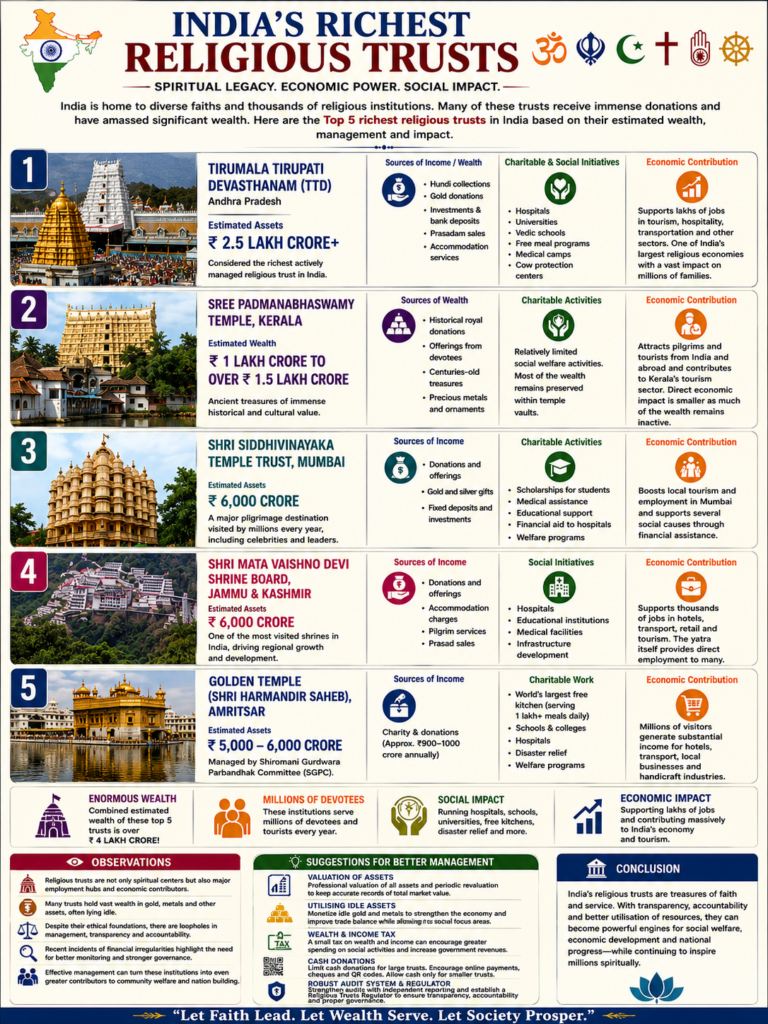
Estimated Assets: ₹5,000–6,000 crore
The Golden Temple,a gurudwara in Amritsar is among the most important Sikh religious institutions in the world. It is managed by the Shiromani Gurdwara Parbandhak Committee (SGPC). According to sources, it receives around 500 crore every year in charity.
Charitable Work
The Golden Temple operates one of the world’s largest free kitchens, serving over one lakh meals every day.
Other activities include:
- Schools and colleges
- Hospitals
- Disaster relief
- Welfare programs
Economic Contribution
Millions of pilgrims and tourists visit Amritsar annually, generating substantial income for hotels, transport services, local businesses and handicraft industries.
NO 4: Shri Mata Vaishno Devi:
Estimated Assets : Rs.6000 crore
The Vaishno Devi shrine attracts millions of pilgrims every year. It is managed by Shri Mata Vaishno Devi Shrine Board. Located in Jammu and Kashmir, the shrine board has played a major role in the economic development of the region.
Sources of Income
- Donations and offerings
- Accommodation charges
- Pilgrim services
- Prasad sales
Social Initiatives
- Hospitals
- Educational institutions
- Medical facilities
- Infrastructure development
Economic Contribution
The pilgrimage supports thousands of jobs in hotels, transport, retail businesses and tourism services. In addition, the typical yatra to the temple itself provide direct employment to thousands of portals and road side dhabas.
NO 3: Shri Siddhivinayaka Temple Trust:
Estimated Assets: ₹6,000 crore
The Siddhivinayak Temple in Mumbai is one of India’s wealthiest temples. It attracts devotees from across the country, including celebrities, business leaders and politicians.
Sources of Income
- Donations and offerings
- Gold and silver gifts
- Fixed deposits and investments
The trust receives large donations throughout the year.
Charitable Activities
- Scholarships for students
- Medical assistance
- Educational support
- Financial aid to hospitals
- Welfare programs
Economic Contribution
Located in Mumbai, the temple contributes to local tourism and employment. It also provides financial assistance to several social causes.
NO 2: Sree Padmanabhaswamy Temple, Kerala
Estimated Wealth: ₹1 lakh crore to over ₹1.5 lakh crore (some estimates are even higher). According to some sources, this is the richest temple in the country now.
Sree Padmanabhaswamy Temple in Thiruvananthapuram is widely regarded as the richest religious institution in India. In 2011, an inventory of several temple vaults revealed enormous quantities of:
- Gold ornaments
- Precious stones
- Ancient coins
- Gold idols
- Jewelry
- Historical artifacts
The market value of these treasures is estimated at more than ₹1 lakh crore, while historians believe the cultural and antique value could be much higher.
Sources of Wealth
- Historical royal donations
- Offerings from devotees
- Centuries-old treasures
- Precious metals and ornaments
Charitable Activities
Compared to institutions such as TTD, the temple undertakes relatively limited social welfare activities. Most of its wealth remains preserved within temple vaults.
Economic Contribution
The temple attracts tourists and pilgrims from India and abroad and contributes to Kerala’s tourism sector. However, its direct economic impact is smaller than Tirupati because much of its wealth remains inactive.
NO 1: Tirumala Tirupati Devasthanam (TTD), Andhra Pradesh
Estimated Assets: More than ₹2.5 lakh crore
The Tirupati temple is often considered the richest actively managed religious trust in India. It receives some of the highest annual donations in the world.
Sources of Income
- Hundi collections
- Gold donations
- Investments and bank deposits
- Prasadam sales
- Accommodation services
TTD earns several thousand crores annually.
Charitable Activities
- Hospitals
- Universities
- Vedic schools
- Free meal programs
- Medical camps
- Cow protection centers
Thousands of pilgrims receive free meals every day.
Economic Contribution
Tirupati has become one of India’s largest religious economies. The temple supports employment in tourism, hospitality, transportation and other activities. The economic impact extends to lakhs of families. They have opened professional educational institutions and health facilities in the country.
Observations:
Not only these 5 trusts but there are many other equally important religious trusts viz Shri Satya Sai Baba trust etc that generate a large sum of money every year in donation and they have also amassed huge assets. These religious organisations serve as employment hubs to lakhs of people. Cities like thirupati have developed and are flourishing due to these religious organisations. There material contribution to the economy is also immense apart from their spiritual value and a source of inspiration for many.
Still when we see objectively there are many loopholes in management of such religious trusts. Though these trusts are based on deep ethical and moral values, they are not free from corruption and economic inefficiencies. Recently, an alleged fraud of around Rs.200 crore in RamTemple Ayodhya, another powerful and rich trust in the country, is an eye opener for policy makers as well as contributors to see if the assets amassed by these institutions can be better monitored and utilised for the good of their own communities and overall nation building.
Suggestions:
Before we jump into suggestions, we must clarify that these suggestions are not for these 5 trusts but all religious trusts irrespective of their religious and community affiliation beyond a particular value.
Valuation of assets:
The assets of such religious trusts must undergo a professional valuation process and the total market value of these assets must be put on record. A periodic valuation procedure should also be in place to revise the value of valuation.
Utilising idle assets:
Most of these organisations are holding assets in the form of Gold and metals, just kept in vaults, totally unutilised. People donate at these places not to create assets but to spend for the general well being of the people. These trusts should be encouraged to monetize the gold that they hold and help country in its trade balance. The treasure of Shri Padmanabhaswami temple is considered as beyond lakhs of crore. Should the nation not get the benefit of such large assets?. Here one thing we must consider that the respective trust must be left free to decide as to what activity they need to undertake and which community they need to benefit out of their idle assets. The assets belong to these trusts, the only recommendation is to monetize it and bring it into the circulation.
Wealth & Income tax:
Religious trusts are also exempt from any type of taxation. A small tax can also be levied on the wealth and income of the trusts that will help the tax receipts of the union and state government. This will encourage them to spend the amount received in charity on various activities to avoid payment of tax.
Cash donations:
Most donations received by these organisations are in the form of cash and have the potential of getting misutilised. There should be a suitable guideline for receiving cash donations by these institutions. If possible, the large trusts may not be allowed to receive anything in cash. All the donations to large trusts must be though online mode or cheques. Daan Patra should be replaced with the QR code. However, the smaller trusts may be allowed to receive cash donations.
Robust audit system and a regulator:
These trusts get tax exemption only if they get their books audited. However, this audit system must be robust enough to screen the transaction and give independent report to the authorities. Even a Religious trusts regulator can be established to monitor such audits and keep a control on the economic activities. This is necessary as large sums are involved and it is public money that comes as donations, then why not a robust audit system and a regulator is needed for this sector?
Conclusion:
The policy makers and administrators have the responsibility to bring in the wealth wells of the country to the mainstream and establish proper system of checks balances and accountability. Religious trusts in India are great source of spiritual well being of the masses and they are contributing to the social and economic cause as well. However, a proper system will ensure a process, justice, balance and accountability in the entire universe of religious trusts and convert them to better economic contributors .
References
https://ijrtspublications.org/fileserve.php?FID=270
About the Auhor: The author of the Blog, Sayed Azhar Hasan, is a CFA (ICFAI), MBA, PGDIBF (Islamic Banking and Finance), ex banker with 29 years of banking experience and a management educator.
On social media:
LinkedIn : Sayed Azhar Hasan | LinkedIn
You Tube: Sayed Azhar Hasan – YouTube
Disclaimer: This blog is for informational and educational purposes only. The data and information is obtained from market available sources. This content does not constitute financial, investment, or legal advice. Readers should conduct their own research or consult a certified professional before making any decisions. The views expressed in the blog are personal and from a purely economic perspective and do not intend to hurt anyone’s religious sentiments.
Discover more from At Silly Point
Subscribe to get the latest posts sent to your email.