
BLOG 17/2026 DATED 08TH MARCH 2026
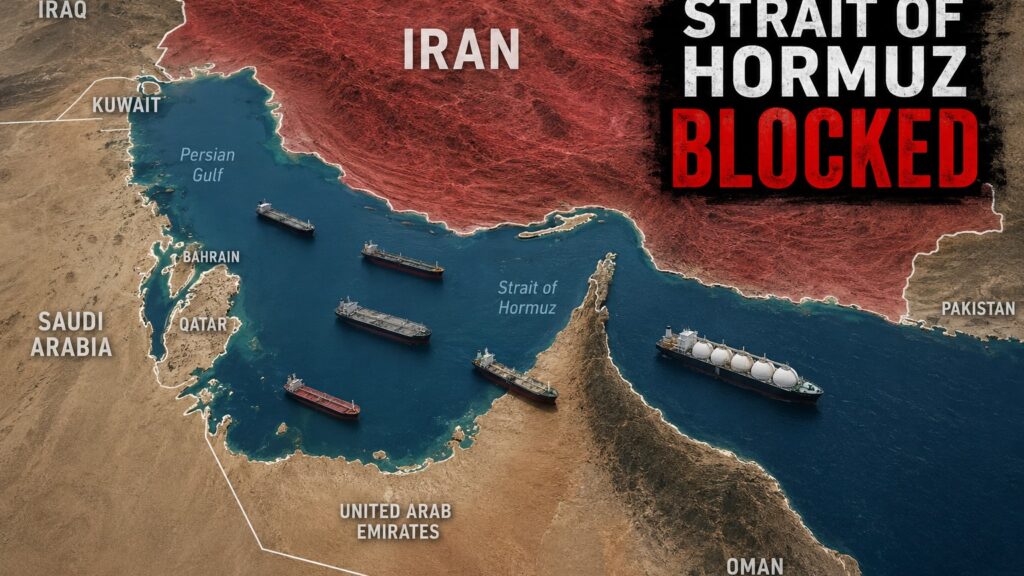
Strait of Hormuz is a narrow passage from several ports in gulf to the broad Arabian sea. Strait means a narrow waterway that connects larger waterbodies. In north of the Strait of Hormuz is Iran, and in South it is UAE and Oman. The maritime passage is controlled by Oman and Iran but governed under International Maritime Law and UN Convention on Law of the Seas (UNCLOS).
The strait is 33 to 95 km wide and separates Iran (north) from Oman’s Musandam on the Arabian Peninsula (south). Bandar Abbas, an Iranian port, lies on its northern coastline. The United Arab Emirates is also located near the strait, about 65 to 80 km to the strait’s narrowest point. The U.S. Navy’s Fifth Fleet has been stationed in Bahrain since 1995 to ensure safe passage in the strait. The narrowest width of the Strait is about 33 km. It is virtually a chokepoint where ships navigate in just around 2 miles width each in a strict two-way traffic. During the recent Iran – US/Israel conflict, Iran has virtually blocked the strait bringing the global movement of oil, petroleum and gas products at halt. This can have far reaching impact on the global economy.
Economic significance:
Being surrounded by the world’s most happening oil, petroleum ang gas resources, the Strait of Hormuz plays an extremely important role in movement of ships and serves as trade route for many nations. The economic importance of the Strait of Hormuz lies in its role as the main gateway for energy exports from the Middle East to global markets, particularly Asia.
| Indicator | Significance |
| Daily oil transport | 20 mn barrels per day i.e about 20% of global oil consumption |
| LNG trade passing through | About 20% of world’s LNG trade |
| Annual Petroleum Value | 1.20 trillion USD |
| Main destination markets | China, India, Japan and South Korea |
Any disruption in the route can immediately spike the oil prices to any level. US also receives around 2 mn barrel per day. As oil/petroleum is base product for various other industries, any price rise in Oil can affect the sharp price rise to any level. In short it may impact the world economy as under:
- Rising inflation in various sectors other than oil and petroleum due to price rise in Oil prices.
- Equity markets can react sharply resulting into loss in investments.
- US dollar can be affected negatively due to economic imbalances.
- It can also result into acute energy crisis where energy requirements are based on these products.
Impact on India:
“Costly energy imports would weaken the rupee, raise inflation, worsen the current account balance, and complicate monetary policy as well as fiscal management if they lead to expanded subsidies to help offset the economic shock.”
Moody’s senior analyst, Madahvi Bokil & Elena Nadtotchi
India imports roughly 45% of its Oil sector through this narrow passage. As per ministry of Petroleum and Natural Gas, Indian crude oil import sources are as under:
| Region | Crude Oil import % from April 25 to Jan 26 |
| Middle East | 46.90% |
| Eurasia | 34.60% |
| North America | 7.20% |
| South America | 4.30% |
| Africa | 6.60% |
| Others | 0.40% |
The above data shows the extreme dependency of India on imports from Middle east where the Strait is the major contributor. Another issue is restriction imposed by US on India, on importing oil from Russia. However, US has temporarily allowed the import from Russia and Iran has also shown flexibility on allowing Indian shipments through the strait. It has been reported that, India’s strategic petroleum reserves is only for 9.5 days while including the storage of state run oil companies, the reserves may stretch upto 74 days has the total reserves of around 74 days. Other countries viz. Japan and South Korea maintain reserves in excess of 200 days. This shows that if the disruption continues and India struggles to streamline the supply, there can be far reaching impact on Indian economy ranging from fuel shortages, tightening of INR valuations, increased current account deficits, rising yields, subdued equity market, fall in production of specific dependent commodities, inflation and others. Further, many Indians are working is gulf countries and sending remittances to India. A chock at oil supply may threaten their safety as well as remittances to India.
To conclude, India may be affected in the following manner:
| Impact area | Result |
| Energy supply | Shortage of oil, petroleum and gas products. |
| Oil prices | Sharp Increase |
| Economy | Inflation, impact on growth |
| Equity Markets | Sharp corrections in equity market |
| Securities Markets | Increase in yields resulting in tightening of valuations |
| Production | Delays and high costs |
| Banking | Defaults and low valuation leading to stress on bottom-line |
| Security | Indian diaspora in gulf may be insecure and may fear losing jobs. |
“If Brent crude sustains above the $90 per barrel mark, the implications for India could extend well beyond higher fuel prices”
-Money control
About the author: The author of the Blog, Sayed Azhar Hasan, is a CFA (ICFAI), MBA, PGDIBF (Islamic Banking and Finance), ex banker with 29 years of banking experience and a management educator.
On social media:
LinkedIn : Sayed Azhar Hasan | LinkedIn
You Tube: Sayed Azhar Hasan – YouTube
Disclaimer: The information provided in this blog is for educational and informational purposes only and does not constitute professional financial, legal, or regulatory advice. The views expressed are those of the author and do not necessarily reflect the official policy of any institution or regulatory body.
Discover more from At Silly Point
Subscribe to get the latest posts sent to your email.
Excellent piece of article , Informative and analytical .
Thank you sir.
Pingback: International Crude Oil vs Petrol Prices in India: The Hidden Truth Behind Rising Fuel Costs (2005–2026) - At Silly Point