
BLOG 26/2026 DATED 16TH APRIL 2026
Public Sector banks in India have debated for long about their compensation systems. Post the wage revision process and 11th bipartite settlement, the industry came with a formula for incentivizing the employees. The system has been a motivation tool or has resulted into resentment and failure. Let’s creep through.
The Purpose of Incentives
An incentive is a reward targeted to motivate the employees for improved performance. In a corporate set up, Performance Linked Incentives serve many purposes such as:
- Motivating the employee for better performance.
- Aligning the individual’s goal with the organization’s goal.
- Inculcating the culture of meritocracy by recognizing and rewarding the achievers.
The First PLI
Ministry of Finance Government of India introduced the Performance Linked Incentive scheme for all the employees of the Bank post 11th bipartite settlement. The first PLI was disbursed by PSU banks post financial results of March 2021. Maximum permissible PLI was to the extent of 15 days of salary of an employee. The scheme was appreciated by the employees. It worked like a bonus for the employees. A workforce that felt underpaid in comparison to their private sector counterparts took it positively. However, there were a few problems with such incentive scheme:
- It does not differentiate between performing and non performing employees.
- It assumes a nature of mandatory bonus and employees expected it as yearly bonus.
Despite the above drawback, it was a welcome first step towards recognizing merit in public sector banks.
The Divide
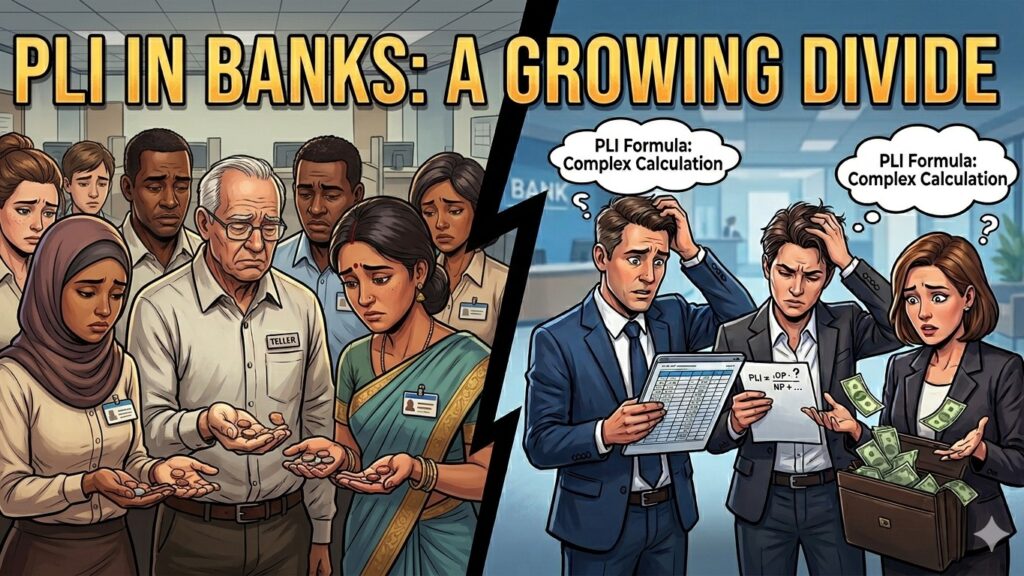
By the end of 2024, MoF again came with a formula to incentivize the Executive cadre in PSBs i.e. Scale 4 and above. The uniform approach introduced by the 11th bipartite continued up to Scale 3, while a separate formula was constructed for scale 4 and above. As per this formula, the executives (Scale 4 and above) were eligible for a very high incentive depending upon the bank’s performance and their individual performance. The formula resulted in a disproportionate pay out, widening the incentive gap between executive leadership and the frontline workforce.
It is here that the purpose of Incentive was thwarted. We can offer higher incentives to higher cadre, no one will mind, but we can-not deploy different benchmarks or different standards for incentivizing employees of large organizations having a history of a century.
Resentment Over Motivation
Failing the basic purpose of motivating the employees for better performance, the PLI caused resentment instead of a unified team striving for excellence.
Several factors contributed to this shift in sentiment:
- The “All or Nothing” Risk: Employees in a high-performing branch may not receive any incentive if the bank’s overall balance sheet is dragged down by corporate slippages, poor decision making at some other level or simply due to Industry trend.
- Widening the Gap: The disparity in calculation of incentives, caused executive versus non-executive debate as a feeling of “top-heavy” rewards creeps in.
- Complexity: When an employee cannot easily calculate what they will earn for their hard work, the “incentive” loses its psychological power.
The executives who are expected to get better incentives are also not sure as to which of their effort will bring incentives for them. The scheme practically failed on both the fronts of motivation as well as culture of meritocracy. The difference in formula in fact created an untold rift between the cadres and worked contrary to the objectives of team building. More than 90% of the employees are non-executive class and they actually contribute heavily to the progress of banking system, some of them are really smart and brilliant. An incentive system that causes resentment among them will not serve the purpose of giving incentives.
Suggestions & Conclusion
The current PSB incentive structure largely fails to achieve the fundamental purpose of incentives.
In the private sector, incentives are often granular—rewarding the specific individual or branch for their direct contribution. By making the PLI almost entirely dependent on the bank’s bottom line and applying rigid cadre-based formulas, the system has become a generic annual bonus rather than a performance driver. Here are a few suggestions of incentivizing the employees of Public Sector Banks:
- MoF should leave the decision to the Boards of the Banks rather than intervening on the reward system of employees.
- The amount of incentive can vary, depending upon the performance of the bank and different cap can be fixed for different banks.
- The PLI should be given at 3 levels.
- On account of performance of bank and that should go to all the employees.
- On account of Unit performance (Branch/Office) that should go to all employees of the specific units. (only selected units to be rewarded as decided by the board)
- On the basis of individual performance. (Only a selected % of employees as decided by the board of the bank)
4. It should be ensured by the Boards that higher cadre gets more incentive but the formula must not be divisive viz. for overall bank performance, board may decide that if a sub staff gets incentive as ‘x’, the clerk may get ‘1.25 x=y’ and scale 1 officer may get ‘1.25 y =z’ and so on. (This is only an illustration; board of directors have better wisdom to arrive at a formula)
For PLI to truly work in Public Sector Banks in India, the formula needs a shift from Institutional Profitability to Unit-level Accountability and Individual performances, duly giving recognition to overall bank’s performance, unit level performance as well as individual brilliance. Until then, the PLIs in Public Sector Banks will continue to be a paper work and a bonus structure rather than giving any boost to the culture of merit, motivation and team building.
Your comments are welcome in the comment’s column.
SUBSCRIBE & SHARE
About the author: The author of the Blog, Sayed Azhar Hasan, is a CFA (ICFAI), MBA, PGDIBF (Islamic Banking and Finance), ex banker with 29 years of banking experience and a management educator.
On social media:
LinkedIn : Sayed Azhar Hasan | LinkedIn
You Tube: Sayed Azhar Hasan – YouTube
Disclaimer: The information provided in this blog is for educational and informational purposes only and does not constitute professional financial, legal, or regulatory advice. The views expressed are those of the author and do not necessarily reflect the official policy of any banking institution or regulatory body.
Discover more from At Silly Point
Subscribe to get the latest posts sent to your email.