
BLOG 28/2026 DATED 24TH APRIL 2026
Reserve Bank of India conducts some fascinating studies and one of them is Urban Consumer Survey. This survey studies the perception of urban consumers with regard to economy across 5 key economic parameters:
- Economic situation
- Employment
- Price level
- Income
- Spending
Conducted bi-monthly across 19 major cities, the latest survey (March 2026) covered 6,069 respondents, offering a valuable snapshot of consumer sentiment.
Key findings- confidence takes a hit:
- Current Situation Index (CSI), deteriorated from 98.1 (Jan 2026) to 95.7 in March.
- Future Expectation Index (FEI) also deteriorated from 123.4 (Jan 2026) to 120.20 in March.
Major purpose of the study was to get a public perception on various economic activities. Current Situation Index depicts the urban consumer’s perception in the present situation while the Future Expectation Index shows how consumers feel with regard to the future of various economic activities in future.
Consumer Confidence Vs Stock Market:
RBI has disclosed the SCI and FEI data since March 2015. Hence, we produce a comparison of these confidence indexes with Nifty, the benchmark stock market index:
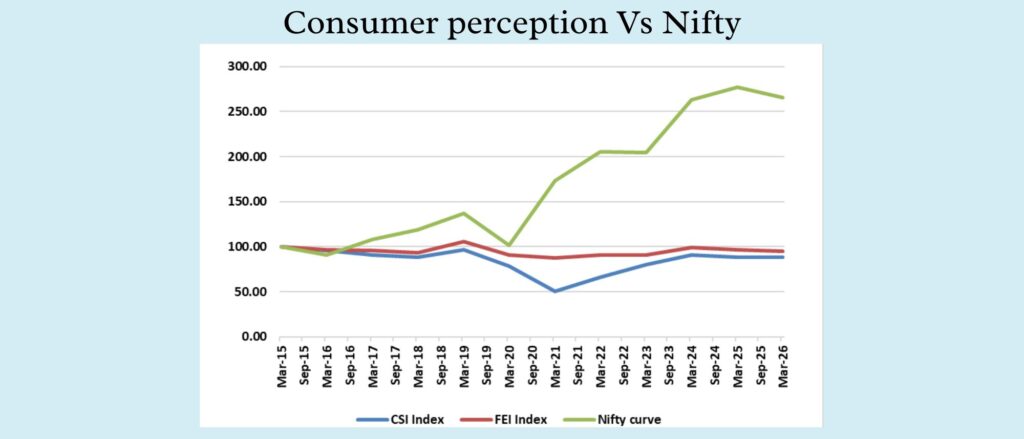
(For the purpose of comparison, Nifty, CSI and FEI, all are equated to 100 as on March 2015)
Now comes the interesting part.
Since March 2015:
- CSI has fallen from 108.6 to 95.7
- FEI has dropped from 126.7 to 120.2
Yet, during the same period, the NIFTY 50 has surged more than 2.5 times. This divergence raises an important question:
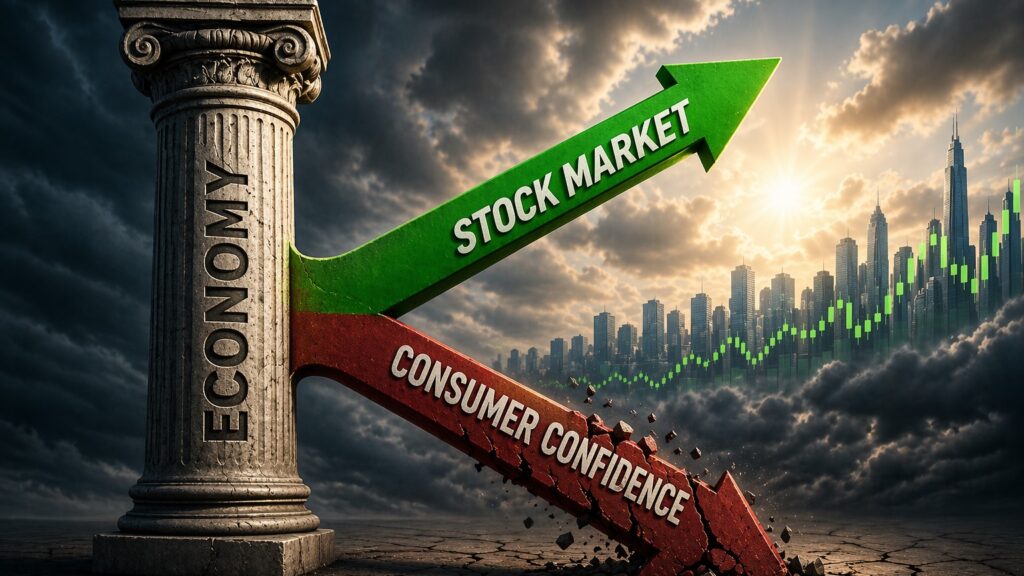
Why is the stock market booming while consumer confidence is weakening?
Is India Experiencing K-Shaped Growth?
This contrast hints at a possible K-shaped growth, where:
- One segment of the economy (corporates, financial markets) prospers
- Another segment (households, especially middle/lower income groups) struggles
Even as India’s GDP and corporate earnings show robust growth, consumer sentiment tells a more cautious story.
Inferences:
- Stock market growth ≠ Consumer well-being
Rising indices may reflect corporate profitability, not household prosperity. - Corporate success isn’t fully trickling down
Gains in business performance are not translating into improved consumer confidence. - Enhancing Confidence gap
Despite economic expansion, sentiment remains weaker than a decade ago. - Hope remains intact
Higher FEI vs CSI suggests consumers still expect better days ahead. - Possible signal of rising inequality
Strong markets alongside weak sentiment may indicate uneven distribution of growth benefits.
Conclusion:
Neither the survey nor the index can be taken as a true representative of the economy. Still, as the consumer confidence survey is conducted by RBI, it speaks for itself and cannot be ignored as theoretical research. The results must be taken into consideration by the policy makers and if it actually represents the growing inequality, suitable steps need to be initiated to ensure that the economic progress is broad based and inclusive.
https://www.rbi.org.in/Scripts/PublicationsView.aspx?id=23807
(Urban Consumer Confidence Survey by RBI-April 2026)
FREQUENTLY ASKED QUESTIONS
About the author: The author of the Blog, Sayed Azhar Hasan, is a CFA (ICFAI), MBA, PGDIBF (Islamic Banking and Finance), ex banker with 29 years of banking experience and a management educator.
On social media:
LinkedIn : Sayed Azhar Hasan | LinkedIn
You Tube: Sayed Azhar Hasan – YouTube
Disclaimer: The information provided in this blog is for educational and informational purposes only and does not constitute professional financial, legal, or regulatory advice. While efforts have been made to ensure accuracy based on the publicly available information, readers should consult official Reserve Bank of India (RBI) guidelines and professional advisors before making business or investment decisions. The views expressed are those of the author and do not necessarily reflect the official policy of any institution or regulatory body.
Discover more from At Silly Point
Subscribe to get the latest posts sent to your email.