
BLOG 54/2026 DATED 22nd SEPT 2026
I used to wonder why; the world remains so concerned about changes in the US Federal Reserve’s interest rates. I am sure many of us may still feel, why the interest rates change by Federal Reserve should make us think about our markets, interest rates and economic parameters? To put things in perspective, the Federal Reserve is for US what Reserve Bank of India (RBI) is for India. When RBI changes its benchmark interest rates, it affects our economy. However, hardly any other country is bothered about the actions of RBI on its interest rates. On the contrary a Federal Reserve rate change on either side affect all of us. It has the potential of affecting our pockets too.
What is FEDRATE?
FEDRATE (Federal Fund Rate) is the benchmark interest rate declared by US Federal Reserve. A benchmark rate is the one over which the Federal Reserve lends funds to Banks in US. It also acts as benchmark rate for various other lending rates in US. US FEDRATE has moved in the recent years as per the following table:
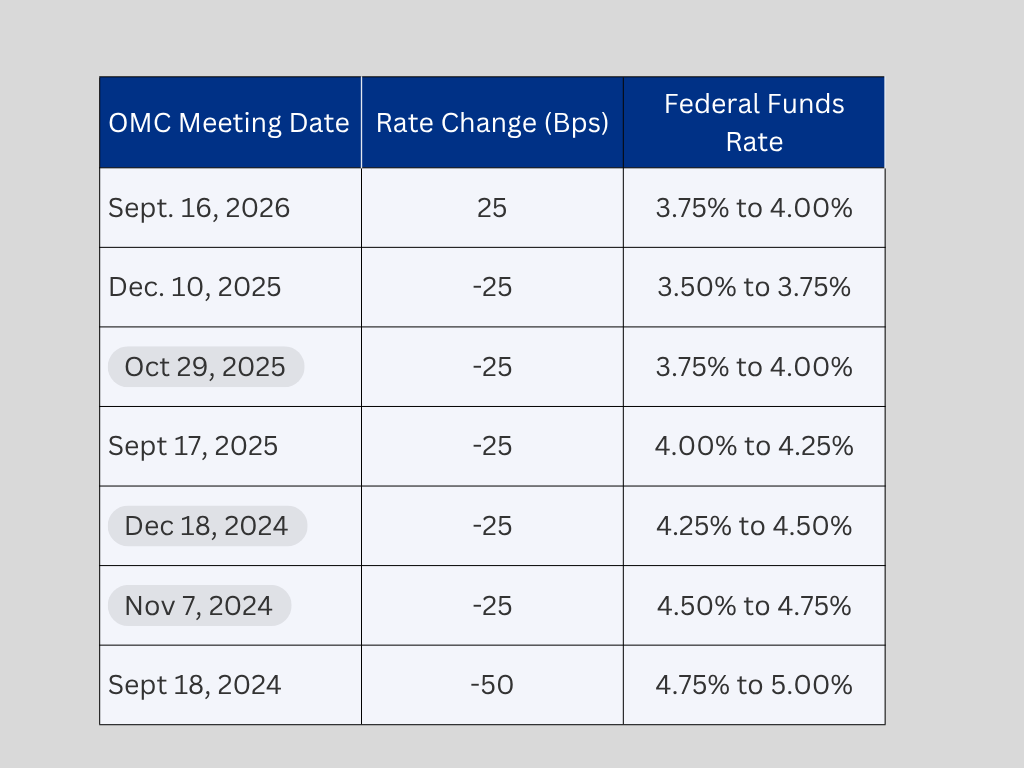
This is the first time in the last three years that Federal Reserve has moved the rates upwards by 25 bps. The FEDRATE has been placed between 3.75% to 4.00% as against presently 3.50% to 3.75%. Federal Reserve has also signalled that further rate hikes are also possible in near future. This has reversed the cycle of rate cuts.
What rate increase means for US?
- A FEDRATE increase in the US means higher Treasury bond yields in US market. A higher Treasury yield will push the overall interest rates upwards. Higher interest rates will increase the cost of funding business in US.
- The benchmark rates are also increased to control a rising inflation. As US has witnessed a rising inflation, the increase in FEDRATE may help easing out the situation.
- As yields in US are expected to go up due to benchmark rate increase, US will be able to attract investors. The investors who have parked their funds in other emerging economies like India, Brazil, South Africa, China etc for higher yields, may be attracted back to US to a certain extent.
- This may also be a response to rising interest rates situation in the other developed economies as the Bank of Japan which has raised its benchmark rate to 1.25% from 1%, the highest rate since 1995. (Japan benchmark rate is called Uncollateralized Overnight Call rate.)
- Local depositors in US may get better returns on their deposits.
What Federal Fund rate hike means for India?
India is now a sizable economy, and it may not be totally swayed by the FEDRATE hike in US. Still as US is India’s biggest trade partner, yield changes in US will definitely have an effect on the business and yields in India. There may be both direct and indirect effects on the Indian economy, its markets and foreign trade.
Capital outflow:
As we have discussed that due to FEDRATE hike the yields may move upwards in US, the investors may be lured to withdraw their funds from emerging economies. This may result in capital outflows affecting the investment domain of Indian markets. India needs funds for its expanding economy and to maintain the growth of 7% +.
Weaker rupee:
The rupee has already been volatile against the US dollar and trading at an exchange rate of nearly Rs.95. With the increase in yields in US, there are chances that demand for USD may increase resulting in strengthening of dollar and further weakening of Rupee. However, the strong Forex reserves of India may act as buffer for both Capital outflow and value of rupee. Still, as in recent times the rupee has struggled to maintain its value and RBI has to resort to a very costly FCNR swap facility, maintaining the value of rupee will not be an easy task for Indian policy makers.
Costly imports:
India imports around 6% to 7% of its total imports from the US. When the Indian importer pays the bill in USD, the import cost may rise due to costly dollar. Not only US but due to weaker rupee, India import bill may further go up while importing from some other countries where currencies are pegged with USD. Let us the take the example of the UAE or Saudi Arabia where currencies are pegged to the US dollar. It means their currencies will also move upward or downwards with USD. India’s imports from such countries may also be at a higher cost due to stronger dollar. However, wherever India has arrangements to trade in local currency and make payment in Rupee instead of dollar, the importer will be protected from exchange rate fluctuations. Major industries like Crude Oil, gold and petroleum products may be affected adversely. Incidentally, around 33% of India’s imports are for Crude oil, Petroleum and Gold only.
Benefit to exporters:
Exporters may be benefitted due to the rate hike as they will receive the funds in dollar. A strong dollar and weaker rupee will benefit the exporters. Major industries that may gain are IT and pharma. However, those exports that are based on raw material imports, may not enjoy the benefit of weaker rupee as their gain in exports may be offset by losses in imports.
Inflation:
India is already struggling with wholesale inflation, though retail inflation looks under control. Weaker rupee and resultant costly imports may have the potential to push the final price for consumer. More specifically when products like crude oil and petroleum becomes costly, it affects the cost of many other resulting products.
Equity market:
Foreign Portfolio Investors are already at a low 15% share in Indian equity market. Their outflow may affect the indexes adversely. However, strong presence of Indian domestic investors and retail investors may be able to balance the equation. There may be some corrections in the market, however, it may not impact it in long term as it looks like that India’s growth story is still intact.
Is India resilient enough?
The answer should be YES in one word. As already said, India in itself is a considerably large economy and carries its resilience from the following factors:
- Massive foreign exchange reserves of over USD 780.78 bn as on 11th Sept 2026.
- Domestic Institutional support as Indian equity market is having more domestic institutional investments than foreign investment.
- Strong GDP growth of consistent 7%+ provides a cushion to absorb such shocks.
- Retail inflation is under control.
- RBI proactively manages interest rates through various methods.
Final thoughts:
India is no pushover, still US is our major trade partner, and USD is the trading currency all over the world. This situation may lead to a few hiccups due to FEDRATE hike. As discussed, it can leave an impact on currency, imports, inflation etc. However, the considerable forex reserves and RBI policy measures can counter the impact to a certain extent. There is also a possibility that RBI may increase the Repo Rate to neutralise the effect of increased FEDRATE. Increased repo rate will increase the Indian Bonds yield and interest rates in the market. This may result as a resistance to the capital outflow. However, increase in Repo rate will have its own impact on the economy. Will this be a reasonable attempt? Will India be able to balance the interest rate-inflation paradigm? These questions will be answered by the RBI in the next monetary policy due in October 2026. Let us wait and see, how RBI reacts to the FEDRATE hike.
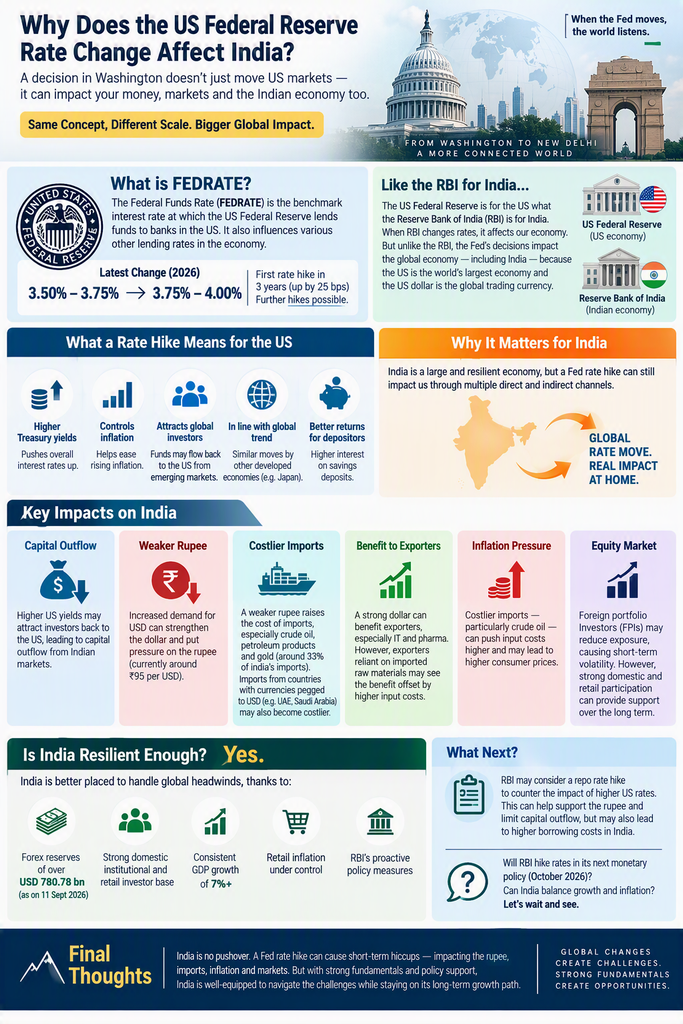
Reference: Federal Funds Rate History 1990 to 2026 – Forbes Advisor
Readers can also refer to related blogs at sillypoint : International Crude Oil vs Petrol Prices in India: The Hidden Truth Behind Rising Fuel Costs (2005–2026) – At Silly Point , RBI FCNR Swap Window: The $136.4 Billion Windfall—Success, Cost, and the Road Ahead – At Silly Point,
Frequently Asked Questions
About the Author
Please refer the about us page @ About us new – At Silly Point
Disclaimer
Please refer the disclaimer page @ Disclaimer new – At Silly Point
Discover more from At Silly Point
Subscribe to get the latest posts sent to your email.