
BLOG 53/2026 DATED 18TH SEPT 2026
BRICS summit closed recently on 13th Sept in New Delhi. BRICS is one of such group of nations who represent a block of emerging economies. The 18th BRICS summit was in New Delhi, India held between Sept 12th to 13th. This was the 4th time that it was conducted under India as chair. Leaders from 11 member countries of BRICS and 10 partner countries participated in the high profile gathering.
Genesis:
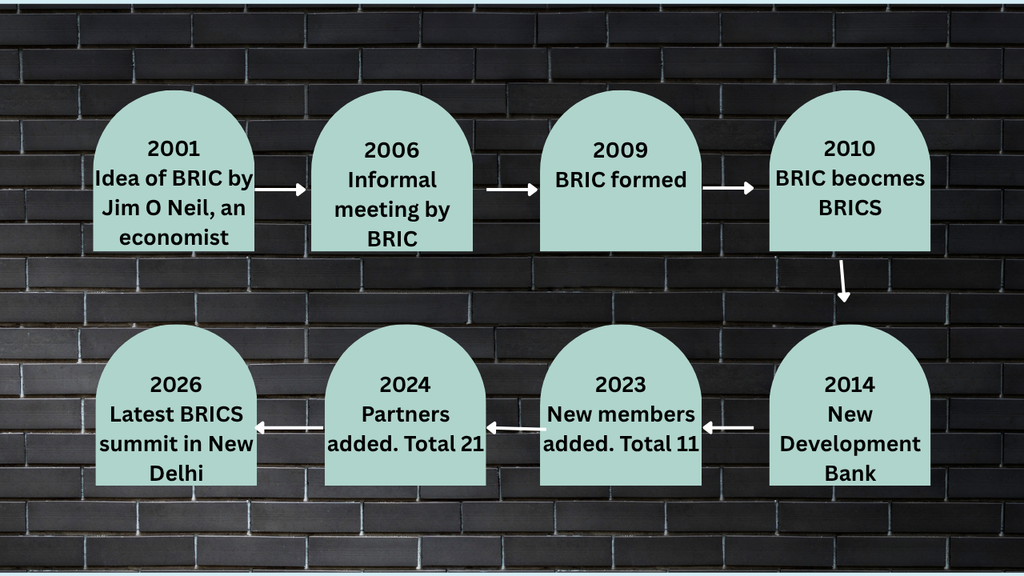
It all begin in 2001 as a result of an economic research paper “Building Better Global Economic BRICs” by economist Jim O Neil, published by Goldman Sachs. He used the term BRIC (Brazil, Russia, India and China) as the emerging economies who can dominate the world economy by mid of the century. Recognizing their shared interest in reforming the international financial order, the four nations began holding informal political dialogues on the sidelines of the UN General Assembly in 2006.
The coalition officially solidified its institutional identity during its first formal Summit in Yekaterinburg, Russia, in June 2009.
Evolution:
Post 2009, BRIC nations strengthened their position with the entry of the 5th nation, South Africa in 2010. In 2014, BRICS nations attempted their Financial Independence during their summit in Brazil. The bloc created the New Development Bank (NDB), headquartered in Shanghai, with an initial capital of $100 billion. The attempt was to provide an alternative to traditional multilateral lenders viz. IMF and World Bank. The BRICS made a historic expansion plan in 2023 and 2024 in 15th summit in Johannesburg (2023) and 16th summit in Kazan (2024). With this, another 6 members were included viz. UAE, Saudi Arabia, Iran, Indonesia, Egypt and Ethiopia. In addition, some other countries named as partner countries were also included. However, Saudi Arabia has not yet formally confirmed its membership of BRICS, although its Foreign Minister, Prince Faisal bin Farhan, attended the BRICS meeting in 2026. India hosted the BRICS meetings four times i.e in 2012 (New Delhi), 2016 (Goa), 2021 (Virtual) and 2026 (New Delhi).
BRICS today:
A research paper of Jim O Neil, has now turned into a global block, countries aspire to join. The expanded block covers around 50% of the world population. It covers approx. 40% of the world GDP (PPP) and 26% of the trade world-wide. With such figures and the total strength of 21 countries (11 member + 10 partner), BRICS is a bloc who matches even G7 in many aspects. However, much of the size and economic influence come from China. As China is the biggest economic/military force within BRICS, Russia is a dominating military power, other countries remain secondary to these two nations.
BRICS 2026:
BRICS 2026 that concluded on 13th of Sept at New Delhi saw the head of states of its member and partner nations deliberating on the issues of international importance. The summit declaration outlines a few critical issues as under:
Local Currency Settlement
A major focus was on mitigating exposure to currency volatility and unilateral sanction risks. Most of the BRICS nations suffered out of the trump tariff. While stopping short of creating a single unified currency, members reaffirmed their commitment to:
- Expanding local-currency trade settlements between member states.
- Studying cross-border payment platforms and independent depository frameworks to streamline direct transactions without relying strictly on third-party clearing systems.
Multilateral Institutions
The declaration issued a strong call for structural changes to global institutions:
- United Nations & Security Council: Urging comprehensive UN reforms to make the Security Council more representative of developing nations, explicitly noting the aspirations of emerging powers in Africa, Asia, and Latin America.
- IMF Quotas: Advocating for a realignment of IMF quota to accurately mirror the growing share of emerging market economies in the global GDP.
Energy Transition, Grid Modernization, and Critical Minerals
Addressing climate change while safeguarding economic development remained a balance point. The summit highlighted:
- Fossil fuels: Acknowledging that fossil fuels will continue playing a transitional role alongside renewables for developing economies.
- Grid Infrastructure: Launching specialized digital initiatives to advance smart grid performance and energy storage across developing nations.
- Sovereignty Over Minerals: Calling for resilient, diversified supply chains for critical energy-transition minerals while explicitly defending the sovereign rights of resource-rich nations over their domestic assets.
Responsible AI and Inclusive Innovation
The declaration highlighted the rapid rise of Artificial Intelligence, calling for a human-centric, transparent, and inclusive approach to AI governance. The leaders cautioned against technological monopolies, emphasizing that developing nations must have equal access to open-source tools, compute infrastructure, and digital skill-building.
Strong worded declaration on terrorism
“We reaffirm our commitment to combating terrorism in all its forms and manifestations, including the cross-border movement of terrorists, terrorism financing and safe havens. We reiterate that terrorism should not be associated with any religion, nationality, civilization or ethnic group and that all those involved in terrorist activities and their support must be held accountable and brought to justice in accordance with relevant national and international law,”
Challenges Facing BRICS:
While the expansion and summit declarations present BRICS as a unified global force, beneath the surface lie structural vulnerabilities, geopolitical frictions, and practical hurdles that limit its cohesion.
1. Severe Internal Geopolitical Rivalries
Unlike established economic blocs like the EU or political alliances like NATO, BRICS contains member states that are in direct conflict with one another:
- India vs. China: The two largest Asian members remain trapped in territorial border disputes and a battle for regional influence across South Asia. India’s strategy leans toward balancing relations with both the West and East, directly opposing China’s goal of using BRICS as an anti-Western platform.
- Middle Eastern Frictions: The bloc’s recent expansion brought in traditional rivals like Iran, Saudi Arabia, and the UAE, introducing complex regional volatility to consensus-building.
2. Unequal partnership
BRICS is far from an equal partnership.
- Disproportionate Size: China accounts for over 60% of the combined BRICS GDP, leaving smaller members vulnerable to Beijing’s economic, political and military might.
- Asymmetric Trade: Most members trade significantly more with China than they do with one another. This creates concerns that BRICS could become an echo chamber for Chinese industrial expansion rather than a truly multilateral development hub. Something not very pleasing for India.
3. The Unrealistic “De-Dollarization” Goal
Despite attempts and emphasis for local-currency trade, creating a viable alternative to the US Dollar faces huge technical and political barriers:
- No Common Currency: Creating a “BRICS Currency” requires a central bank, shared fiscal policies, and identical inflation management—an impossibility given the vastly different economic structures of members. China’s push for promoting Yuan as common currency has also not received many takers.
- Currency Volatility & Convertibility: Non-convertible or heavily controlled currencies (like the Chinese Yuan or Russian Rouble) and volatile currencies (like the Brazilian Real or South African Rand) face serious liquidity issues. Exporters often refuse to hold large reserves of non-dollar currencies due to depreciation risks. Even Indian currency Rupee has been considerably volatile in the recent past.
4. Contradictory Foreign Policies
The group lacks a shared ideological framework:
- Anti-Western vs. Non-Aligned: Russia, Iran, China actively use the platform to counter Western sanctions and challenge the current international order. In contrast, democracies like India, Brazil, and South Africa explicitly view BRICS as a non-aligned forum—seeking deeper ties with the West while maintaining autonomy, not building an anti-Western coalition. Relation with Israel is another contentious issue between the members.
Final thoughts:
What started with an economic research paper of Jim O Neil is representative of 40% of the world’s GDP today and 26% of the trade. Even G7 cannot shrug the impact of this group. With BRICS expanding its base from just 4 to 11 members and 10 partner members, it is no longer an economic debate club. However, the disparities and uncommon interests of the member nations, the major conflict points viz China and India, Iran and Saudi Arabia will remain a major hurdle in promoting BRICS as an effective force.
Readers can also refer to other blogs on world economy like India Must Lead – At Silly Point and Iran, a civilisation at war – At Silly Point
Frequently asked questions
About the Author
Please refer the about us page @ About us new – At Silly Point
Disclaimer
Please refer the disclaimer page @ Disclaimer new – At Silly Point
Discover more from At Silly Point
Subscribe to get the latest posts sent to your email.