
BLOG 60/2026 DATED 24th OCTOBER 2026
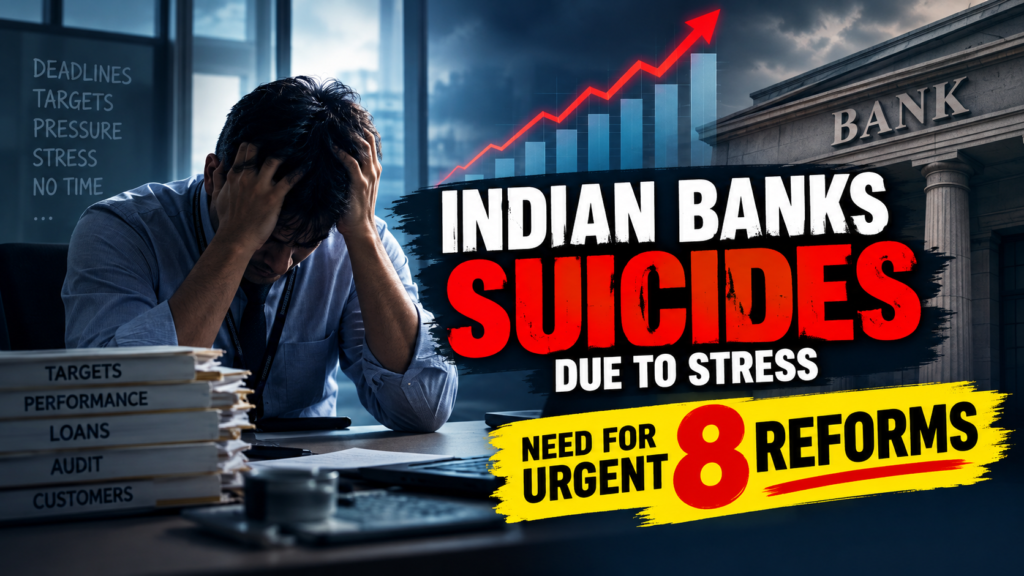
February 2026 saw a solemn discussion in the Indian parliament when A A Rahim, CPI-M leader from Kerala raised a concern over alarming working conditions and the increased number of suicides cases in Indian banking industry. It was disclosed that more than 500 bank employees have committed suicide in the last 10 years, often mentioning stress and workplace abuse as a reason. Despite being brought to the highest legislative forum, the issue has met with little to no meaningful action. Post February 2026, we have further witnessed several suicide cases of bankers. This begs a crucial question: are we failing to find a solution, or do we simply lack the political and institutional will to act? This question demands answers. Perhaps it is time for risk management departments to classify toxic workplace environments and extreme work pressure under operational risk. In management, the problem is first identified along with its causes to create a solution for that. Bank management seems far away from the solution. In any high-level committees or in recently concluded PSB confluence too there was hardly any discussion on these points.
Suicides in banks in 2026:
| Month | Bank | Remarks |
| March | A Private Bank | Regional Head died. Family blames harassment. |
| June | Bank of Baroda | A probationary officer committed suicide pointing to stress. |
| Oct | Indian Bank | A Chief Manager died at Chennai Head office |
| Oct | HDFC Bank | A sales manager died at Vijayawada. Family members blame work pressure. |
| Oct | Bandhan Bank | A deputy manager died leaving a note about harassment. |
| Oct | Punjab and Sindh Bank | A manager suspected to commit suicide in Panchkula |
| Oct | Punjab and Sindh Bank | A Chief Manager died in Chandigarh. Suicide suspected. |
These are a few cases available in the public domain. That creates a fear that are we immune to such news? Have we accepted it, as normal? In fact, the stressed employee is one of biggest operational risk for the bank. The boards of the banks must take cognisance of this emerging risk and establish checks and balances to counter this.
Probable reasons for suicides:
We cannot put a straightforward blame towards stress, harassment, work life balance etc, rather we should try to understand the several reasons and then try to find out the possible solutions. These cases can be divided into 3 categories:
Personal reasons:
Every death or suicide can not be attributed to the management or work place stress. There can be multiple reasons for a person committing suicide. Family issues also play a great role contributing to such events. The deceased person’s own guilt due to a misdeed may also be the reason for suicides. Sometimes the inefficiency to do a job also creates stress and results in the unfortunate decision.

Work culture:
Work culture plays an important role in keeping an employee in the best of moods. A toxic work culture can add to the miseries of the employee. It has been reported that on many occasions an abusive language, a discrimination or lack of facilities to perform has caused extreme stress and resulted into the unfortunate event of suicide.
Systemic problem:
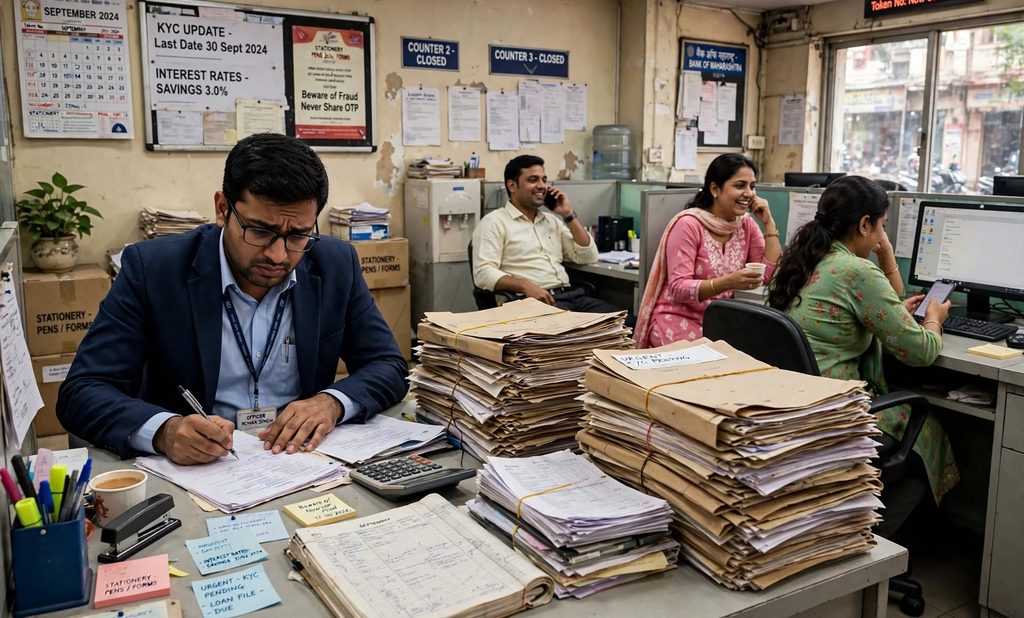
The above two reasons can occur in any organisation or any industry. However, banking industry itself is prone to stress. First of all, it deals with public money. If the standards are not kept high, banks may not be able to hold the public trust. The high standards of integrity and performance sometimes cause extreme stress that employees are not able to handle. Another issue is non transparent HR management in banks. Specially in public sector banks, the promotions, transfers, work allocation and distribution of staff is not done with the proficiency and transparency that is required at this level. All the decisions are opaque and often employees are not aware as to why a particular decision is taken. Unsystematic target setting is something no one want to fix. One figure is arrived at the top and target is distributed to each unit accordingly. It does not read the market potential, availability of resources etc. This leaves some with light and some other with heavy targets compared to the potential. Extreme duplicity and wastage of resources is another reason to increase work load without any productivity.
Probable solutions to resolve stress and suicidal thought:
Disclosure by Banks:
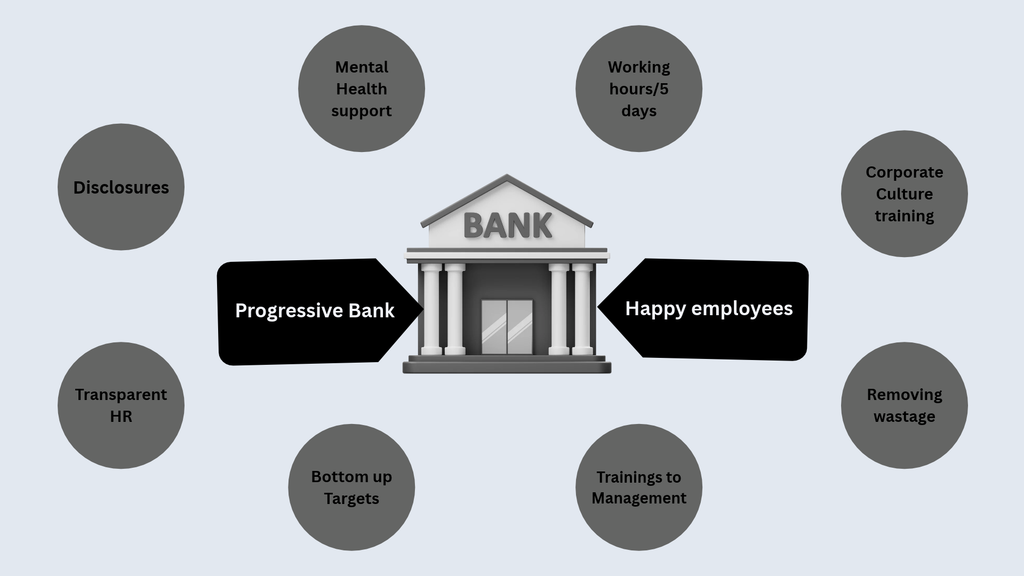
It should be made mandatory for a bank to disclose the details of death of employees during the year with full details of name, reason for death and action taken. It should include all the deaths during the year/reporting period. This will activate the bank management to follow each and every case and take necessary action to improve the working condition, if the death happens due to work culture or systemic problem. Deaths happening at workplace will be seen by the market and banks will be forced to improve the working condition.
Upgrading HR:
A competent HR management must be able to find the balance between the organisational aspirations and need of the individual. HR is not expected to fulfil all the desires of employees, but it should remain just as well as transparent in all the decision making. For example, an employee writes the online promotion exam and wait for result for weeks causing doubt of wrongdoing. The online exam can very well display their results immediately without wait. This small step will make things transparent and employees will not have any doubt against the management in their minds. Such small steps in every process will enhance the confidence of employees resulting into better work environment. In the same way, some units may have more human resources than necessary at the cost of others, HR is expected to balance this anomaly, so that different units are staffed as per their strength.
Bottom-up targets:
At every level the units should be asked to fix their own targets vis a vis resources available to them. Top management must analyse targets to each unit vis a vis resources and potential in the area. After this exercise final targets should be fixed. This will solve the problem of unrealistic target setting to a considerable extent.
Management at field level:
Management personnel down the level should be trained to handle teams and keep a balance between targets achievement and employee’s wellbeing. Specially training about both verbal and written communication is needed at this level. Any statement, spoken or written, can cause severe distress and can result into actions like suicide. People who are posted in administrative positions viz head of regions/zones or head of branches should be provided with managerial training.
Wastage & duplicity:
Banks need to assess the processes that are not required or where time can be reduced through technological support. A small example is conducting online interviews, instead of calling employees to the interview centre. This will save time, money for the interviewee as well as interviewers. A little reduction in wastage of time at every level will enable the workforce to produce better results.
Corporate culture training to employees:
On many occasions even employees fail to understand that they are working in a competitive environment and market conditions demands more efforts from them. Young entrants to the corporate culture find themselves vulnerable against the stress of targets and monitoring. Management must be aware of this phenomenon and arrange for quality training of their employees. Management professionals can be utilised to train this class of employees.
Working hours, leaves, 5 days:
Management must focus on the end results rather than appreciate late working hours. In fact, working hours should be defined for most of the staff. Sanctioning of leaves also should be generous as employees should not be forced to avoid taking leaves. We have numerous instances when leaves are denied because of lack of staff or not achieving targets. If there is genuinely a shortage at any place, HR must take steps to resolve that problem. The demand of bankers regarding 5 days banking must be addressed as soon as possible. Management can also consider reducing the other holidays to maximum 10 in a year but allow a 5 days banking.
Mental health support:
Banks can also hire or collaborate with specialist guides who can attend an employee for mental stress or any other phycological disease. This can be done at two levels. First a new employee can be assigned to a senior mentor who can guide him/her on doubts. Second a phycological expert can attend to specific employees in case of need.
Way forward:
A resilient banking workforce is essential for the sustainable growth of industry and business. A workforce that is stressed, overloaded, and burned out can never produce sustainable long-term results. A nation aspiring to grow at double-digit rates must ensure that its human resources are valued above its physical assets and growth targets.
It is the responsibility of every organization to foster a growth mindset among its employees—not through abrupt pressure and excessive workloads, but through robust systems and a balanced management approach. The parliamentary discussion in 2026 was a timely wake-up call, and we cannot afford to ignore this critical operational risk.
Readers can also read the related blogs :PSB Confluence 2026: Do Public Sector Banks Really Need to Become “Cool”? – At Silly Point
Suicide Stress and Service – At Silly Point
Bank employee dies, family suspects harassment at workplace – The Hindu
About the Author
The above blog is authored by Sayed Azhar Hasan; an independent Financial Analyst, and the blog is written only for educational purpose. For further details, please refer the about us page @ About us new – At Silly Point
Disclaimer
The views expressed above are personal as ‘At Silly Point’ is not associated with any other regulator/bank etc. For detailed disclaimer, please refer the disclaimer page @ Disclaimer new – At Silly Point
Discover more from At Silly Point
Subscribe to get the latest posts sent to your email.