
BLOG 49/2026 DATED 22ND AUGUST 2026
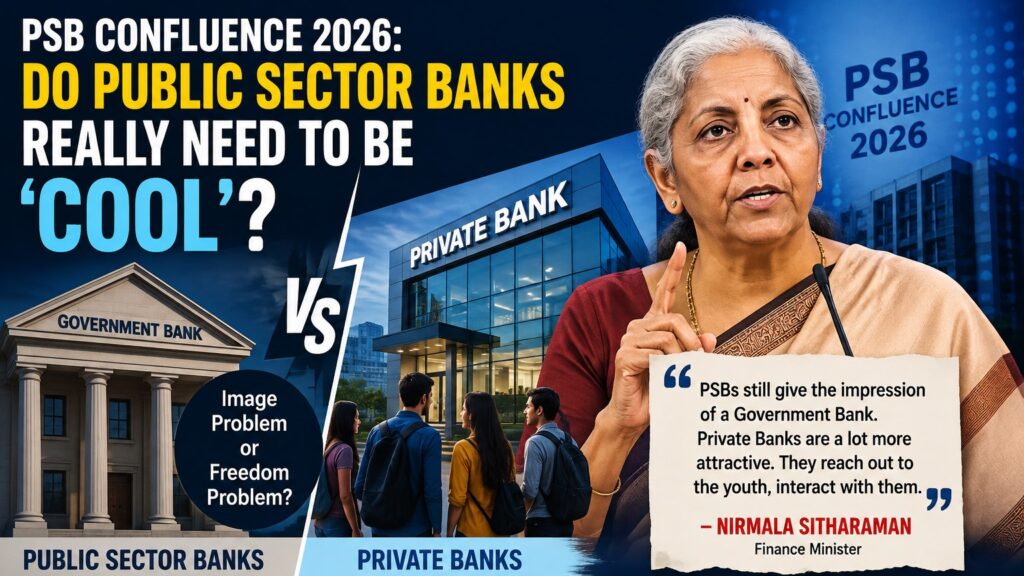
“Pardon me, But PSBs still give the impression of a Government Bank. Private Banks are a lot more attractive. They reach out to the youth, interact with them.”
Nirmala Sitaram, Finance Minister in PSB confluence 2026.
The above statement was given by the honorable Finance Minister at the closing ceremony of the two-day PSB confluence 2026 that concluded on 18th August 2026. The statement has inherent problem with the way the finance minister looks at the Public Sector Banks in India.
The top- level conference saw the heads of all Public Sector Banks in India under one roof, conferring on the future banking strategies. There were several outcomes, however following 7 points can be a sum up of the PSB confluence 2026.
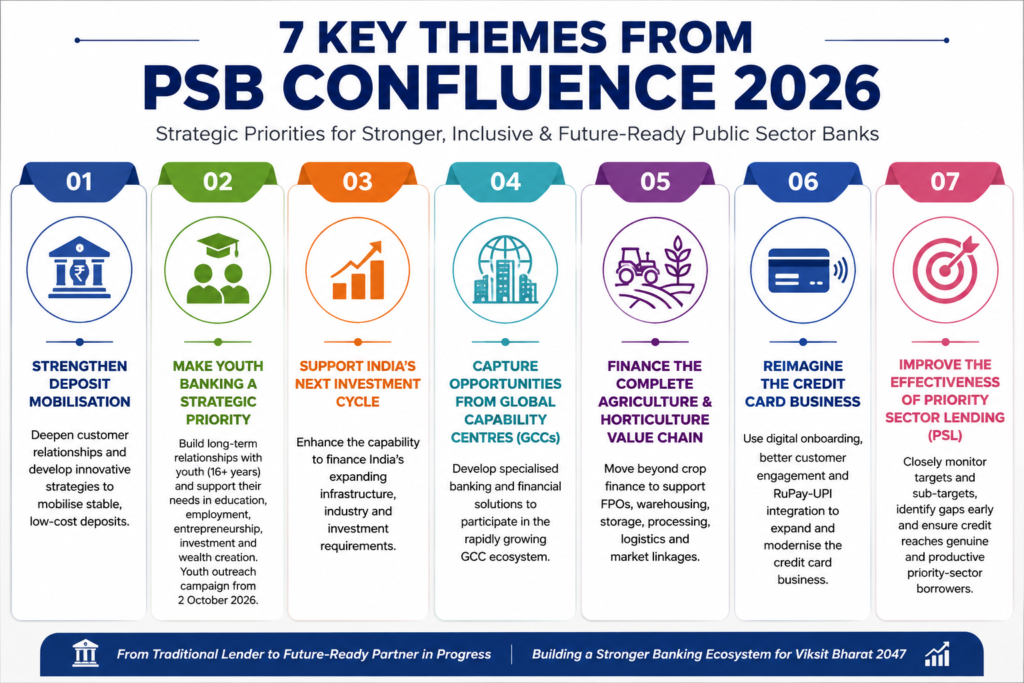
All the points are discussed in detail in media; however, we will base our discussion on the statement of the finance minister and getting the youth in banking fold.
Focus on Youth
The Finance Minister also advised all PSBs to have dedicated youth banking spaces such as ‘Yuva Kiosks’ and ‘Yuva Banking Mitra’ at the branches. She asked Public Sector Banks to launch a one-month long Banking campaign on ‘Banking for youth’ from October 2, targeting citizens above 16 years of age and targeting long -term banking relationship with younger customers. She also said that the campaign should be the beginning of a sustained engagement, rather than a one-time account opening exercise. Theoretically, this looks good as if you catch a customer young, you can have a more sustainable customer relationship.
The Approach of the Minister
“PSBs still give the impression of a Government Bank”
The first question that comes to mind is Should they not give the impression of what they actually are?
- Government of India has 60% to 70% shareholding in public sector banks.
- Their CEO and working directors are appointed by the Government of India.
- MoF (Ministry of Finance) has one representative in the Board of every Bank.
- MoF not only gives macro level directions but also decides even minor issues such as promotion process, salary fixations, incentives etc.
- PSBs also approach people to implement Government schemes.
- PSBs employees are deputed for election duties.
- And the list is endless.
PSBs cannot and should not be asked to play Hockey and Football together. Either make them a government arm or let them do business on their own. Even as an arm of Government, the way they are at present, PSBs have done remarkably well on profitability ground under her regime. As far as digital progress is concerned, PSBs have grown leaps and bound. I remember a few years back UPI, Banking Apps, digital lending was not seen, now it is available with all PSBs along with private banks.
Hence, public sector banks are not required to change their image as private as with the government tag itself, they have done a very good progress
The second question that comes to mind is, why the Government tag has a bad impression in the minds of the youth?
Does this mean that the finance minister believes the Government tag itself has a negative image among the youth, and that Public Sector Banks must therefore distance themselves from that image by appearing more like private banks? If this is the case, the problem lies with the governance and not with the banks. Thus, the government has to work in a way that the youth of the country have a good image of the government. If the impression of the government is good and efficient, banks need not change their image. Let us take one example, PSB employees have been demanding 5-day banking. The proposal has been accepted by the bank managements, but the ministry has not been able to take a call for more than 10 years. Such lethargy on the part of ministry makes the government a dull organization and same goes out as an image in the minds of the public at large. The finance minister is requested to look into such inefficiency in her own department to make the Finance Ministry ‘cool’. Public Sector Banks will automatically become cool. They need not copy private banks. In fact, the Government tag with the bank adds to trust factor that no private bank can achieve.
Is campaigning the right thing to attract youth?
The finance minister advised the banks to be ‘Cool’ and observe a one-month campaign focussing on the youth. This is exactly the problem with public sector banks and their masters. In the name of growth, PSBs often depend upon campaigning. The result is that multiple campaigns run at the same time with faulty targets. Huge expenditures are incurred without any long-term planning. The field work force which is responsible to actually carry out the campaigns remains confused and unconvinced about these campaigns. Some campaigns do give good result but at an exorbitant cost and without any long-term vision. (Refer to my blog on ‘Campaigning in Public Sector Banks’ where the pros and cons of campaigning have been discussed). Here are certain points for this specific campaign.
- All banks campaigning together will give a chance to the target audience to exploit and ask for undesirable favours or services. Some of the banks may also fall in this trap which will not be prudent for the banking sector.
- The youth today is not attracted by the flashy campaigns but by quick and smart service. Banks can become cool not by campaigning but by smart decision making and efficient systems.
- PSBs will compete with each-other, increasing their own cost and finally shifting one youth from one PSB to another, leaving net result as ZERO.
- At the most, PSBs can attract some accounts from the private banks. Will it benefit the national economy in any way?
Request to the finance minister
It is very easy to criticize any decision of the Government but difficult to provide resolution. Let us contribute positively, in the matter of making public sector banks ‘cool’. I place some advice to the respected Finance Minister and her team.
- Take a thorough review of the department and see that proposals from banks are responded within a reasonable time.
- Take financial decisions with professional approach e.g. 5 day banking. If you wish to reject, reject it with sound logic or accept it. I do not see any sound logic to reject it from my level. 5 day banking is a very pertinent demand, there can be many genuine business friendly requirements that you may have to look into personally.
- Have confidence on the CEOs and EDs appointed by you. They are thoroughly experienced banking professionals and as a team are capable to get the desired results.
- Give more freedom to Public Sector Banks to make their own policies rather than dictating terms for HR related and business development matters.
- You have already instructed to form a high -level committee to implement the 7 points agenda. Let them work out the solution themselves.
- If you feel that PSBs need to learn something from private banks, arrange for high quality training of employees of PSBs where they can interact with private bank counterparts as well.
- Avoid giving unreasonable targets to achieve political gains rather keep banking away from politics as far as possible.
- You may personally focus on making big bank agenda and for that purpose arrange for high quality international training for banking as well as ministry employees.
- Review the structure of Board of Directors and if possible, try to include a few professionals from relevant fields as independent directors.
Rest assured, Public Sector Banks are ‘cool’ and have capacity to be more alert and agile to attract quality customers and not only youth. They are also competent to carry out the national priorities. The only desirable thing is to have confidence in your team, give them respect and take calls professionally rather than emotionally
Conclusion
To be fair, the Finance Minister’s concern cannot be dismissed entirely. Private banks have generally been more successful in creating youthful brands and simplifying customer journeys. The younger generation often evaluates a bank not by its ownership but by the speed, convenience and quality of its digital experience. Therefore, PSBs should certainly learn from successful private-sector practices. The above discussion carries suggestions for the ministry, but Public Sector Banks too need to relook at their internal systems and duplicity in the procedures. However, learning from private banks does not necessarily mean copying them or abandoning the distinct strengths of public ownership. The government ownership adds the Trust factor for the benefit of PSBs and there is no urgent requirement to abandon this trust.
Readers may also refer to the related blogs such as Campaigning in Public Sector Banks – At Silly Point, 5 Days Banking Dream – At Silly Point and Performance Linked Incentives (PLI) in Public Sector Banks- Motivation tool or failed experiment – At Silly Point
Feel free to give your views in comments & subscribe to get the blogs in your mailbox
Frequently asked questions
About the Author
The author is an ex-banker, educator, YouTuber and a free-lance writer. Please refer to About us new – At Silly Point for further information.
Disclaimer
The views expressed by the Author are personal and do not represent the policy or views of any organisation. Please refer to Disclaimer new – At Silly Point for further information.
Discover more from At Silly Point
Subscribe to get the latest posts sent to your email.