
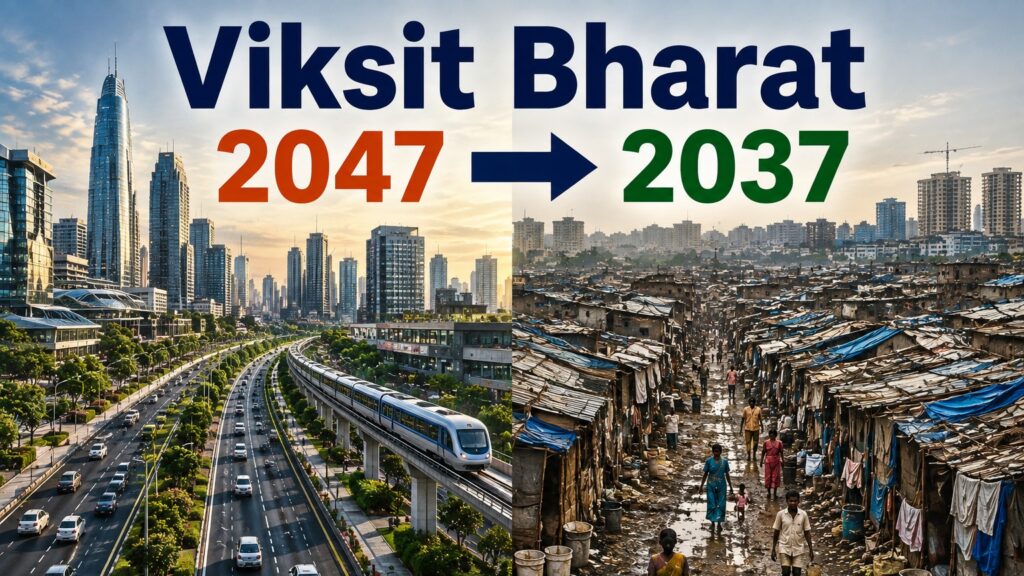
Why is India still a developing economy?
BLOG 48/2026 DATED 16TH AUGUST 2026
Way back in 1985 when I was is class 10th, I was taught ‘Bharat ek Vikas-sheel arthayavastha hae’ (India is a Developing Economy). I continued to read the same lines in 1990s while persiuing my MBA. In 2026, my son also studies in his Economics PG course that India is a developing economy. I wonder will my grandson also read that India as a developing economy? My entire generation, Gen X, toiled hard and pulled the economy but still it remains developing. Gen X did a lot of work, really believe me! yet we are developing. My next generation, probably smarter than us still toiling with the tag of ‘developing.’ Finally, our Prime Minister fixed the target of Viksit Bharat as 2047. Oh, I do not know about the PM but half of my generation will be under the earth or reduced to ashes by 2047 (I am a very positive person, you see!). So, after having worked so hard why not give another push with the new generation and bring the target forward to 2037. Are you on the same page? Remember Sholey “Ab bol diya hae to dekh lenge”.
On a serious note, let us examine why a country is called developed. There is no fix mathematical formula to define an economy as developed, developing or under developed. IMF, UN and World bank apply different parameters still resembling to one another to recognise an economy as developed. Let us see the parameters that are actually assessed by these 3 international bodies to classify a country
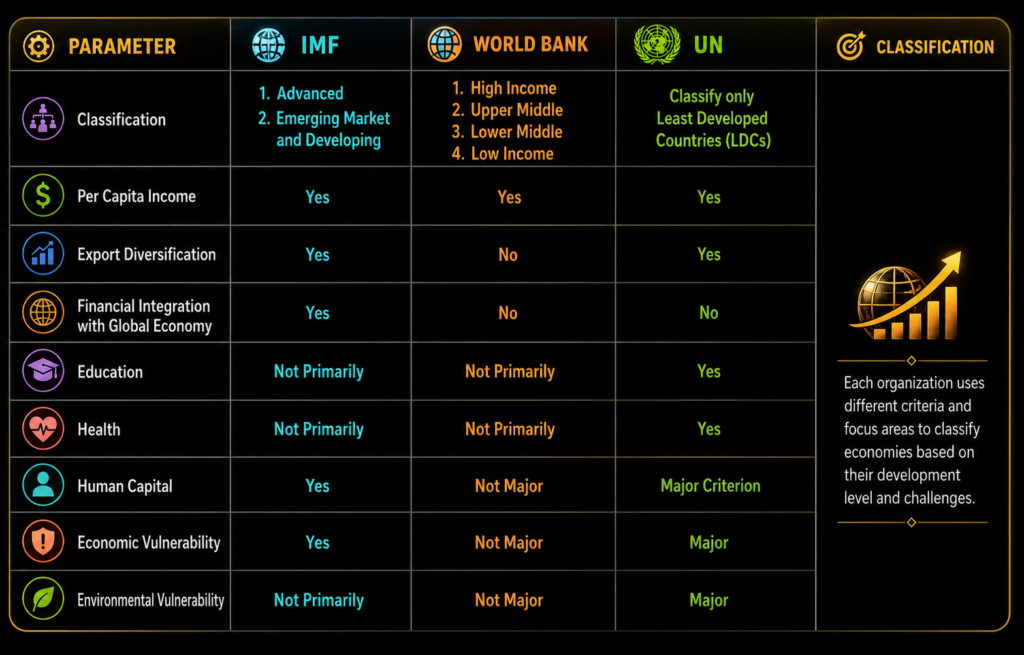
Let us see where we stand on these parameters. Even if some parameters are not central to an organisation’s classification, better performance across a combination of these parameters will result in India being recognised as a developed economy.
Where are our problems?
Over obsession with GDP data:
Our country has reached 4th/5th/6th spot and has become a major economy in terms of GDP. But GDP parameter hardly matters in identification of a developed economy. Still, it is an important parameter because it leads to the progress in other parameters. Too much emphasis on GDP will keep us in fools’ paradise as what matters most is GDP or GNI (Gross National Income) per capita. It is here that we are failing. India’s GDP is high as India is the home of 1/7th of the world population.
Low per capita:
Per capita income is a common criterion for all three, IMF, WB and UN. Our per capita income is not fit even with developing economies. As per world Bank open data, India’s per capita is just 2702 USD per year in 2025. Incidentally, Bangladesh is having per capita of 2500 USD, Sri Lanka USD 5002, Pakistan USD 1600, China USD 13900. People with wisdom will take it easy and say that since our population is huge, per capita will be low. However, it is not that simple and the parameter drags India down more than anything else.
Disparity in Income:
Our low per capita has another skewed feature and that is disparity.
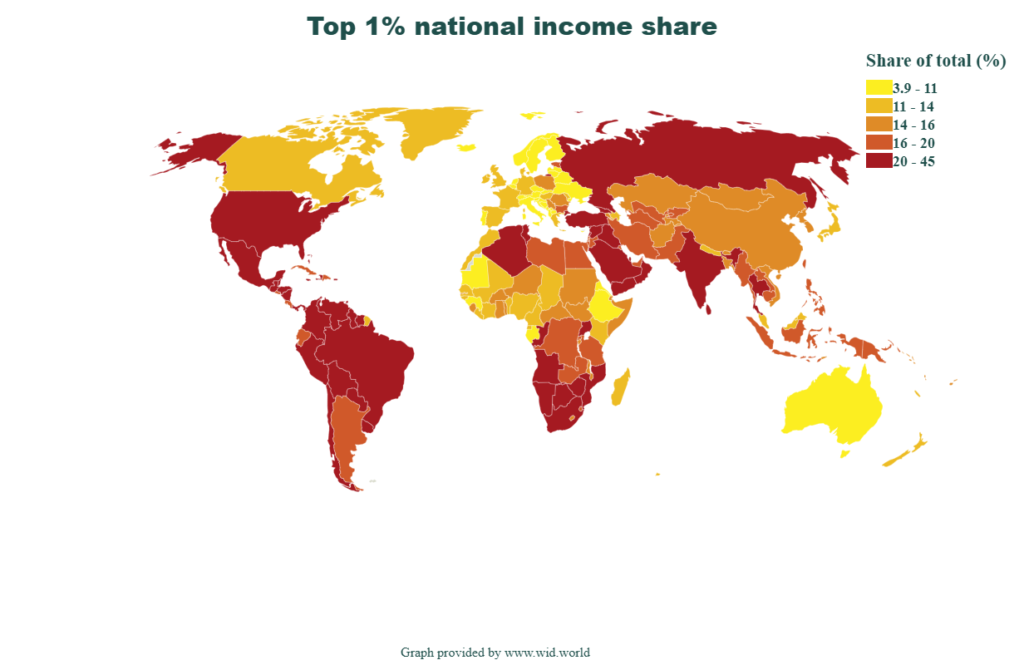
The above graph is as per World Inequality Database. We can observe, India amongst the highest inequality nations. Top 1% people enjoys around 40% of total wealth of the country.
Poor in Human Development Index:
Human Development Index that is constituted by the education, health, hygene etc reflects a very sorry state of affairs in our country. HDI 2025 by UN Development Program ranks India at 130th, out of 193 countries. If we do not prefer to talk on such issues, we better wait for 2047 and beyond.
Environmental considerations:
Off late, environmental concerns are bothering world bodies and here again we lag behind other nations. We are way behind the schedule of net zero target of the United Nations. Our ESG and sustainability progress is mostly in laws and regulations. We are yet to see a practical application of such efforts.
Way forward:
Above criticism does not mean that we have not achieved anything. Apart from the top GDP nations, we hold a robust Forex reserve, we are the fastest growing economy among major nations and there is a decent improvement in per capita income as well. India is adapting to new technologies including AI and also attempting to be the hub for secure data centre for the world economies. All these display a hope and provide a solid base for exponential growth to break into the top economies. However, I prefer that our approach need to begin from grassroots rather than top down. Let us open the knots one by one.
Per capita and income disparity:
- Let us first come out of the mathematical mindset that we are poor because we are too many. Let us work seriously on multiple poverty alleviation programs.
- Identify 10% bottom population i.e 14 crore population that will equate to around 3 crore families.
- Make a 6 years program to uplift these families i.e 50 lakh families every year.
- Divide it into 545 parliamentary constituencies i.e 9,174 families every constituency every year. Now it looks a bit easy.
- Let the MP of the constituency take this charge. Involve NGOs and religious and cultural organisations for every constituency. Publish the progress constituency wise along with the name of the MP. So that the public can see the performance of their MP.
- Some NGOs should be given the follow up work so that families once brought out of poverty do not drag them back due to inefficiencies.
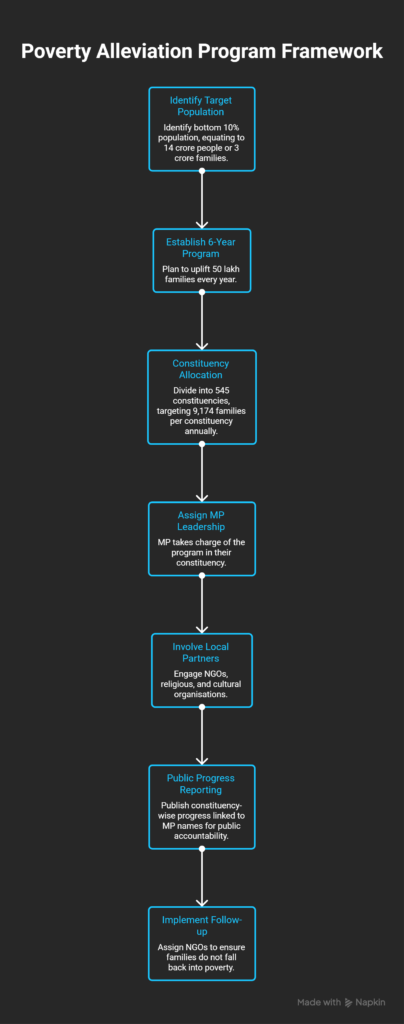
An attempt in this direction will directly address the issue of inequality of income.
Health, Education & Hygiene:
- Provide quality training to teachers, if need be, even some international teaching models can be applied.
- Make quality education accessible at least upto 12th standard (target 5 years).
- Collaborate with high ranked international universities so that worthy students may be able to approach them at affordable costs for higher education.
- Increasing the number of AIMMS and IITs retaining the quality and spending on research. Research spending will help innovation in technology and securing patents. An innovation can dramatically change the status of the economy than a thousand other efforts combined.
Create an export, trade and manufacturing hub:
India is a huge economy with both resources and population. Develop big export houses supported by MSMEs to turn the table on balance of trade. Establishing Gift city is a good progress in this direction. In a 1.40 bn people county, we must have 10 gift cities helping the Indian traders and manufacturers deal in the international markets. However, for this, government will have to facilitate quality and price competitive products. Signing of FTAs with various countries is also a good step in this direction. In a span of 8-10 years, India must become a manufacturing hub for the world with ease of doing business.
Public discourses:
How will a country develop when the youth do not prefer to read, innovate and research? Rather India is arguably the largest market for purposeless videos on Instagram, YouTube etc. The thinktank has to change the public discourse. The young brain is to be diverted towards innovation, growth and cooperation rather than discords among the communities. India has to change its public discourse from Cast and Communalism to innovation and support to grow and beat the word.
Let’s begin:
This is not the conclusion instead let this be the beginning of the last forceful push from Gen X to lead the nation to a state of developed economy, developed in true sense where people enjoy the basic amenities and liberties of life. India’s challenge is therefore not merely to become a bigger economy. It has to become a richer, healthier, better educated and more productive society. That is the real journey from a developing economy to a developed economy.
Readers can also refer to the blog 32/2025 on GDP and Viksit Bharat at GDP and viksit bharat – At Silly Point
Frequently asked questions:
About the author
Please refer to the About us page at About us new – At Silly Point
Disclaimer
Please refer to the disclaimer at Disclaimer new – At Silly Point
Discover more from At Silly Point
Subscribe to get the latest posts sent to your email.