
BLOG 47/2026 DATED 5TH AUGUST 2026
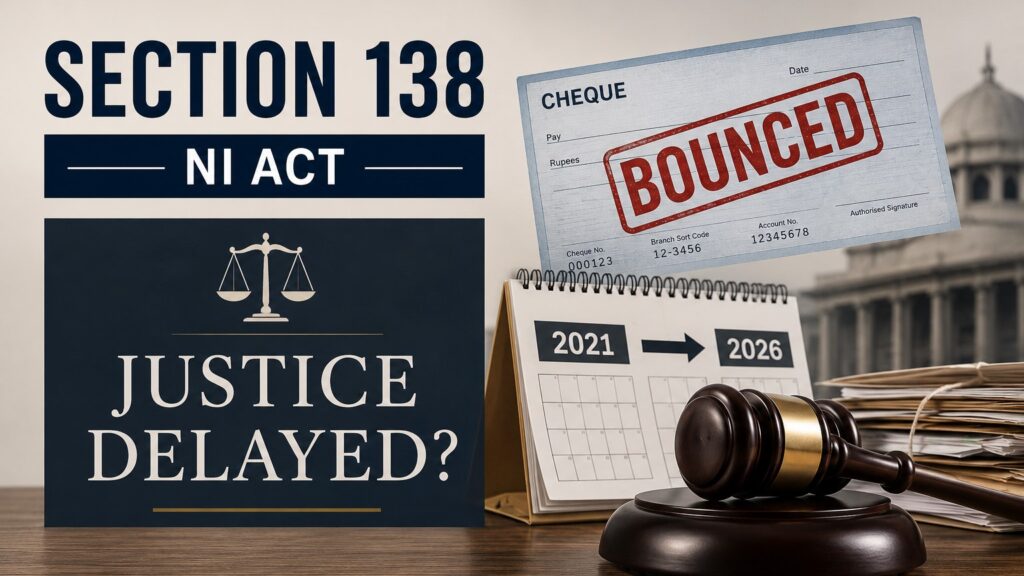
As a banker I used to wonder as to why people are not afraid of issuing a cheque without keeping sufficient balance in the account. Numerous cheques bounce due to ‘Insufficient balance’. This is despite the fact that the law is clear and decisive in favour of the beneficiary. Section 138 of the Negotiable Instruments (NI) Act, 1881 is unambiguous and clear in this regard. A cheque bounce is a clear case where the victim can move to court and expect a swift justice i.e payment of the cheque amount and damages, if decided by the court.
To file a valid complaint under Section 138 of the NI Act, 1881, the following 5 statutory conditions must be met
- The cheque must be drawn by the accused on a bank account maintained by him
- The cheque must be presented within its validity period.
- The cheque must be returned unpaid for insufficient funds or exceeds arrangements.
- The payee must give notice to the accused within 30 days of receiving information of dishonour from the bank.
- The accused failed to pay within 15 days of the receipt of the notice.
Conceived as a fast-track summary trial mechanism, Section 138 was designed to instil commercial discipline and ensure speedy recovery.
However, the reality is far from the robust legal framework promised by law. Ask anyone who has actually filed a Section 138 complaint in an Indian court, and they will tell you a very different story—one of endless adjournments, procedural loops, mental trauma, and decrees that exist only on paper.
Here is a look at how a seemingly “open-and-shut” legal remedy degrades into a multi-year marathon, illustrated through a classic real-world scenario unfolding in Indian courts every day.
Real Case Study: Victory on Paper, Empty Pockets in Reality
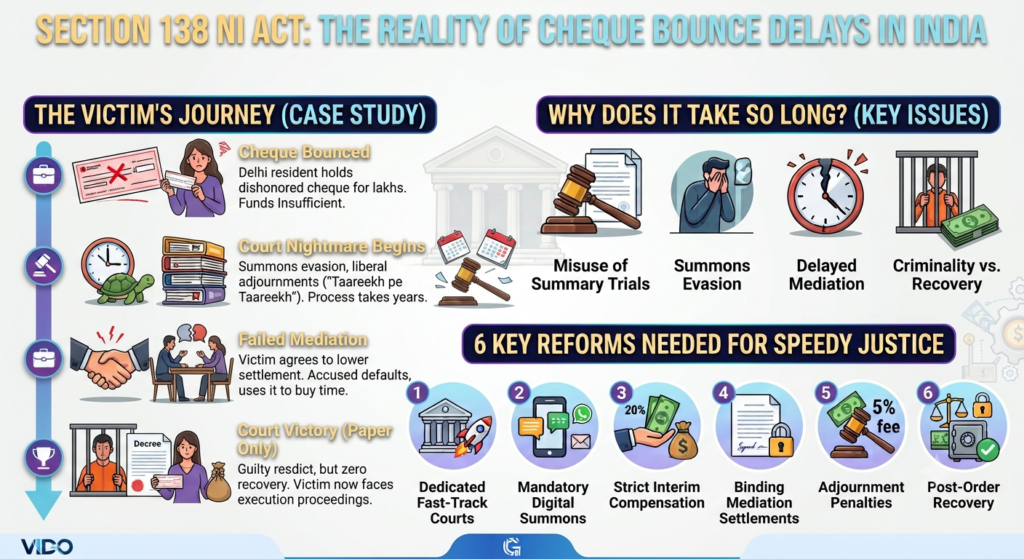
1. The Trigger: A Cheque bounce
A resident of Delhi was owed a substantial sum running into several lakhs of rupees. The debtor issued a cheque to clear the dues. Trusting the instrument, she deposited it at her bank branch for encashment. Days later, the bank returned the cheque with a familiar, dread-inducing slip: “Funds Insufficient.”
Following the mandatory procedure under the NI Act:
- A formal legal notice was drafted and duly served within 30 days, demanding payment.
- The debtor ignored the notice entirely, displaying a clear intent to defraud.
Her advocate assured her: “The law is 100% on your side. Section 138 is straightforward. We will approach the court, and this will be settled swiftly.”
2. Justice begins to slow down
The complaint was filed before the Metropolitan Magistrate. What should have been a straightforward case meant to conclude within a few months, instantly ground to a halt. Unnecessary adjournments, missing court dates, and heavy court dockets stretched months into years. Arguments upon arguments, proofs over proofs continued and the court continued to grant adjournments, with ‘taareekh pe taareekh, taareekh pe taareekh’
3. The Mediation Trap
Recognizing the backlog, the court referred the matter to mediation. Desperate to resolve the matter and recover at least part of her hard-earned money, the victim agreed to settle the dispute for a significantly lower amount.
The Result? The defaulter used mediation merely as a delay tactic. He paid a nominal fraction of the agreed amount to show “good faith,” defaulted on the remaining instalments, and pushed the case back to the judge’s desk.
4. The court declares victory
After nearly five years of court visits, advocate fees, and considerable mental agony, the judge finally delivered the verdict: In favor of the victim. The offence was proved, the law was applied, and the accused was convicted.
The Aftermath: Two Uncomfortable Questions
While the legal battle was technically “won,” two harsh realities remained:
- Time & Cost: The process consumed close to 5 years of the victim’s life, accompanied by mounting legal costs and constant emotional distress.
- What about Recovery: Winning the criminal case does not automatically restore the money back in her bank account. To actually recover the funds, she is now faced with initiating execution proceedings—another legal battle prone to identical delays.
Final outcome: The victim is still running to advocate as she received next to nothing in the form of recovery and the recovery proceedings still continue. The criminal case has concluded but the case study remains unconclusive.
Why Section 138 takes so long?
Section 138 cases account for over 10% to 15% of all pending criminal cases in Indian courts. Despite statutory mandates for quick disposal, the system chokes due to several structural flaws
- Misuse of Summary Trial Provisions: While Section 143 mandates trials to be conducted summarily on a day-to-day basis, courts routinely convert them into full-fledged summons trials, allowing endless cross-examinations.
- Summons Evasion: Accused individuals frequently evade service of court summons, weaponizing administrative delays to keep the trial from even starting.
- Delaying Tactics via Mediation: Defaulters frequently agree to settlement terms in court-annexed mediation with no intention of paying, merely buying months of free time.
- Separation of Criminality and Recovery: A conviction under Section 138 puts the offender in jail or imposes a fine, but executing compensation orders often requires execution petitions that drag on endlessly.
Reforms needed: How to Fix Section 138 Delays
Merely enacting a strict law is meaningless if the judicial mechanism cannot enforce it in a reasonable timeframe. To restore public faith in commercial transactions, structural and legislative reforms are needed immediately. Even Supreme court has also emphasized time and again in such matters and issued guidance for speedy disposal of these cases. The problem still persists.
Dedicated Fast-Track Cheque Bounce Courts
Establish specialized, paperless tribunals staffed by retired judicial officers or dedicated magistrates handling only Section 138 cases. It will relieve standard Magistrate Courts and enforce the timelines to settle such matters.
Mandatory Digital Summons
Legally validate summons sent via WhatsApp, email, and SMS with automated delivery receipts. This will eliminate the 6–12 month delay currently wasted just attempting to bring the accused to court.
Strict Enforcement of Interim Compensation
Make the deposit of 20% interim compensation by the accused non-negotiable within 60 days. If unpaid, court proceedings should move directly to attachment of assets. This willDiscourage frivolous trial delays designed purely to wear down the complainant.
Cost Imposition on Unnecessary Adjournments
Enforce a strict “maximum 2 adjournments per side” rule with heavy, compounding financial penalties for requesting adjournments without verifiable medical emergencies. 5% of the claim amount to be paid in case of seeking an adjournment after the maximum 2 adjournments.
Binding Mediation with Asset Attachment Clauses
Amend mediation rules so that a settlement agreement carries the weight of a decree with automatic asset attachment in case of a single default on instalment. It will prevent defaulters from using mediation as a stalling mechanism.
Reduce time after final orders
Once the court establishes the case and decides in the matter, there must be a provision in law to affect the recovery immediately by freezing the assets to the extent of the allowed amount. The purpose is to provide justice to the victim and not to punish the culprit. Sending the culprit to jail can be used as a deterrent but it will not serve the purpose of the entire exercise.
Final Thoughts
A legal system that takes five years to decide an undisputed cheque bounce case sends a dangerous message: cheating pays, while honesty costs time and money.
Justice in financial matters must be swift; otherwise, commercial trust erodes. Until procedural loopholes are sealed and execution is tied directly to judgment, Section 138 will remain a strong law on paper—and a weak shield in practice. We need to convert paper tigers to actual actionable rules. This makes our financial ecosystem more robust and responsive.
Share your thoughts in the comments below
Note: Readers can also read my blog Digital Arrest-scams draining bank accounts – At Silly Point on digital arrests and its prevention.
About the Author:
Please refer the about us page: About us – At Silly Point
Disclaimer
Please refer the disclaimer page: Disclaimer – At Silly Point
Discover more from At Silly Point
Subscribe to get the latest posts sent to your email.