
BLOG 55/2026 DATED 26th SEPT 2026
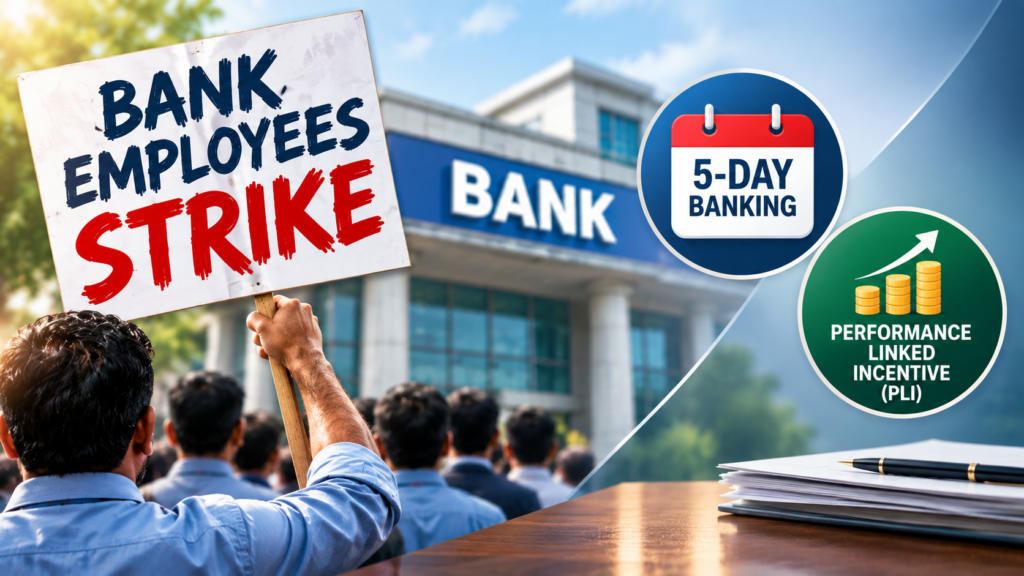
Bank officers and workers unions went on a one-day strike on 11th Sept 2026 demanding 5-day banking and better incentive schemes. Once again, they have called for a 3 days strike starting from 28th Sept to 30th Sept 2026. There may be multiple demands but the two that attract most public attention are 5-day banking and Performance Linked Incentive (PLI). 5-day banking has been under discussion for more than a decade among bank managements, the regulator (Reserve Bank of India), the government and bank employees’ unions. Performance Linked Incentives were introduced by Government of India in 2020 and were welcomed by all including bank employees. However, the government introduced an alternative Performance Linked Incentive scheme for bank executives in 2024 which changed the game of incentives in Indian Public Sector banks.
We will assess both these demands and discuss possible solutions. Before discussing the issues, let us briefly understand the structure of hierarchy of bank employees in PSBs (Public Sector Banks).
Bank hierarchy:
Public sector banks have following hierarchy in the management of human resources.
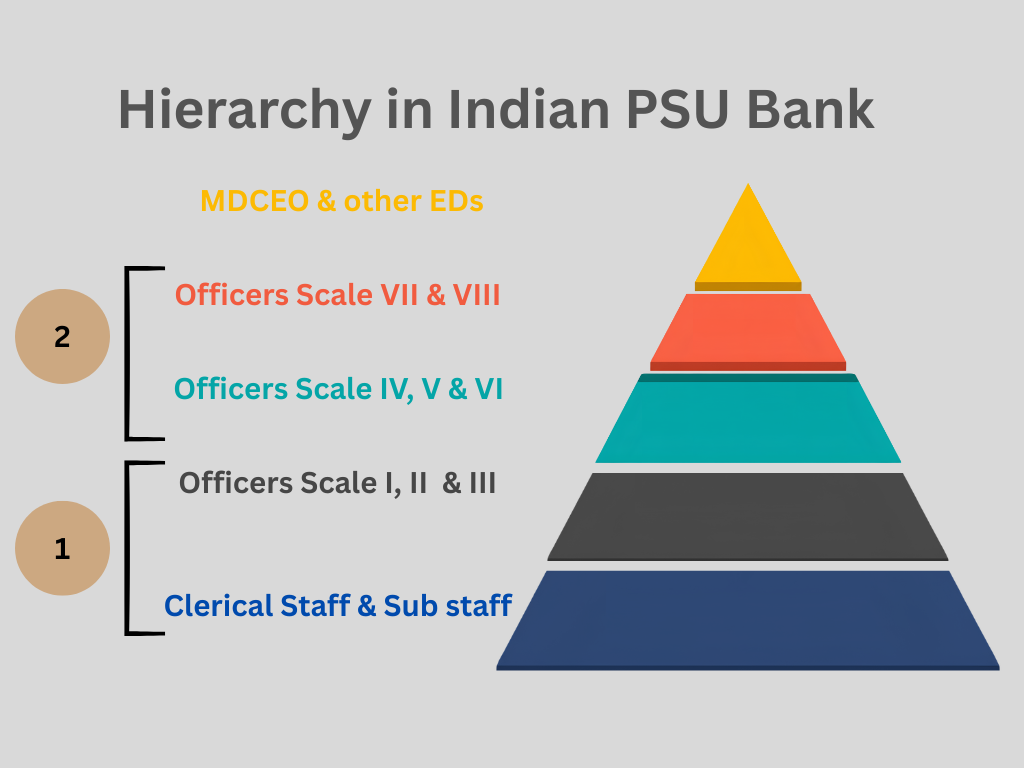
Only Category 1 i.e., Clerical staff and Officers in scale 1,2 & 3 has the right to go on strike. Category 2 which comprises executives do not participate in strikes. Category 1 constitutes almost 95% of the total staff strength, and it generally takes a considerable period, normally 10–15 years, to enter the coveted Category 2 level. Although the salary structure of the PSBs follows a relatively smooth curve, with salary hikes at every level, the culture within banks displays visible differences between category 1 & 2 employees in terms of their perks, clothing, approach and responsibilities. Work wise clerical staff has their time bound job and normally work between 10-5 i.e., 7 hours a day. On the other hand, officers’ staff both in Category 1 & 2 work without any time restriction, somewhere between 10-12 hours a day. These extended working hours have gradually become part of the banking culture, although there is no guarantee that longer working hours necessarily result in higher productivity. At the top of the management hierarchy are the MD&CEO and other Executive Directors, who are appointed by the Government of India. They deal with the policy matters and decision making along with the Board of Directors.
Against this backdrop, let us now examine the two major demands.
5-day Banking:
Public Sector Bankers in India are dreaming for 5-day banking for more than a decade. They have also been able to convince the representatives of Indian Bank Association, to recommend their 5-day banking demand to the Ministry of Finance. The matter, however, appears to have reached a deadlock. Ministry has neither approved it nor rejected it. In the present circumstances the demand of bankers seems logical, considering the stress level that they go through the week days and the extensive digital reach of the banking system. Both these developments provide a strong base for their demand of 5-day banking. Then why is there silence from the ministry?
As there has been no formal statement from the Ministry of Finance, we do not know the reasons for keeping the matter in abeyance. One possible concern may be customer service. A few customers may require banking services on Saturdays. However, we are way ahead of such situation as about 99% of the banking transactions being carried out through digital mode. Government is also well aware of the benefits of 5 days banking. A few of these benefits could include:
- Better work life balance for employees.
- Operational cost savings for the banks.
- Lower absenteeism.
- A boost to the local economy by giving more time for leisure & travel spendings.
- A possible help in pollution control and traffic ease in metro cities.
In addition to the above, the regulator, Reserve Bank of India, and the Ministry itself are working under 5 days working model. As described in my earlier blog on 5 days banking, most developed countries follow a 5 days banking system rather than a six days system (Refer Blog link in bottom).
This is a clear case of employee’s dissatisfaction arising from a slow and opaque decision-making process.
Performance linked Incentives (PLIs):
Refer to my blog on performance linked incentives (link at bottom), where I argued that incentives are meant to motivate employees for better performance. However, the existing PLI structure may have had the opposite effect on many employees, even though banks have spent significant amounts on incentives. To briefly summarise the PLI scheme, the government introduced one PLI scheme in 2020 that provided for 5/10/15 days salary as incentives to almost all employees depending upon certain profit parameters. The scheme was welcomed by employees. However, it was largely treated as another employee benefit because it had little direct connection with individual performance.
In 2024, Government introduced another Performance linked incentive (PLI) scheme, exclusively for category 2 employees as shown in the above chart, covering around 5% of the total staff strength. This incentive scheme described strict profitability and business parameters for banks and also incorporated the individual performance grades of executives. However, the amount of incentive was almost 6-10 times higher than the earlier PLI scheme, which remain available exclusively for Category 1 employees. This has created a degree of dissatisfaction between the two categories, against the backdrop of an already existing, though largely unspoken, perception of a higher–lower hierarchy within banks.
Category 1 employees now came out openly in opposition to the new scheme. I have already discussed the weaknesses of the scheme in my earlier blog. One of the major concerns is the use of different parameters, formulae and incentive amounts for different categories of employees.
This is a clear case of employee’s dissatisfaction, arising out of poor designing and unprofessional management of incentive schemes.
I fail to understand why the Government should determine individual incentives and arrive at an employee-level formula.
The Strike call:
The above two issues, along with a few other demands that may or may not be equally important to employees, have led the bank unions to call a three-day strike from 28 September to 30 September 2026. It is pertinent to mention here that when bank employees go on strike, they do not receive salary for those days. The public at large must understand the significance of this situation. Banks employees prefer to sacrifice 4 days salary (1+3) in order to make the government pay attention to their demands.
Suggestions:
- The Ministry of Finance should immediately take a call on 5-day banking. If there are any apprehensions, they must discuss it with the bank employees and other stake holders and arrive at a decision.
- Both Performance Linked Schemes should be withdrawn. Government should decide on the total incentive corpus for individual banks, depending upon their performance. The Government’s job is to govern and not to decide the incentives for the bank employees.
- Individual Board of Directors of the banks should take a call, on how they wish to distribute the incentive amount among their employees.
- While designing the incentive structure, boards should consider that; incentives are not charity but reward for performance. Accordingly, the performing employees across all cadres must be eligible to get their share from the total incentive corpus.
- Performance measurement system should be made robust and as objective as possible.
Government is taking steps to globalise the Indian banking and create a few large international banks. For this to happen effectively, it is necessary to strengthen the Boards of Directors so that they can take business decisions independently. The government should focus on national level priorities rather than micro-managing banks or any other business unit. At the same time, the bank employees should also be trained to be more professional while the management culture within banks should gradually move from designation cantered to performance cantered.
Readers may also read the following blogs at sillypoint to get an analysis of both PLI schemes and 5 day banking.
5 Days Banking Dream – At Silly Point
Frequently asked questions
About the Author
Please refer the about us page @ About us new – At Silly Point
Disclaimer
Please refer the disclaimer page @ Disclaimer new – At Silly Point
Discover more from At Silly Point
Subscribe to get the latest posts sent to your email.