

BLOG 22/2025 DATED 19TH OCTOBER 2025
“The most important thing in communication is hearing what isn’t said”
-Peter Drucker
Try to find out somebody who listens well, it will be herculean task to find one, as people become bosses by good speaking, dominant speaking and not necessarily by listening. However, listening itself is a great art and those who listen well become leaders not just managers or bosses. Now a days we can see many advertisements promoting courses on good speaking, confident speaking and hardly any professional push for good listening.
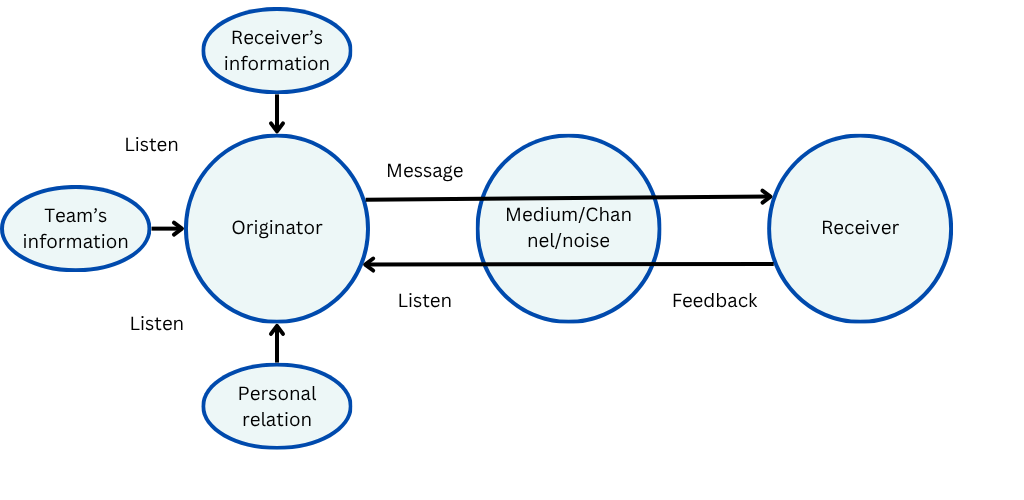
Communication has 2 most important nodes one is the originator and the other is the recipient. Communication gets completed only when the originator effectively communicates and receiver effectively receives it. However, in general all our attention is on speaking, clear and confident without considering the fact that the receiver’s competency is also equally important. In fact, whatsoever is the competency of speaker, if listener fail to grasp, communication fails. On the other hand, when a subordinate speaks and leader fails to understand, he can’t give right direction or he can’t solve the issue despite the clarity of his speech. In both circumstances, a leader has to be an excellent listener as well. Then why not courses on good listening?
The reason goes with a general understanding that if we can speak clearly and firmly with added eloquence, work is accomplished, but there is a catch, work is only half accomplished as receiving part is not ensured. In fact, the work of receiving or listening starts before origination. The originator of communication has to first listen with understanding of the environment and then speak, to make it possible for the receiver to effectively receive it.
A small case of 2 bosses:
Scene 1: Mr K is a very senior credit specialist and in entire organisation there is hardly any one as expert as him in credit matters. He is heading the credit department of a big bank. Mr A, a bright officer joins the Credit Unit. K was known for his discipline, hard work and knowledge. Mr A prepared a credit proposal and it went to Mr K for sanction. After some time, Mr K called him and asked “you prepared this. You have not put up the proposal correctly. Is this the way you should analyse a credit proposal”. “Sir, I checked all…” A started but before he could complete, K shouted back “You are trying to argue with me, it is better to improve upon your skills rather than talking”. Communication ended; A never knew what went wrong.
Scene 2: Mr K retired and was replaced by Mr M, another senior guy well known for his management skills and solving difficult tasks. Another proposal was on the table of Mr M once again prepared by Mr A and he was called inside the cabin of M. “Hello Mr A can you sit for 2 minutes and explain what you want to say in this proposal” M asked. A sat quietly and explained the entire proposal, M appreciated his presentation skills and suggested a few improvements.
Almost same type of situation and 2 different reactions. K do not want to listen while M listened and suggested improvement. What M did was, that it allowed the communication to be completed and then he could affect the improvements that he wanted. K was brilliant to carry out things on his own and did not bother the other node of communication. It was not needed for him. However, M listened peacefully without wasting much of his time and completed the communication by positively guiding the future course. The result, A became motivated to deliver what M wanted giving ease in future communications while K left that to the ability of A. If A is competent, he will be able to join dots left open by K and will complete the job while in M style of communication even a mediocre A will also be able to deliver what M wanted.
A good leader takes care of every level of intellect of his/her team and built it in a way that every resource of his team become result oriented, what exactly was done by M. In order to complete the communication in today’s business world we may emphasise upon some of the following things:
Understand your receiver quickly. The receiver is boss or subordinate, we must know his level of intellect and ability. Knowing the receiver, enhances the probability of communication getting completed.
Be a good receiver. If the other node speaks something, listen carefully without cutting him in between. This will help in articulating your own message according to the requirements of your receiver (the other node).
Give a pause. More often than not, giving a pause provides our mind a second to prepare the response and its delivery in the right manner.
Now comes clarity and eloquence. If we do the above 3 steps correctly, speaking in a clear and eloquent way may help us to take the communication back to the other node. It is only this part of communication that is being emphasised upon, resulting in failed communications despite very eloquent speech.
Be a part of team. The receiver should believe that we are towards his/her side. If the receiver start thinking that we are the other part, communication may fail. This can also be accomplished once we listen carefully.
Be a leader of team but individual friend: Apart from being a team leader, the leader should be a personal friend of each of the members or at least most of the members. That also, is possible by lending an ear to what the other individual says.
Do not mix things: Discuss on one topic at a time. Normally in communications people tend to mix things ending up nowhere. The leader always avoids that, and bring back the communication where it is intended to.
Know when to stop listening: Listening is necessary for an effective communication but one must also know when to stop that. There are many instances when the one party kept on speaking and disrupts the entire communication. The leader must know when and how to stop him. Off course avoid doing if the boss is speaking.
Take honest feedback: This is also a part of listening. Honest feedback helps us to improve. However, people do not give honest feedback for fear of repercussions. Leader has to create an environment of honest feedback.
“Courage is what is takes to stand up and speak; courage is also what it takes to sit down and listen”
Winston Churchill
Discover more from At Silly Point
Subscribe to get the latest posts sent to your email.
K type boss is in majority 🙈🙈🙈🙈
hahhahaha mae bhi K type tha kya ….just joking I know I am not like that.
Are sir you are my motivation 🙏🙏
Pingback: Disturbing Dialogues - At Silly Point
true
My spouse and I stumbled over here by a different web address and
thought I should check things out. I like what I see so now i’m
following you. Look forward to exploring your web page repeatedly.