
BLOG 58/2026 DATED 10th OCTOBER 2026
The Monetary Policy Committee of Reserve Bank of India has decided to increase the repo rate from 5.25% to 5.50%. This is the first hike in repo rate by Reserve Bank of India since February 2023, when the rate was increased from 6.25% to 6.50%. Since then, we have witnessed a considerable decrease in the repo rate i.e from 6.50% to 5.25%, a fall of 1.25%. Any economy desires to keep its interest rates low as far as possible. Businesses benefit from lower interest rates because industries can obtain funding at cheaper rates. Retail borrowers enjoy lower rates as their EMIs are lower. Lower EMIs prompts higher demand and consequently stronger economic growth. Almost everyone is happy to see a lower repo rate by Reserve Bank of India. We can also observe that normally the developed countries have lower benchmark rates than the developing economies. India has been recognised as one of the fastest growing economies, then what was the need for RBI to press the reverse button and increase the repo rate?
Reasons for increasing Repo Rate:
The decision on the repo rate is influenced by many factors. It is decided after a thorough analysis at RBI and after assessing all pros and cons by a committee of experts and best economic minds available in the country. Out of the many possible reasons, we shall discuss two main reasons as mentioned in the press release of RBI:
Rising inflation:
Interest rates are nothing but the reflection of interest rates in the economy. One of the factors for increasing repo rate is rising inflation. Press release from RBI states “it is clear that inflation and its outlook are not benign as they were last year with headline CPI inflation expected to average almost 5.8 per cent in the next three quarters and core inflation projected at 4.4 per cent this year. In this milieu, recalibrating the policy rate is imperative.”
| Month | CPI | CFPI (Food price inflation) |
| Jan | 2.74% | 2.11% |
| Feb | 3.21% | 3.35% |
| March | 3.40% | 3.71% |
| April | 3.48% | 4.01% |
| May | 3.93% | 4.78% |
| June | 4.38% | 5.32% |
| July | 4.45% | 5.52% |
| August | 4.82% | 5.95% |
Ministry of Statistics and Program Implementation | Government Of India
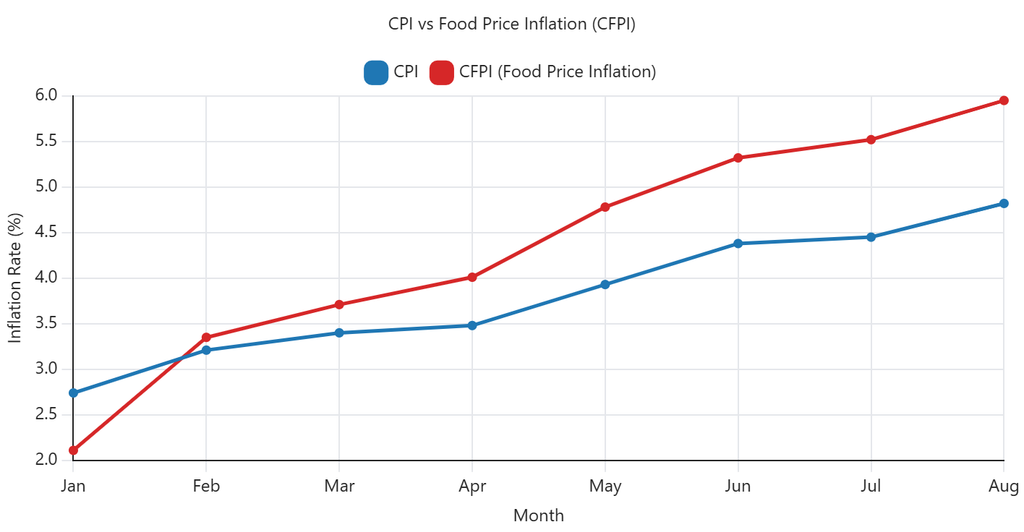
The above data shows that the Consumer Price Index has been on a consistent upward trend during the year. From 2.74% in January, it has gone up to 4.82% in August, while the more vulnerable figure is food price inflation that has gone up from 2.11% to 5.95%. The inflation of 4.82% recorded in August is highest since December 2024. Due to continuing crude oil supply disruption, the inflation is expected to rise further. In such circumstances, RBI may not have any other option but to increase repo rate as well.
Increase in Federal Reserve Rate:
Reserve Bank of India also mentions the increase in Fed rate as one of the possible reasons for such a decision. RBI writes, “Acceleration of inflation in key economies has prompted a shift towards hawkish monetary policy. The U.S. Fed hiked by 25 bps in September. The Fed commentary thereafter along with rate tightening by major systemically important central banks have reinforced expectations of higher global policy rates.”
Refer to Fed rate hike blog at sillypoint (link in bottom), where it is argued that one of the ways to counter the increase in fed rate is increasing our own repo rate. The increase in Fed rate may have resulted in outflow of funds towards dollar-based economies where rates have increased. Investors who park their funds in emerging economies may shift their investments due to higher yields on U.S. treasury bills and that can in turn affect the value of the currency of the economy. One of the ways to counter this phenomenon is to increase our own interest rates and RBI has responded exactly on the same lines. On 16th Sept 2026 U.S Federal Reserved announced increase in Federal Funds rate to 3.75% to 4.00% from the previous 3.50% to 3.75%, an increase of 25 bps.
What can change due to increase in repo rate?
Lending rates:
Most banks have shifted to external benchmark lending mechanism where interest rates change due to change in external benchmark. This will make changes in most interest rates in the direction of repo rate only. An increase of 25 bps may result in almost equivalent increase in the lending rates.
Costly housing/other retail products:
Due to the increase in lending rates, even existing EMIs may increase, placing additional financial pressure on households. Higher EMIs may also impact the housing loan market. The builders who have already created inventory may find it a bit difficult to offload the same. Vehicle loans may also face the same results. People may find it difficult to fund their EMIs.
Higher rates on deposits:
Higher interest rates on deposit are a normal by-product of an increase in repo rate. However, at present, due to recently closed FCNR swap scheme, banks are flooded with funds and hence they may not opt to increase their deposit rates. Much depends upon the actions of market leader SBI. Unlike lending rates, interest rates on deposits are not directly linked to the external benchmark rates. Banks have freedom to change the rates as per their liquidity requirements.
Liquidity of banks:
As mentioned above, banks are highly liquid due to FCNR scheme and RBI is busy sucking this extra liquidity through VRRR auctions (Variable Rate Reverse Repo). A higher reverse repo rate will attract bankers to place their surplus funds with RBI. The increased rates may help RBI balancing the liquidity position of the financial markets.
Banks profit:
Banks will be charging higher rates on their lending and will be getting a better return on deployment of liquid funds with RBI. On the other hand, they may or may not transfer the entire 25 bps to depositors due to comfortable liquidity. This may help banks in maintaining their NIM (Net Interest Margin) and hence their profitability. However, if the deposit rates are also increased, the NIM advantage may be nullified. However, banks may have to make higher provisions on mark to market of their HFT and AFS portfolio due to reduced valuation of their investments in bonds.
Stock markets:
Stock markets have already responded negatively to this change. The reason for a negative stock market response is due to costly availability of corporate and business funding. Higher lending rates may affect the bottom line of the listed companies as well. In addition, if banks increase their deposit rates, some amount may shift from the stock markets to bank deposits. However, this will happen only if banks increase their deposit rates.
Production and growth:
A high interest rates regime will make the borrowing costly for the corporates and MSMEs. This may also restrict business activity on the supply side. On the other hand, due to higher retail EMI, demand may shrink and result in slowing down of growth.
Currency:
An increase in repo rate may stop outflow of dollar funds. Competitive domestic interest rates may help prevent capital outflows from the country. This may also result in supporting the value of rupee specially against USD and maintaining some stability in Forex rates.
Inflation:
As discussed above, a higher repo rate may make borrowings more expensive, tightening system liquidity and this may result in reversing the upwards inflation trend formed in a few months.
Conclusion:
Repo rate is one of the strongest monetary policy tools with reserve bank of India. Although, it remains an expectation and endeavour of RBI to keep the interest rates down and boost the economy, circumstances may lead to a different decision. Rising inflation, fed fund rate hike, international trade disruptions were the major reasons for the hike in repo rate at this time. The long easing cycle has ended and RBI will keep strict vigil on the tightening cycle as we expect to end this soon and return to a downward slope of interest rates. If inflation moderates in the coming months, Reserve Bank of India may eventually return to a more accommodative interest rate path.
Ref:Press Releases | Official Website of Reserve Bank of India
Readers may also refer the related blogs: Fed Rate Hike Explained: Impact on India’s Economy, Rupee, and Stock Market – At Silly Point and RBI’s Monetary Policy and your pocket – At Silly Point
Frequently asked questions:
About the Author
Please refer the about us page @ About us new – At Silly Point
Disclaimer
Please refer the disclaimer page @ Disclaimer new – At Silly Point
Discover more from At Silly Point
Subscribe to get the latest posts sent to your email.