
BLOG 37/2026 DATED 01ST JUNE 2026
In this document we have covered the select RBI notifications and directives issued during May 2026 and produced a gist of it. For detailed and full study, readers may refer to the links provided below the gist.
1. Eligibility for an Authorised Dealer
| Category | Eligibility | Permitted activities |
| AD I | A bank license by RBI | Any current and capital account. |
| AD II | Bank or NBFC A Full-Fledged Money Changer or Forex Correspondent with 50 crore turnovers in previous 2 years. Minimum Net worth – 10 crore | Any non-trade current account transaction, other than gift and donation. Forex trade transaction upto Rs.25 lakh per transaction. |
| AD III | Required to deal in Forex incidental to his activities. Intends to offer innovative products offering Forex. Minimum Net Worth – 2 crore | Separately permitted by RBI in the authorisation letter. |
| Full Fledged Money Changer (FFMC) | Net Owned Fund 25 lakh for single branch. Net Owned Fund 50 lakh for multiple branches. | Purchase of Foreign currency notes and travellers’ cheque. Sale of Foreign currency notes and travellers’ cheque for foreign travel. As an agent under Money Transfer Service Scheme. |
An Authorised person other than Bank and NBFC has to achieve the following turnover within 2 years of authorisation and then maintain it.
AD II – 50 crore
FMCC – 10 crore
Link to RBI notification: FOREIGN060520269122C857178F4E5286FB5ABDB219F59E.PDF
2. How to Recon Profits for CRAR calculation:
A bank may reckon the profits in current financial year for CRAR calculation on a quarterly basis subject to the following conditions:
(a) The financial statements shall be audited or subjected to limited review on a quarterly basis; and
(b) The amount which can be reckoned shall be arrived at by using the following formula:
EPt = NPt – 0.25 *D*t
EPt = Eligible profit up to quarter ‘t’ of the current FY, t varies from 1 to 4
NPt = Net profit up to quarter ‘t’
D = average dividend paid during the last three financial years
The cumulative net loss up to the quarter end shall be fully deducted while calculating CET1 capital for the relevant quarter;”
Link to RBI notification:
https://rbidocs.rbi.org.in/rdocs/notification/PDFs/NT799FE6755C8A644D72931699FE567462DF.PDF
3. IFR discontinued
The requirement of Investment Fluctuation Reserve (IFR) has been discontinued w.e.f. May 18, 2026. The balance in the IFR as on May 17, 2026, shall be transferred ‘below the line’ to Statutory Reserve, General Reserve, or Balance of Profit & Loss Account.
For a foreign bank operating in India in branch mode, the balance in IFR shall be transferred directly to ‘statutory reserves kept in Indian books’ or ‘remittable surplus retained in Indian books which is not repatriable so long as the bank functions in India’.”.
Link to RBI notification: https://rbidocs.rbi.org.in/rdocs/notification/PDFs/NT83024DCDBEA7DE44C8AF2C0025AB1177DE.PDF
RBI has issued draft master circular on recovery during may 2026, covering technology based methods of recovery. Please refer to blog RBI guidelines on Recovery – technology-based mechanism – At Silly Point for details.
POLICY RATES (As per MPC dated 8th April – rates unchanged)
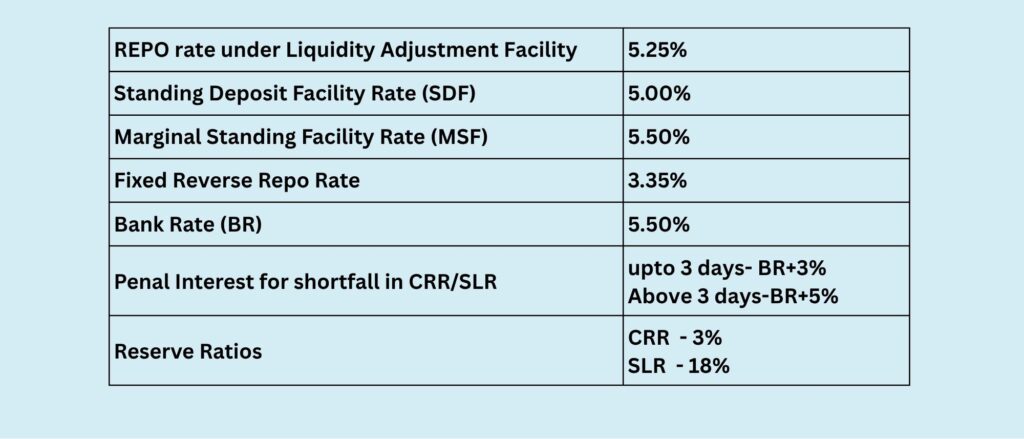
Authors Note: For shortfall in CRR and SLR of 3 days or less a rate of Bank Rate + 3% is charged by RBI while for shortfall of above 3 days a of Bank Rate + 5% is charged.
FREQUENTLY ASKED QUESTIONS
About the author: The author of the Blog, Sayed Azhar Hasan, is a CFA (ICFAI), MBA, PGDIBF (Islamic Banking and Finance), ex banker with 29 years of banking experience and a management educator.
On social media:
LinkedIn : Sayed Azhar Hasan | LinkedIn
You Tube: Sayed Azhar Hasan – YouTube
Disclaimer: The information provided in this blog is for educational and informational purposes only and does not constitute professional financial, legal, or regulatory advice. While efforts have been made to ensure accuracy based on the RBI circulars, readers should consult official Reserve Bank of India (RBI) guidelines and professional advisors before making business or investment decisions. The views expressed are those of the author and do not necessarily reflect the official policy of any banking institution or regulatory body.
Discover more from At Silly Point
Subscribe to get the latest posts sent to your email.