

BLOG 34/2026 DATED 22ND MAY 2026
Reserve Bank of India has issued a draft guideline on Responsible Business conduct for banks and NBFCs. Among other things these guidelines also cover recovery methods through technology-based mechanism. The guidelines specify the terms and conditions for restricting the borrower’s usage of his digital devices in the event of a default. Going through the draft guidelines it looks that RBI has drafted these guidelines very carefully and without giving a free go ahead to lenders. Still giving them a tight rope to go ahead with imposing control on the digital devices of the borrowers gradually and very specifically.
What the draft guidelines say:
The guidelines start as under-
A bank shall not deploy any technology-based mechanism which restricts or disables any of the functionalities of a mobile device of a borrower such as mobile phone, tablet, etc., as a recovery tool, except to recover its loan dues arising out from financing of such a device. The bank may resort to such restriction or disablement of the functionalities of a mobile device provided the following conditions are satisfied:
- The acquisition of the concerned mobile device is financed by the bank through a loan.
- The loan contract / agreement expressly and unambiguously permits such an action
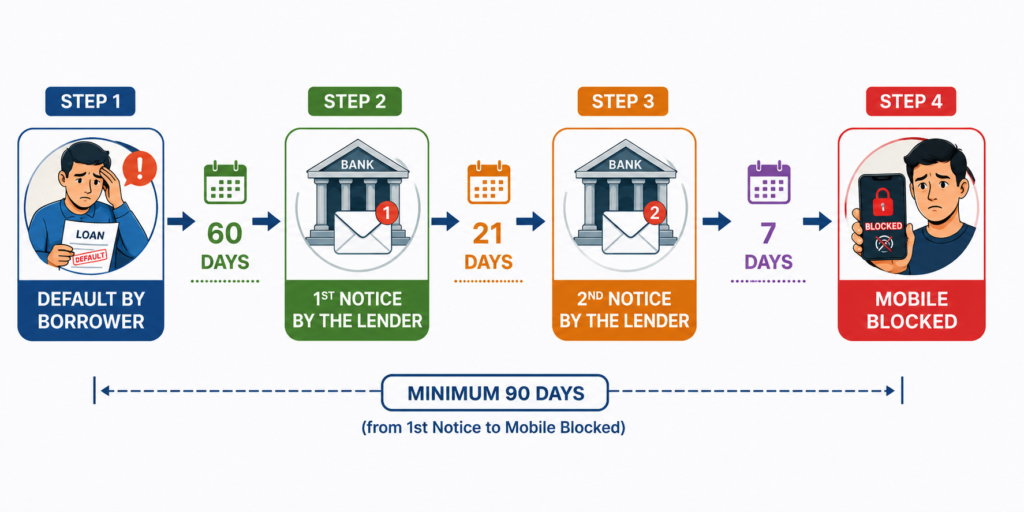
- A notice is issued to the borrower after the loan becomes 60 days past due, with at least 21 days of time being provided to the borrower to cure the default;
- Another notice has been given to the borrower after the expiry of the above notice with at least another 7 days of time being provided to the borrower to cure the default.
- The bank shall not deploy the mechanism to restrict or disable the functionalities of the device until the associated loan has become 90 days past due and the borrower has not cured the default despite being served notices.
Restrictions on banks:
- The bank shall adopt a graduated approach rather than disabling the device, ab initio.
- The bank shall not restrict / disable certain essential functionalities, such as access to internet, incoming calls, emergency SOS features, and receipt of emergency Government or public-safety notifications.
- The bank shall ensure that the restrictions on device functionalities are reversed expeditiously, in any case within one hour of the borrower curing the default.
- In cases involving wrongful restriction or delay in reversal of restriction in the device functionalities after the borrower cures the default, the lender shall compensate the borrower at the rate of ₹250 per hour till the wrongful action is remedied.
- The technology-based mechanism deployed for restricting the functionalities of the mobile device shall be uninstalled soon after the loan is repaid in full.
- The borrower shall have the right to prepay the loan, either partly or fully, at any stage.
- The bank shall put in place a robust grievance redressal mechanism to resolve borrower’s grievances regarding delays and issues in unlocking of mobile device functionalities.
- A bank shall neither access or use nor obtain or retain the data stored in the mobile device of a borrower for the purpose of loan recovery or any other purpose under any circumstances.
Challenges ahead for the banks:
As the directions shall come into effect on 1st Jan 2027 as per amended RBI circular on 6th Aug 2026 (1st October 2026 was the original date at the time of writing this blog), lenders need to prepare in advance for implementing the guidelines.
- Setting up a suitable technical system is a challenge that may require system integration with various mobile companies, service providers and media platforms such as whatsapp etc.
- Developing a suitable policy covering the operational, compliance and well as technical aspects of the entire procedure.
- The ground resources need to be trained specially with regard to handling the annoyed customer and also about the timelines to restart the blocked facilities once the default is cleared.
- Lenders also have to classify the defaulted borrowers where the instalments could not come due to genuine reasons beyond the control of the borrower, and may have to exempt such cases. However, this need to be done very selectively.
Challenges for the borrowers:
- In the first step that RBI has permitted such action only on loans sanctioned to buy such electronic devices. In future, this may get extended to other loan as well.
- Borrowers need to be more serious about their repayment and cannot treat lenders lightly.
- Borrowers need to be aware about the guidelines as no lender should cross the lines specified and harass the borrower.

Conclusion:
These guidelines give extra teeth to lenders to deal with the procrastinating borrowers. If they can implement the guidelines in true letter and spirit, it is possible that for other loans also RBI permits them to adopt such measures. It is a welcome step to protect the public money as the punishment will only be for the defaulters. Such punishments shall be more effective in disciplining the borrower and creating a decent credit culture rather than imposing financial penalties. A credit culture where borrower himself repays the due amount without reminders from the lender.
Reference:
1CBSRA20052026B430C322D37E45FD84879751A066D05D.PDF
8NBFCRA2005202669A3A7BB867443DAB750DB8FB29A3AD9.PDF
Frequently Asked Questions:
About the author: The author of the Blog, Sayed Azhar Hasan, is a CFA (ICFAI), MBA, PGDIBF (Islamic Banking and Finance), ex banker with 29 years of banking experience and a management educator with banking and Management Institutes.
On social media:
LinkedIn : Sayed Azhar Hasan | LinkedIn
You Tube: Sayed Azhar Hasan – YouTube
Disclaimer: This blog is for informational and educational purposes only. The content does not constitute financial, investment, or legal advice. Readers should conduct their own research or consult a certified professional before making any investment decisions. Reference to specific products does not imply an endorsement.
Discover more from At Silly Point
Subscribe to get the latest posts sent to your email.
Very informative video.
thanks sandeep
Pingback: RBI CIRCULARS UPDATE MAY 2026 - At Silly Point