
BLOG 59/2026 DATED 10th OCTOBER 2026
IDBI Bank will now be controlled by a foreign entity Fairfax, as Cabinet Committee on Economic Affairs (CCEA) approved the strategic divestment of a controlling 60.72% stake in IDBI Bank to Fairfax Financial Holdings for ₹52,878 crore ($5.5 billion). It is termed the biggest FDI in the Indian financial sector. This has added another chapter of reforms in Indian banking industry that began way back in the1990s. Among the several efforts to modernise Indian banking, IDBI Bank presents one of the most interesting case studies. Its formation, contribution, strengths, weaknesses and, ultimately, its sale make for a fascinating story in itself. Let us dive into the seesaw history of IDBI Bank, its strategic sale, and its impact on various stakeholders—including customers, employees and shareholders.
The Heritage: IDBI as a Development Financial Institution (DFI)
To understand the weight of this transaction, one must trace IDBI back to its roots in 1964, when Industrial Development Bank of India (not IDBI Bank) was established under an Act of Parliament as a subsidiary of the Reserve Bank of India (RBI). The ownership was later transferred to the government of India in 1976. For nearly four decades, the Industrial Development Bank of India (IDBI) served as the financial backbone of India’s industrial economy. Its mandate was to provide long-term project finance for large infrastructure, energy, manufacturing, and heavy industry projects. IDBI also contributed to nurture early-stage capital markets and equity culture across post-independent India.
Before it became IDBI bank, Industrial Development Bank of India immensely contributed to the growth of economy. Various refinery projects viz Reliance Industries, petrochemical complexes viz., Southern Petrochemical Industry of India, mega capacity Urea and fertiliser plants viz National Fertilizers Limited, integrated steel plants viz Tata Steel, Essar Steel among others have an IDBI imprints on them. In the field of capital market, IDBI played a primary role in promoting Securities and Exchange Board of India (SEBI), National Stock Exchange (NSE), National Securities and Depositories Limited (NSDL), Small Industries Development Bank of India (SIDBI), EXIM bank, CARE ratings etc. Such is the imprint of IDBI on the Indian industrial canvas and its capital markets.
The Conversion: Making of IDBI Bank
As India liberalized its economy in the 1990s, the financial system evolved. Development Financial Institutions (DFIs) faced structural challenges. As a structure IDBI relied on long-term concessional government funding and institutional bonds. As the economic model changed and retail funding was emphasised, IDBI also changed its structure. To survive in a market-driven landscape, IDBI underwent a historic transformation:
- 1994: IDBI incorporated a commercial banking subsidiary called IDBI Bank Ltd.
- 2004: Parliament passed the Industrial Development Bank (Transfer of Undertaking and Repeal) Act, paving the way to convert the parent DFI into a commercial bank.
- 2005: IDBI merged with its own banking subsidiary (IDBI Bank), transitioning into a full-service commercial bank. It was a reverse merger as the parent entity got merged into its subsidiary.
This financial engineering converted a big development bank into a commercial bank. Industrial Development Bank of India was now IDBI Bank. This bank could take retail deposits finance retail loans as other banks. However, it has two distinct features from other commercial banks. First, its huge infrastructure that it had developed as a development bank and second, its expertise in project loans.
Financial troubles & NPA crisis
While the reverse merger granted IDBI Bank access to retail deposits, its legacy balance sheet remained burdened with corporate debt exposure. During the infrastructure and corporate credit boom in the first decade of the century, IDBI Bank aggressively expanded its loan book toward power, steel, road, and real estate assets.
When commodity markets turned and infrastructure projects faced regulatory delays, IDBI Bank’s non-performing assets (NPAs) ballooned. The expertise of project financing became the reason for its financial troubles.
- Gross NPAs: As on March 2018 IDBI Bank clocked the gross NPA level at 31.78%, among the highest stress levels recorded across listed Indian banks.
- Losses: Severe asset classification rules and provisioning requirements under the RBI’s Asset Quality Review (AQR) plunged IDBI Bank into deep consecutive annual losses.
- CAR (Capital Adequacy Ratio), a regulatory ratio that defines minimum capital to total assets fell down to 6.22% as against the regulatory minimum level of 11%.
- PCA Framework (2017): In May 2017, the RBI placed IDBI Bank under the Prompt Corrective Action (PCA) framework, constraining many business decisions.
The organisation that was once the darling of Indian industry and capital markets became a loss-making entity under the prompt corrective action of Reserve Bank of India.
The rescue: capital infusions & the turnaround
Faced with systemic risk, the Government of India (GoI) and the Life Insurance Corporation of India (LIC) stepped in with a joint rescue strategy in 2018–2019:
LIC of India invested around Rs. 21000 crore to take the stake of 51% in the share capital of IDBI Bank. The Government also infused around 4500 crore through recapitalisation bonds. This aggressive investments by LIC reduced the government holding to 45% from the earlier 80%. The bank was then classified as a private bank and government of India was holding only 45% shareholding. This huge inflow of funds enabled IDBI Bank to increase its capital, write off/settle the NPAs and increase the regulatory ratios. In March 2021, RBI lifted the PCA constraints and IDBI Bank was now free to take its business decisions. Bank’s balance sheet was entirely reshaped as it started earning profits. As on 31st March 2026, the Bank earned a net profit of Rs. 9513 crore, gross NPA of 2.32% and capital adequacy ratio at handsome 26.55%.
The disinvestment and terms of sale to Fairfax:
In 2021 itself, government had cleared its intentions to sell stake in IDBI Bank. CCEA approved the sale in May 2021 itself. The sale process took around 5 years as valuations, fixing of sale price, bidding etc took its time in the finalisation of sale. Finally, there were 2 bidders one of Fairfax Financial Holdings of Canada, promoted by Prem Wasta and the other was a Dubai based firm Emirates NBD. The decision went in favour of Fairfax on the following broad terms and conditions:
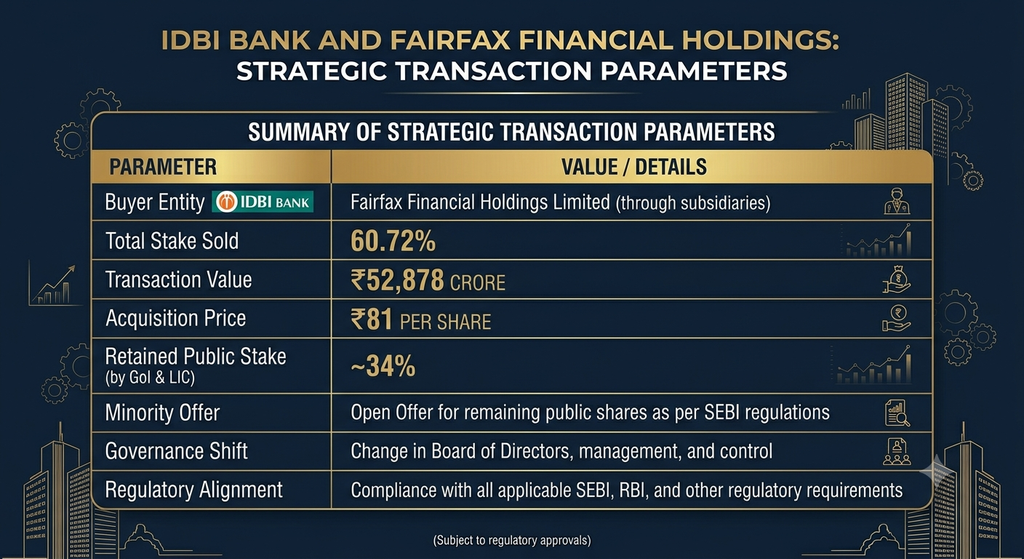
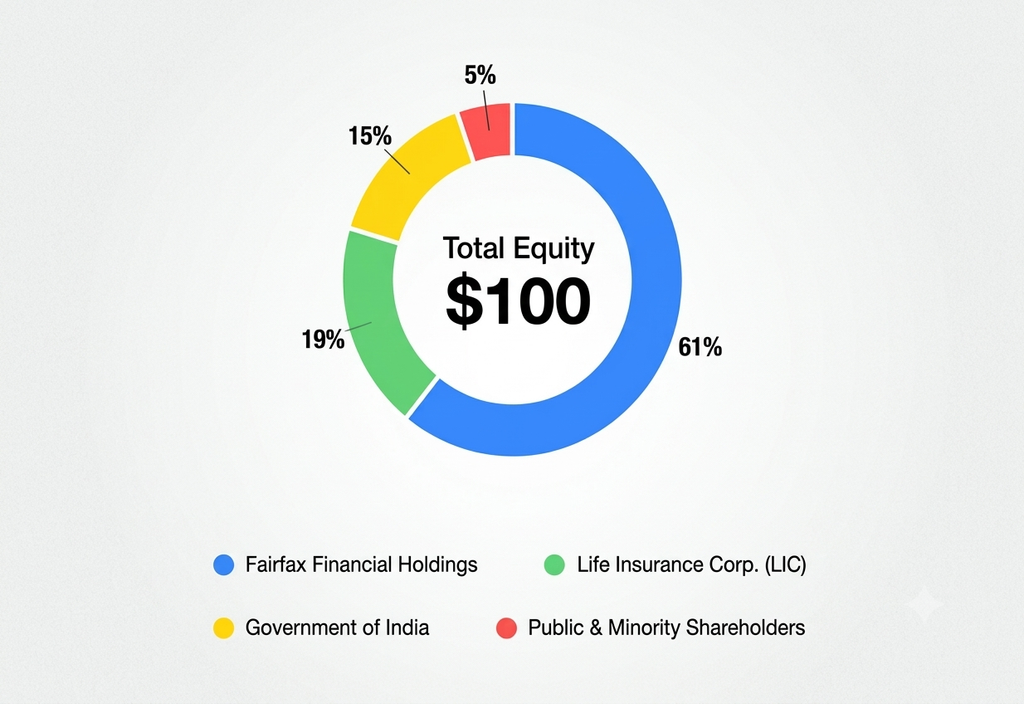
CCEA has approved the sale terms on 14th October 2026. Post stake sale the shareholding will be as under:
This completes the story of one of the biggest government sales in financial industry. However, the sale is not free from various unanswered questions like:
- Why has the price been fixed at Rs. 81/- when market price is above Rs. 81/- most of the time in the last 6 months?
- What was the need to select Fairfax when as per SEBI, a foreign entity cannot hold controlling stake in 2 Indian companies and Fairfax already holds a controlling stake in Catholic Syrian Bank (CSB)?
- Why have no details been made public so far regarding treatment of employees to address the concern of the trade unions?
- Why sell the bank after doing all hard work of reviving it?
- IDBI is a landmark banking asset, why to hand it over to a foreign entity?
- Why not treat IDBI Bank like other public sector banks and involve it in the proposed merger process.
The sale is expected to take place before 31st March 2027 and we hope that a clear answers and a roadmap shall be available before the public by that time.
Impact on stakeholders:
| Stakeholders | Impact |
| Depositors | No impact. All deposits will be covered under DICGC for Rs. 5 lakh as in case of other banks. |
| Borrowers | No impact. All loans will continue as it is. |
| Employees | May have an impact. At present although IDBI Bank is classified as private bank, due to LIC shareholding of 51% and government shareholding of 45%, the bank has PSU type polices and systems. Post sales, the bank may treat its employees as per the norms in private sector. |
| Public shareholding | May get an offer for sale from Fairfax. |
| Regulator | No impact. The new bank will be governed by RBI as any other private bank. |
| Government | May have an impact as government is going to lose its control and a foreign entity will deal the matters on business considerations rather than favouring national priorities. |
Final thoughts:
IDBI tells the story of a complete lifecycle of an organisation. From a development bank that left its imprints across the national economy, to a commercial bank struggling with bad assets and losses, followed by a turnaround and finally, its sale to a foreign entity. Government has also demonstrated that, if it wills, it will not allow a national asset to fall. It has displayed as how a stressed balance sheet can be converted to a valuable global investment asset. However, the entry of Fairfax at such a significant level does raise some concerns and will be a litmus test for such sale of assets in future.
Readers can also read PSB Confluence 2026: Do Public Sector Banks Really Need to Become “Cool”? – At Silly Point
Frequently asked questions
About the Author
Please refer the about us page @ About us new – At Silly Point
Disclaimer
Please refer the disclaimer page @ Disclaimer new – At Silly Point
Discover more from At Silly Point
Subscribe to get the latest posts sent to your email.