

BLOG 31/2026 DATED 05TH MAY 2026
ECL (Expected Credit Loss) is an accounting concept under IFRS 9 to estimate the probable future losses from loans or financial assets due to default as against the actual incurred loss method/Standard method adopted in the present accounting system.
What is ECL:
In simple terms, it is How much money might the bank lose on a loan, considering the chance the borrower won’t pay?
RBI in its circular dated 27.04.2026 defines ECL as . “Expected credit losses are a probability-weighted estimate of credit losses, measured over the relevant time horizon of the financial instrument”.
Components of ECL:
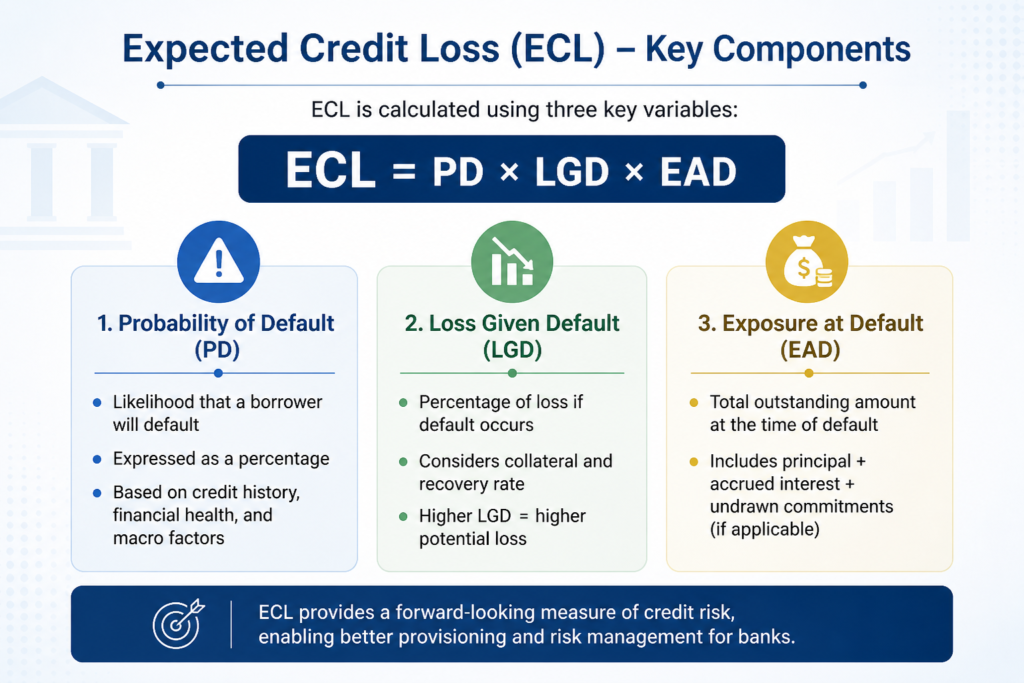
ECL is calculated using three key variables:
- PD (Probability of Default) → likelihood the borrower defaults
- LGD (Loss Given Default) → % of loss if default happens
- EAD (Exposure at Default) → total amount outstanding at default
Probability of Default:
The chances that the borrower will default from the payment terms. Normally bank calculates it on the basis of the historical data available. In simple terms if you give loan to a person and you are sure to the extent of 90% that he will comply and not default in payment. Then the PD will be 10% or 0.10.
Loss Given Default:
This shows the percentage of loss happening in the event of a default. Now suppose the same person where probability of default was 0.10 defaults. You have to assess basing on the information available to you that what amount of money you can recover, if default happens. Let us assume you are sure that even if default happens you will recover at least 70% of the amount. This means that your LGD is 30% or 0.30.
Exposure at Default:
How much is your exposure that is at risk, if there is default. Here one thing to be considered that if the exposure is Non Fund based say commitment, guarantee etc, you have to arrive depending upon your expertise the amount of Exposure. RBI has allowed to use CCF (Credit Conversion Factors) till the time that expertise is not acquired.
Simplified example:
Suppose you give a loan of Rs. 1,00,000 to a borrower. Let us calculate the ECL.
PD : As per your expertise you know that there are chances of 10% default. This can be found from the exposures in the similar category and defaults in those categories.
LGD : As per your expertise you know that you can recover around 80% of the expected receivables. LGD will be 20% of 0.20.
EAD: You have given a loan of Rs.1,00,000 hence EAD on day one will be 1,00,000.
ECL = 0.10*0.20*1,00,000
= 2,000/-
In this case you have to provide for Rs. 2000/- from day one, even without any default.
Here we have used term ‘as per your expertise’ because with the latest directions of RBI, banks are expected to develop their own models to arrive at such calculations and get the values on these models.
Stages of ECL:
There are three stages depending on credit risk:
- Stage 1 (Performing assets)
- 12-month ECL
- Only defaults within next 12 months considered
- Stage 2 (Increased credit risk)
- Lifetime ECL
- Covers entire life of the loan
- Stage 3 (Credit-impaired)
- Lifetime ECL + interest calculated on net basis
Banks have to develop their own models to identify the type of ECL depending upon stages. However, any exposure with 30 days past due has to go to stage 2 unless there is a clear reason for not to do so. Credit impaired (NPAs) shall be a part of Stage 3 ECL.
Reserve Bank of India has issued the circular on 27th April 2026 making the ECL based provisioning in Indian banks effective from 1st April 2027.
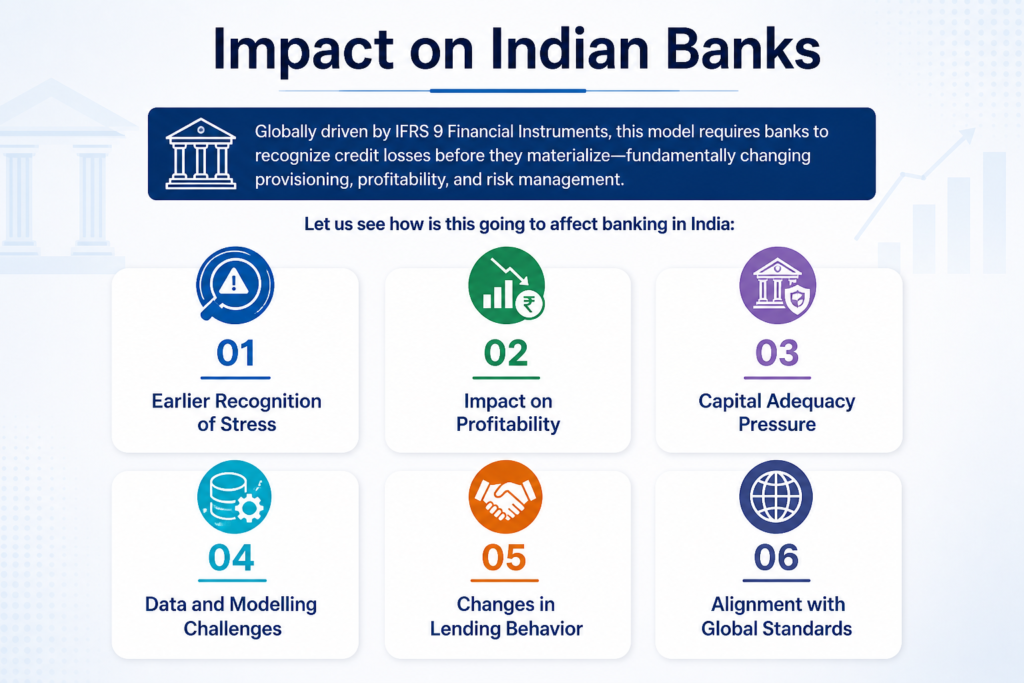
1.Earlier Recognition of Stress
Traditionally, Indian banks recognized stress after loans turned NPAs. ECL requires anticipation of stress, which can lead to:
- Higher initial provisions
- Reduced “hidden risk” in loan books
- Better transparency
2. Impact on Profitability
ECL tends to increase provisioning levels, especially in volatile economic conditions. For Indian banks, this implies:
- Lower reported profits in the transition phase
- Increased earnings volatility due to macroeconomic assumptions
- Greater sensitivity to sectoral risks (e.g.,Agri)
3. Capital Adequacy Pressure
Higher provisions directly affect retained earnings and thus capital buffers. Banks may face:
- Pressure on Capital to Risk-Weighted Assets Ratio (CRAR)
- Need for capital infusion
- More Tier I & Tier II bonds in the market.
4. Data and Modelling Challenges
ECL is heavily data-driven. Indian banks face challenges such as:
- Difficulty in building robust PD, LGD, and EAD models
- Integration of macroeconomic variables (GDP growth, inflation, etc.)
This necessitates significant investment in analytics and AI, Risk modelling infrastructure and skilled workforce.
5. Changes in Lending Behavior
Banks may do more robust credit and risk assessment as provisioning will be carried out on expected loss basis. This may result into better asset quality, however in case of industry not able to meet the standards, it may also result into restricted credit outflows.
6. Alignment with Global Standards
Adopting ECL aligns Indian banks with global best practices, improving:
- Investor confidence
- Comparability with international banks
- Access to global capital markets
Adoption of global standards will further help Indian Banking Industry to spread operations in other countries bringing synergy for Indian Industry and banking domain.
Challenges in the Indian Context
- Despite its benefits, ECL implementation in India is not without hurdles. Not only in India but even in other countries as well, a model based provisioning may not be suitable for an economic volatile environment, like the one we are facing due to US/Israel Vs Iran conflict.
- Further, the approach is tech driven and involves cost. To what extent banks will be able to adapt to the new system is yet be seen.
- A mass of banking exposure is in Agriculture sector which is still dependent on the unpredictable climatic conditions. It will be a challenge for the ECL model to capture such sensitivity.
- In the event of downturns, there are chances of over provisioning.
Conclusion
The Expected Credit Loss framework represents a paradigm shift from reactive to proactive risk management. For Indian banks, it introduces short-term pain in the form of higher provisions and operational complexity. However, it also offers long-term gains through improved transparency, resilience, and global alignment.
In order to avoid the teething troubles and unpreparedness of banks, it is advisable that IBA or RBI may initiate development of ECL model for the industry itself. Bank level adjustments may be done depending upon the size and operations of banks. This need to be done to strengthen the system and to counter the cost, competency issue
As the Reserve Bank of India continues to refine regulatory expectations, ECL is set to become a cornerstone of India’s banking risk architecture—reshaping how banks lend, provision, and manage uncertainty in an increasingly dynamic economic environment.
FREQUENTLY ASKED QUESTIONS (FAQ)
About the author: The author of the Blog, Sayed Azhar Hasan, is a CFA (ICFAI), MBA, PGDIBF (Islamic Banking and Finance), ex banker with 29 years of banking experience and a management educator.
On social media:
LinkedIn : Sayed Azhar Hasan | LinkedIn
You Tube: Sayed Azhar Hasan – YouTube
Disclaimer: The information provided in this blog is for educational and informational purposes only and does not constitute professional financial, legal, or regulatory advice. While efforts have been made to ensure accuracy based on the RBI circular dated April 27, 2026, readers should consult official Reserve Bank of India (RBI) guidelines and professional advisors before making business or investment decisions. The views expressed are those of the author and do not necessarily reflect the official policy of any banking institution or regulatory body.
Discover more from At Silly Point
Subscribe to get the latest posts sent to your email.
The concept is narrated in simple words .
As most the banks in India have a CRAR of 16 to 17% , the potential impact may leave the banks CRAR much above the regulatory requirement.
The article brings clarity to the reader.
Appreciated 👍
thank you