
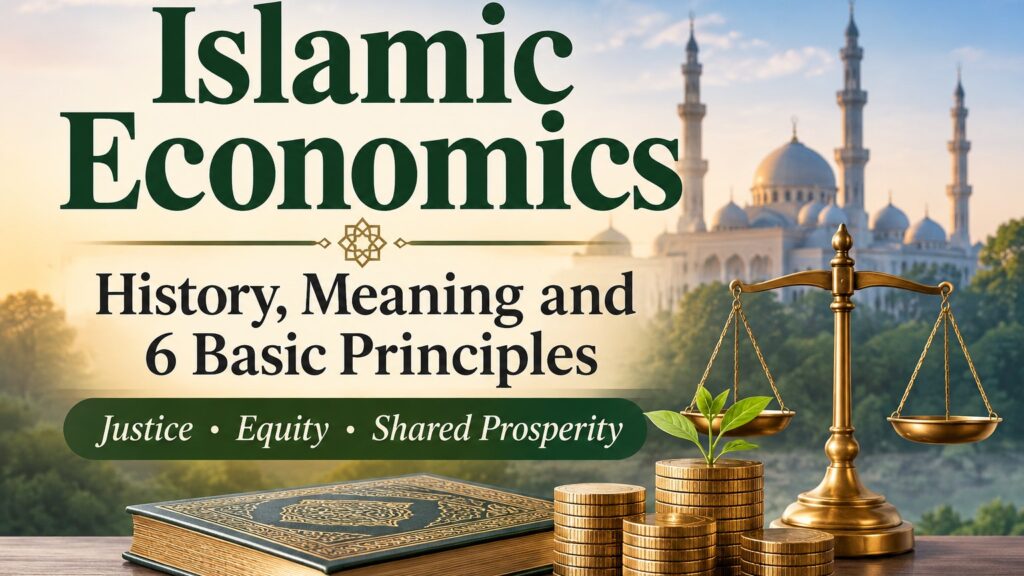
BLOG 62/2026 dated 9th November 2026
Islamic Economics sounds relatively new term in the vocabulary of present-day financial gurus as we are used to the word ‘Islamic banking’ as an alternative banking system that emerged in the Middle East sometime in the 1970s. However, long ago Islamic Economics had already stamped the financial arena by offering the principles that are based on Justice, Equity, Cooperation and society building rather than Growth, profitability, Competition and Capital building. None of the concept is better or worse than the other. It depends upon what type of the world we desire to see. Let us explore the history, and the basics of Islamic economics with reference to modern world.
Genesis of Islamic Economics:
Islamic economics and financial system find its roots in Qur’an and hadeeth along with the sunnah of the prophet Muhammad (p.b.u.h). The concepts of distribution of money through Zakat which is one of the five principles of Islam finds a very prominent place in the Qur’an. In addition to zakat, the concept of spending money on social causes has been stressed upon in several places. Zakat and charity have been defined as a ‘Loan to God’ to encourage people to voluntarily come forward for public expenditure.
“Who is the one who would give Allah a good loan…….” Al Qur’an – 2:245
We need to remember that such system was promoted when there was no formal system of governance and taxes, except a few developed civilisations viz Roman, Persian, Indian and Chinese. In addition to zakat and charity the law of inheritance is also explicitly mentioned in the Qur’an. It was ensured that the property left by people is neither wasted nor misutilised. The distribution of property was restricted to the family members only barring some exceptions. In addition to the above, the system of Waqf also finds its roots in the practice of charity. Waqf deals with voluntary giving of ones’ assets for specific charitable purposes. This is normally applied in the case of fixed assets or recurring incomes generated from that asset. Other than the spending, people were encouraged to avoid miserliness as well as extravagance, creating a balance between the two to achieve a balance in spending.
“And do not keep your hand tied to your neck, nor extend it to the full extent, lest you should be sitting reproached, empty-handed.” Al Qur’an – 17:29
Along with the concepts of charity and distribution, a few financial transactions were thoroughly prohibited. Most elaborate ban was imposed over Riba (Usuary or interest in the modern terms). A few other things that were either banned or discouraged were gambling, excessive risk taking, breach of contractual terms etc. The combination of these directions and practices ensured that the flow of money is continued and hoarding was thoroughly discouraged. All this happened in the 7th century when Islam was in the process of building a society. These principles were carried forward initially through recordings of hadeeth i.e sayings of the prophet and then through the magnificent scholars of medieval period viz Abu Hanifah, Al Ghazali, Ibn Sina etc.
Islamic Economics in the modern world:
I have deliberately skipped the medieval period, often referred to as the Golden Age of Islam, when along with the other disciplines, Islamic economics also strengthened its roots and introduced many concepts like bills of exchange, partnership etc. Islamic Economics could successfully establish itself somewhere between capitalism and socialism. Some of these concepts were adopted by Europe through cultural assimilations. However, with the advent of industrial revolution and fall of the great kings and rise of British empire, the concepts of Islamic economics gradually diminished. A system that provided a balance between capitalism and socialism was lost between the battle of the two. However, with the discovery of oil in south west Asia, the economic significance of these nations increased. Saudi Arabia, UAE, Iran, Iraq and other neighbouring countries started becoming the economic hub of the developed US, Europe and more recently China and Japan. Along with these developments, it became necessary to take along the cultural requirements of the people at large. This gave birth of modern Islamic banking. Islamic Banking is not the total Islamic Economics, however the acceptance of the Islamic Banking products beyond South West Asia viz in UK, US, Malaysia, Singapore, Indonesia etc once again provided a window to the concepts of Islamic Economics.
Basic Principles of modern Islamic Economics:
What took root in the 7th century started defining the principles for complex modern financial problems. Though unique and still in its infant stage, these principles present a school of thought capable of providing solution to many modern problems. Basic principles of the modern Islamic Economics can be understood as follows:
Absolute ownership vs trusteeship:
The owner of an asset is only the trustee of that asset as the absolute ownership belongs to God. This may appear to be more theological than economic. However, this leaves a basic behavioural understanding that every property earned by an individual and state also belongs to the public at large and more importantly the the natural environment. The owner cannot boast an absolute ownership of the asset. Its proper distribution is the responsibility of the owner of the asset.
Growth should not harm God’s creation:
Economic growth of individuals as well as the state is encouraged in Islamic Economics. However, this should not result in the widespread destruction of environment and natural set up. Protection of environment becomes an integral part of the growth. The concept of ESG in the modern economies resembles this approach. ESG stands for Environment, Society and Governance. If we cut a number of trees to build a factory, the loss of environment must be recompensed at some other place or in some other form.
Economics and ethics are not separate:
Normally in a scholarly activity, special focus on ethics is missing. However, Islamic Economics ensures that ethics, morality does not sit at the back bench and is not considered as theory only. The ethical concepts introduced through the classical Islamic teachings are all intact as part of modern scientific study. It is not restricted to economics but is prevalent every field of study. Probably this represents a variation from the conventional economics. Though conventional economics also focuses on ethical issues, the real target remains economic usage of resources and growth. However, in Islamic economics the concept rest at ethical usage of resources and justice.
Equity not Equality:
Islamic Economics does NOT believe in equality, but in equity. It promotes the concept of risk and reward. Every individual needs to be rewarded according to the efforts, risk and intelligence put forth in a venture. It does not profess that people have to live a similar standard of living. It recognises that reward should come in proportion to the efforts. However, an exception to this rule is the provision of support to needy and incapable.
Balance between entrepreneurship and capital:
It establishes a balance between the reward on capital and entrepreneurship. It is due to this reason that fixed returns on capital investments in the form of ‘Interest’ is absolutely prohibited. Interest rates provide a cover to protect the return on capital while leaving the return to the entrepreneur open to risk. Islamic system of profit sharing ensures a balance between the two.
Asset behind every financial transaction:
Islamic economics give precedence to the overall growth of the economy rather than growing simply in the terms of money. In other words, one person gaining at the expense of another without any overall gain to the society. It is due to this principle that gambling is prohibited. Modern Islamic economists and bankers therefore ensure asset creation behind every financial venture.
Conclusion:
It is not that these principles are unfamilier to economic scholars in modern economics. However, probably the sheer weight of higher profit generation and growth of capital and defined national priorities have made them think in a different manner. In fact, even the highly Muslim populated countries too have failed to stick to the principles of Islamic economics. As the world moves towards the choice-based systems, we can expect the people choosing ethical alternatives for the benefit of all instead of relying solely on growth and profitability indicators.
Readings:
https://dergipark.org.tr/en/download/article-file/2336559
A History of Islamic Finance traces orgins to modern form.
Readers can also read living and giving – At Silly Point
Frequently asked questions:
About the Author
The above blog is authored by Sayed Azhar Hasan; an independent Financial Analyst and holding a Post Graduate Diploma in Islamic Banking and Finance. For further details, please refer the about us page @ About us new – At Silly Point
Disclaimer
This article presents an independent, educational perspective on Islamic Economics. It is intended for general information and discussion and should not be treated as a religious ruling or financial advice. For detailed disclaimer, please refer the disclaimer page @ Disclaimer new – At Silly Point
Discover more from At Silly Point
Subscribe to get the latest posts sent to your email.