
BLOG 51/2026 DATED 6th SEPTEMBER 2026
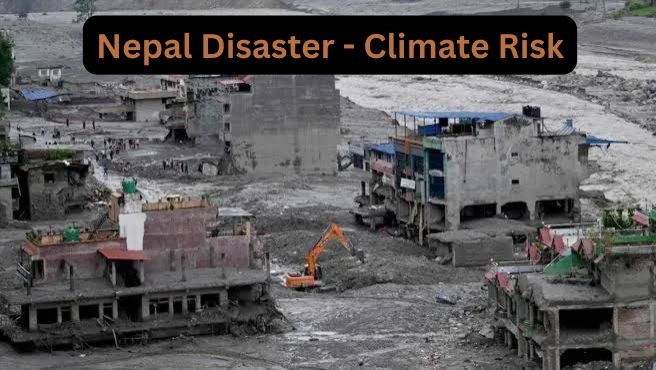
1344 persons killed and 5000 missing, our devastated tiny neighbour Nepal, is struggling to come to terms with the climate risk that is beyond anyone’s assessment. Himalayas a massive protective rock turned its fury on the innocent lives and properties. The ice wall and the peaceful landscape has become a massive killer. But who is to blame and how to manage such climate risks? Today it is Nepal, tomorrow is can be India. Are we ready?
The catastrophic flash floods and landslides that recently swept through Nepal’s mountain valleys were a terrifying wake-up call. A wake-up call for the entire world and the policy makers who take the climate risk as jest. Entire villages were buried under mud, concrete bridges snapped like twigs, and over a thousand people lost their lives, injured within no time. Out of the many killed and missing, hundreds are from other countries viz India and China.
In the fallout of this tragedy, something surprising happened. Instead of simply asking world leaders for charitable disaster relief, Nepal pointed a finger at the world’s biggest economies: the United States, China, and India. Nepalese leaders are arguing that this wasn’t just a natural disaster—it was a human-made crisis caused by heavy polluters, and those polluters should pay for the damage. However, later backtracked from such approach duly considering their vulnerable condition.
What Actually Happened in the Mountains?
To understand why Nepal is angry, it helps to look at why these floods were so unusually destructive.
“Climate models and some observational studies show that, as climate warms, elevated surfaces tend to warm more rapidly than non-elevated surface. This elevation-dependent warming (EDW) suggests that the impacts of a changing climate will be amplified for elevated surfaces, with implications for societies and ecosystems in mountainous regions as well as for glaciers and meltwater runoff”
WCD – Elevation-dependent warming: observations, models, and energetic mechanisms (European Geosciences Union)
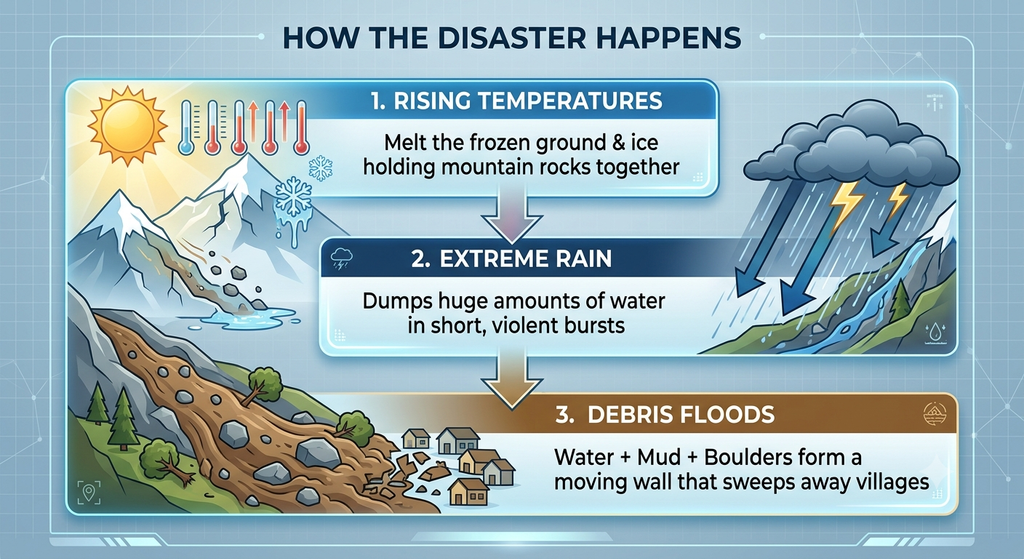
It starts with a phenomenon called elevation dependent warming. Mountain ranges warm up much faster than flat, coastal areas. As temperatures rise in the high Himalayas, two dangerous things happen at the same time:
- The Melting: High up in the mountains, frozen ground and ice act like natural concrete, holding massive rocks. When temperatures rise, this ice melts. Mountain walls lose their structural support and crumble, creating massive rockslides.
- Rainfall is Becoming Explosive: Warmer air holds more moisture. Instead of gentle, steady rain spread out over a long monsoon season, warmer skies dump massive amounts of water all at once in short, intense bursts—often called cloudbursts.
Why Nepal blames the US, China, and India?
Nepal is one of the few countries who produces almost zero percent of the world’s greenhouse gas emissions. Yet, its people are paying the highest price for a warmer planet. This fairness gap—what experts call “climate justice”—is why Nepal is holding three specific nations responsible.
1. The United States: The Historical Polluter
Even though China currently produces more pollution each year, carbon dioxide stays in the atmosphere for hundreds of years. The heat trapped over the Himalayas today is largely the result of smoke and emissions built up over the last century. Because the US was the driving engine of the industrial world for over 100 years, it has put more total carbon into the sky than any other country in history.
2. China: The Heavyweight Neighbour
China is currently the world’s biggest yearly emitter of greenhouse gases. Because China sits right on Nepal’s northern border, its industrial activity has a direct physical effect on the regional climate. Polluted air and rising warmth cross the border directly, heating up the glaciers shared by both nations.
3. India: The Nearby Industrial Powerhouse
India is rapidly expanding its economy and factories to lift millions of people out of poverty. But as Nepal’s neighbour from all sides except north, India’s massive coal power plants and regional air pollution directly affect the local weather in Nepal.
Who are the Top polluters?
Here is the list of top 10 countries emitting carbon that can be the prime reason for such catastrophic events.
| Country | Emission (megatons) |
| China | 13125 |
| US | 4632 |
| India | 3154 |
| Russia | 2009 |
| Japan | 972 |
| Iran | 829 |
| Indonesia | 812 |
| Saudi Arabia | 653 |
| South Korea | 588 |
| Germany | 580 |
CO₂ Emissions by Country 2026 (World population review)
Compared to these world pollutants, Nepal generates only 16 megatons of CO2 constituting 0.08% of the world emission.
India, however has a defence that its per capita emission of Co2 is still much lesser than the other economies due to the huge population. Further, India has to feed 1/6th of the total world population and for that it has no other option but to expand its industrial canvass. China argues that it is still technically a developing nation. Chinese leaders point out that Western countries caused the problem first over the last 150 years, so rich Western nations should pay the bill today. The US agrees that climate change is a critical threat, but refuses to accept formal liability or legal blame. US officials fear that agreeing to pay compensation would open the door to endless lawsuits from every country hit by bad weather. Instead, they prefer providing voluntary aid money.
Are we still serious?
| Year | Carbon emission (billion tons) |
| 2000 | 25.50 |
| 2005 | 29.60 |
| 2010 | 33.30 |
| 2015 | 35.40 |
| 2020 | 35.20 |
| 2024 | 38.60 |
CO₂ emissions | Our World in Data
The above data clears the seriousness, the world economy has bestowed to climate risk. Barring the period 2015-2020, in all other periods the carbon emissions have increased. The block of 2015-20 saw a marginal decline that was mainly attributed to Covid attack. This shows that we have to do a lot more than what we are actually doing to counter climate risk.
Moving From Charity to Compensation
In past decades, when a developing country suffered a storm or flood, rich nations sent aid workers, tents, and food packages. By blaming top 3 polluters, Nepal has given a statement that they do not need charity, they need compensation. Nepal has made an attempt to change the dynamics of how we see climate risk and its effects. However, Nepal has not stated such demand further, an indication that it will not pursue the path of conflict.
Through new UN programs focused on Loss and Damage, vulnerable countries are demanding dedicated financial funds as a matter of right, not pity. The logic is simple: if a factory’s waste output spills chemicals into your backyard and destroys your garden, you don’t ask the factory owner for charity—you ask them to pay for the clean-up.
The tragedy in Nepal is an early preview of what the world will face as the planet grows warmer. The climate risk is on its way to take the monetisation path rather than simple aid model.
The glaciers in the Himalayas feed the major rivers that supply drinking water and farming irrigation for nearly two billion people across Asia. If these ice reserves disappear, flash floods will eventually give way to severe water shortages across the entire continent. Nepal’s initial demand for accountability sends a clear message to world powers: climate disasters can no longer be brushed off as unpredictable acts of nature. They are connected directly to choices made in distant capitals, and the nations suffering the consequences are no longer willing to stay quiet.
Should UN create a Climate Risk Management fund and the countries contribute in the ratio of their carbon emission?
Carbon Footprint by Country 2026: Global Rankings & Data
Check the related blog at sillypoint : Climate Risk Explained: How Climate Change Threatens Banks, Businesses and the Economy – At Silly Point
Frequently Asked Questions
About the Author
Please refer the about us page @ About us new – At Silly Point
Disclaimer
Please refer the disclaimer page @ Disclaimer new – At Silly Point
Discover more from At Silly Point
Subscribe to get the latest posts sent to your email.