
BLOG 35/2025 DATED 10TH DECEMBER 2025
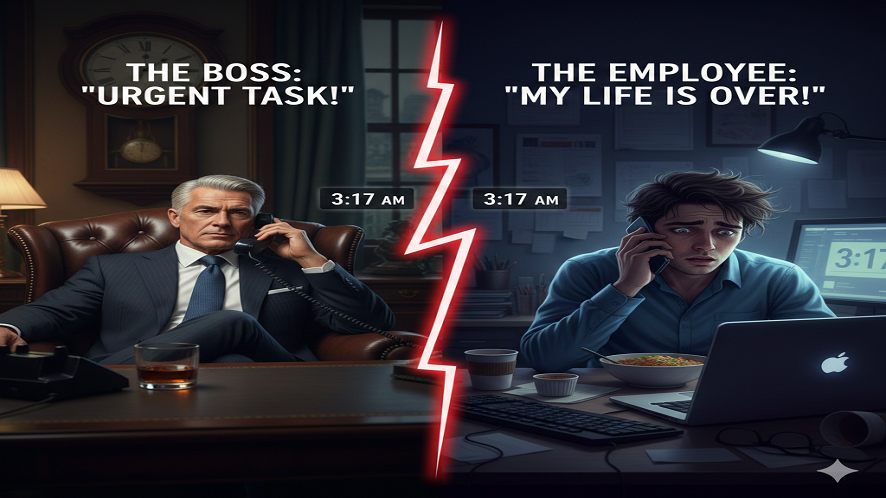
It is 11.30 PM on a Saturday winter night in a U.P town and temperature freezing at 6 degree, here rings the mobile phone of a senior Bank executive who lives alone in a rented apartment and heads a critical region. Oh it’s a group WhatsApp call from the controlling office. The General Manager and his deputies are connected and other heads of the region getting connected all in night paijamas and some in woolen monkey cap as well. Executives form the controlling office start discussion after a customary sorry and it continued for around ½ an hour seeking all the regional heads to make their teams work on Sunday as it is the end of quarter the next day and a last push effort is needed. Meeting ended with a grand YES SIR from all regional heads.
The above is a real instance and not the only instance in the Corporate world today where the management expects employees to work and get work done in odd hours/holidays etc. Specially in India, in the recent past, we have seen employees succumbing to work pressure.
On the other hand, it is argued by none other than Mr Narayana Murthy that today’s generation should work 70 hours a week if we want our nation to be at par with the developed nations. Needless to say, that growth and development demands sacrifices and extra efforts from the workforce in today’s competitive world. If work remain time-bound, can we grow with the pace it is desired.
In the above two polar positions, Indian Parliament saw a private bill placed as Right to Disconnect, that enables employees not to respond to the calls of the employer/boss/management after office hours or after agreed hours. As bill has been placed as a private bill, that too by a member of the opposition, it is far from seeing the light of becoming a bill. Even if the bill is passed, much is not going to change until, we understand that a person has certain personal commitments too and he/she need some personal time alongwith another fact that an organisation can not sleep, it has to be vigil and active 24 hours.
Culture is better than law:
An inclusive work culture where the employees understand the need of their organisation and ready to perform accordingly, but Organisation never push them to do extra job. It has to cut both ways to get a positive result. Making a law is not going to help as we can see many rules not being followed or they are only on paper to keep the records update. Take the example of 10 days mandatory leave in a year in the Banking Sector. RBI provides for 10 days mandatory leave for designated employees in banks. In practical, even if the mandatory leave is continuing the employees are asked to join without record or many a times employees themselves are joining but not lodging the attendance, failing the entire purpose of mandatory leave. On the other hand, if we are able to inculcate a culture of confidence and understanding and organisational goals are aligned with the personal desires of employees, no law will be required. Even if a law is there, it will be applied in true letter and spirit.
Inefficiency at both levels:
Inefficiency is another culprit for such late hour’s culture. Inefficiency can happen at both level management as well as employees. An employee who is inefficient for a job will take more time to complete it than desired, resulting into late hours sittings and also unwarranted calls even after office hours. On the other hand, poor planning and execution model of the management may also result in such awkward situation when employees have to work more than required timelines. Duplicity of work is another reason that causes inefficiency and slow outcomes. Management needs to identify where the inefficiency lies and then take corrective steps to avoid the undesirable communications.
Right to disconnect can be actually implemented by organisations with or without law, if we can implement a few things as under:
- Robust HR assessment and placing right person on the right place where the abilities of the employees should meet the requirement of the organisation. An elephant can’t be asked to climb a tree.
- A formal time schedule and agreement between the employees’ representatives and the management.
- Online vigilance on persons working beyond working hours and encouraging them to leave early. An employee consistently working beyond scheduled hours depicts either his/her inefficiency or extra workload. In both the situations, HR has to act accordingly.
- There can also be a ‘No disturbance window’ that management can decide themselves.
- Due rewards for those who perform and deliver results by way of recognitions, incentives, promotions etc.
- Emergency situations should be kept out of any rule and employees should be expected to respond. However, emergency should not become a norm.
If the above is ensured, Right to Disconnect can be implemented in its true sense, otherwise even if the bill is passed, it will only be in letter and not in spirit.
Discover more from At Silly Point
Subscribe to get the latest posts sent to your email.
These points if implemented will definitely help employees to maintain work life balance and with increased efficiency will boost organisation’s efficiency.
Yes definitely