
BLOG 63/2026 dated 15th November 2026
YES Bank issued Additional Tier 1 (AT1) bonds during 2016 and 2017 to strengthen its capital base. The bonds were well received by investors, and the issues were fully subscribed. After all, they offered attractive returns of 9.50% and 9.00%, respectively, which were significantly higher than the fixed deposit rates normally offered by banks. Yes Bank was then a budding private sector bank, giving serious competition to both private sector and public sector banks. Its balance sheet reflected strong growth in both the top line and the bottom line. The AT1 bonds further strengthened its capital base. As part of a robust corporate sales strategy, these bonds were marketed at both branch and corporate levels. Yes Bank’s marketing team and field staff actively and aggressively promoted these instruments.
However, Yes Bank subsequently witnessed a major downfall, marked by misgovernance, mounting losses, restructuring, a change in management and, eventually, revival. The bank has come a long way and has once again managed to stand on its feet. Credit goes to the RBI, SBI and other financial institutions that came forward to rescue Yes Bank. In the meanwhile, the AT1 bond investors suffered an unprecedented setback when the new management decided to write down these bonds in their entirety. This resulted in enormous losses for investors, many of whom were retail investors. The matter eventually reached the High Court and, subsequently, the Supreme Court for judicial intervention.
Let us delve into this story of ‘Paradise Lost and Paradise Regained’ for Yes Bank’s AT1 bond investors.
What are AT1 Bonds?
Additional Tier 1 Bonds are capital instruments, introduced to Banking system through BASEL committee post 2008 reforms. Salient features of these bonds are as under:
- These are part of the Tier 1 Capital of the Bank.
- Bonds are unsecured in nature.
- It has perpetual maturity, i.e there is no maturity of these bonds.
- Issuer has the Call Option, i.e issuer can redeem the bond after specific interval but there is no obligation to mature.
- Interest is paid at regular interval at agreed rate.
- Interest is normally higher than the normal interest rates prevailing in the market.
- Issuer has the discretion to write off the principal or deny Interest payment if capital position is not comfortable.
- These bonds are normally listed in a stock exchange, hence provide liquidity.
Investors benefit from higher coupon rates and the possibility of selling the bonds in the secondary market. Banks, on the other hand, benefit because these instruments qualify as Tier 1 capital and thereby strengthen their capital adequacy position. Yes Bank issued AT1 bonds in 2016 and 2017 aggregating ₹8,415 crore, offering attractive coupon rates of 9.50% and 9.00%, respectively.
Writing down of AT1 Bonds:
Yes Bank’s gross NPA ratio touched approximately 18% during 2019–20, and several instances of misgovernance came to light. The bank was facing a liquidity crisis and a capital adequacy breach. The RBI swung into action and devised a reconstruction scheme to revive the bank. Under the scheme, SBI was to acquire a 49% stake in YES Bank’s equity capital. At this stage, the decision was taken to write down the AT1 bonds. The rationale was that reviving and managing YES Bank would be difficult if the burden of more than ₹8,000 crore in high-coupon AT1 bonds remained on its balance sheet. The RBI approved the reconstruction scheme, under which these AT1 bonds were written down and cancelled. The investors were informed of the decision. This resulted in a substantial loss of investment for the bondholders, many of whom were retail investors.
Investors approached High Court:
The investors appealed in High court of Bombay for reinstating these AT1 bonds on the plea that they had invested their life savings and bank never explicitly disclosed the risk of fully cancelling the bonds. Bank and RBI had the plea that their action was in compliance with the BASEL guidelines and also financially prudent. Another twist in the tale was an investigation by SEBI in the matter of mis-selling that established that the mis-selling was actually resorted to while marketing these bonds. Investors were not explicitly informed about the risk inherent in these bonds. Bonds were marketed like another high yielding deposit of the bank. This turned the waves in favour of investors and High court instructed the bank to reinstate these AT1 Bonds in 2025.
Yes Bank approached supreme court:
Yes Bank was not convinced by the decision of the high court and approached Supreme Court. Once again, the arguments before the court were financial prudence vs trust in the system. Finally, in 2026 Supreme court also decided in favour of trust in the system. Yes bank was instructed to reinstate the bonds and start interest payments. As on date Yes bank has appealed to SC for a review of the decision.
Yes Bank financials -then and now:
| Particulars | March 2020 | March 2026 |
| Yealy profit | (16418.02) | 3475.59 |
| CRAR | 8.50% | 15.30% |
| Gross NPA | 16.80% | 1.30% |
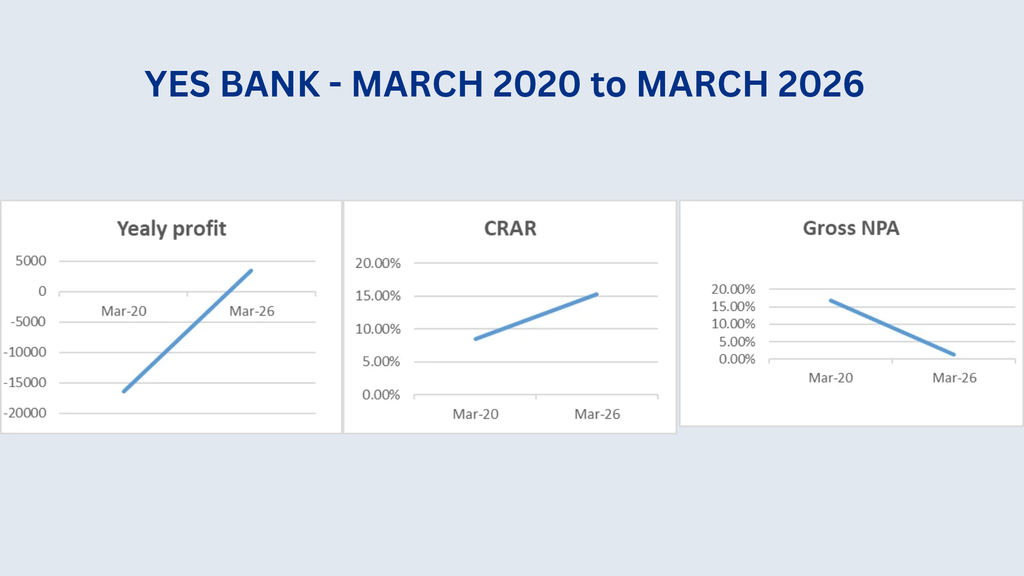
We can observe the difference in the financial position of the bank in 2020 and 2026. It shows the brilliance of the regulatory oversight and also the strength of the Indian banking system. However, it also displays a blatant disregard to the investors confidence and trust by cancelling the bonds.
Impact of the Supreme Court decision:
On Yes Bank:
- Capital adequacy will get a hit, however it may remain at above the minimum required level.
- Share prices may also take a hit.
- Interest outgo will impact the profits and dividends.
- As the financials have improved, Yes bank may be able afford the burden.
- Bank will look into seriously on the issue of mis-selling in other instruments as well.
On investors:
- Increased confidence in the entire financial system.
- Restart of the interest payments will be sight of relief.
- Bonds can be traded on stock exchange and hence the investors can get back their principal as well.
- Investors will be more cautious before investing in such instruments.
On regulator- RBI:
The regulator needs to re-think on the option of cancelling the bonds, in case of all future AT1 bonds issue. In case the bank is in financial difficulty, at best it can stop payment of interest for a limited period. Once bank starts earning profits, interest payment should start. AT1 bonds should also rank equal to equity. As an equity is never cancelled unless the company/bank is wound up, an AT1 bond should also not be cancelled. However, at present these bonds are issued as per the standards set by BASEL. This will leave an option to the investors to sell the bonds in secondary market even at a discount. The regulator’s job is not only to defend the bank and its financial structure, it has to also protect the rights of the customers and protect customer’s and investor’s trust in the system.
Conclusion:
YES Bank has once again approached the Supreme Court seeking a review of its decision, and we await the outcome. The entire episode surrounding YES Bank’s AT1 bonds offers several important lessons. It demonstrates how banks market their products, how investors sometimes commit substantial amounts without fully understanding the nature of the instruments, and how even a regulator may face limitations when it comes to protecting investors from losses arising out of the contractual and regulatory framework. It is important to acknowledge that neither the bank nor the RBI necessarily acted outside the applicable AT1 bond framework. Nevertheless, the episode highlights the need to examine the adequacy of disclosures, the responsibility of banks in selling complex financial products and the protection available to retail investors. Credit is due to the Bombay High Court and the Supreme Court of India for examining the matter from the perspective of investor confidence and the principles of fairness.
Ultimately, trust is more important than regulatory ratios, and the financial system is more important than any individual bank.
Readers can also refer to Yes Bank AT1 Bonds-Missing ethics? – At Silly Point
Frequently asked questions
About the Author
The above blog is authored by Sayed Azhar Hasan; an independent Financial Analyst. For further details, please refer the about us page @ About us new – At Silly Point
Disclaimer
This article presents an independent, educational perspective on AT1 Bonds. It is intended for general information and discussion and should not be treated as an opinion or recommendation on AT1 bonds or Yes Bank. For detailed disclaimer, please refer the disclaimer page @ Disclaimer new – At Silly Point
Discover more from At Silly Point
Subscribe to get the latest posts sent to your email.