
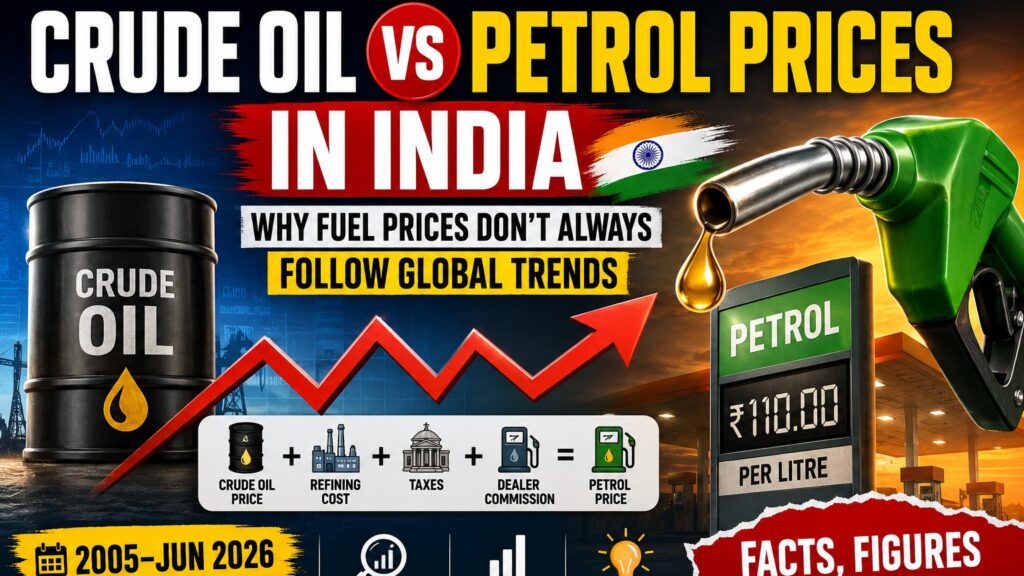
BLOG 38/2006 DATED 5TH JUNE 2026
Why Petrol Prices Matter in India?
Petrol prices in India are not just numbers on a fuel station board. They directly affect the daily life of the citizens, impacting food prices to transport cost and overall inflation. When petrol prices rise, everything becomes expensive. From vegetables transported from farms to cities, to online delivery charges, fuel plays a hidden but powerful role.
Since India imports its most fuel requirements, it is necessary to understand the relationship between international crude oil prices and petrol prices in India. It is a common understanding that petrol prices in India move exactly with global crude oil prices. Let us examine.
How Petrol Prices in India Are Determined
India imports more than 80% of its crude oil requirement. So naturally, international crude oil prices (mainly Brent crude) play a big role in determining the price of petrol that we are paying. There are various factors that affects the final petrol price paid by consumers. The chain of final petrol price and the international crude oil price constitute the following elements.
- Crude Oil Price
- Refining Cost
- Taxes by Central Government (Excise Duty)
- State Government VAT
- Dealer commission
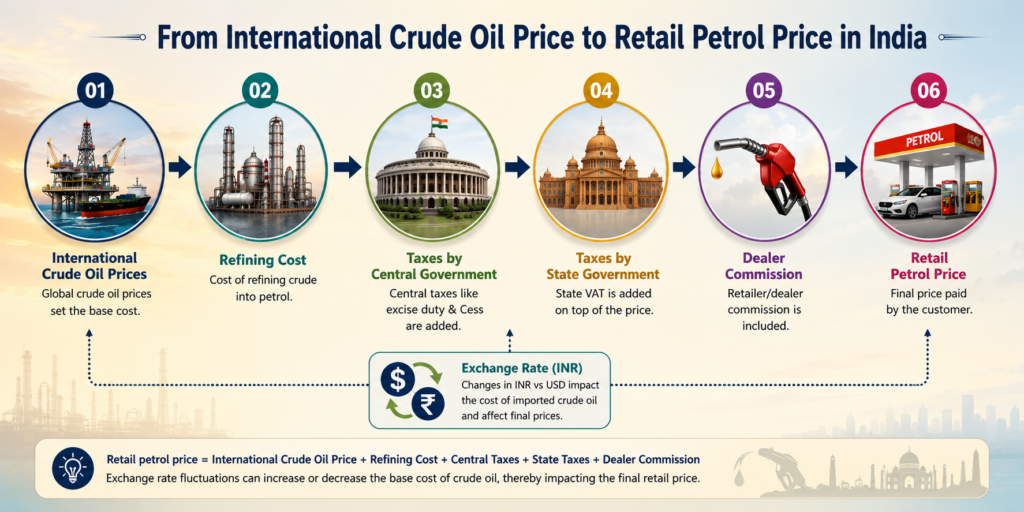
The chain of final petrol pricing tells that the retail Petrol price may or may not change even if the Crude Oil prices changes in the international markets. Further, the exchange rate becomes another factor that affects the final pricing. Specially, in the last few years due to drastic fall in the value of INR, pricing of petrol has also taken a toll. Once the international price increase or decrease, Government has to touch the other intervening nodes to manage the retail prices
Historical Comparison: Crude Oil vs Petrol Prices in India (2005–2026)
Let us now analyze the real data since 2005:
| Year | International Price of Crude Oil($/bbl) | Petrol Price in India(Rs /ltr) | % change in int prices | % change in indian market |
| 2005 | 48 | 38 | ||
| 2010 | 73 | 52 | 52.08% | 36.84% |
| 2015 | 47 | 61 | -35.62% | 17.31% |
| 2020 | 52 | 80 | 10.64% | 31.15% |
| 2025 | 72 | 105 | 38.46% | 31.25% |
| 2026 | 64 | 102 | -11.11% | -2.86% |
| Jun-26 | 96 | 110 | 50.00% | 7.84% |
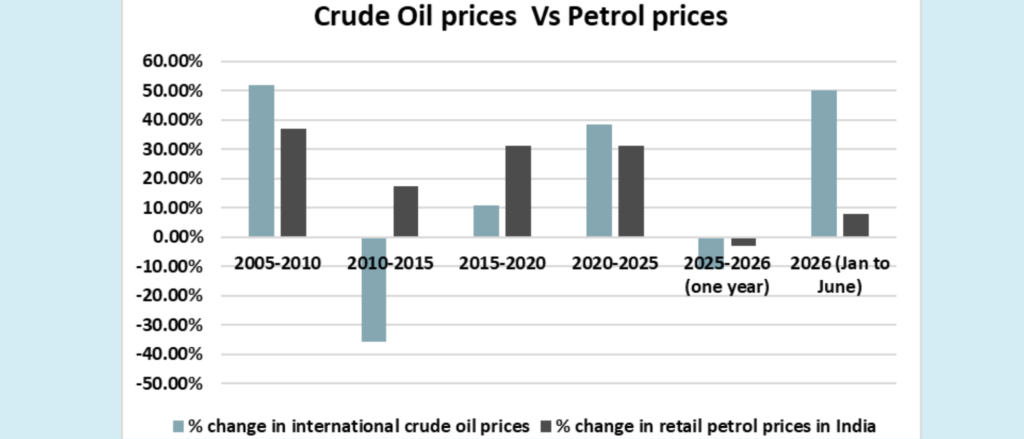
Phase 1: 2005–2010 (Strong Global Price Rise, Moderate Domestic Impact)
- Crude oil increased from $48 to $73 (+52.08%)
- Petrol in India increased from ₹38 to ₹52 (+36.84%)
Analysis
In this period, international crude oil prices rose sharply due to global demand and supply pressures. India also saw petrol price rise, but the increase was lower than global crude oil price growth. A part of global price shock was absorbed by the Government or at any other level of the chain but the effect on final consumer was minimised. The impact was managed at 36% against 52% price rise globally.
Phase 2: 2010–2015 (Global Crash, Domestic Price Still Rising)
- Crude oil fell from $73 to $47 (-35.62%)
- Petrol in India increased from ₹52 to ₹61 (+17.31%)
Analysis
This is one of the most important phases in this analysis. Crude prices continued to increase till 2014 before crashing in 2014 and 2015. Even though crude oil prices fell sharply in 2014 and 2015, the benefit was not passed on to the consumer. It is evident that the concessions given to the consumers were reversed during 2014-15. Government concentrated more on fiscal prudence rather than the consumer benefit. This phase saw a 17% increase in petrol prices even if the crude oil prices crashed in the international market.
Phase 3: 2015–2020 (Domestic prices again beat the International prices)
- Crude oil increased from $47 to $52 (+10.64%)
- Petrol in India increased from ₹61 to ₹80 (+31.15%)
Analysis
Even though crude oil increased slightly (10.64%), petrol prices increased significantly, again burdening the retail consumers much more than (3 times) the increase in actual crude oil prices. In the 15 years till 2020 the international prices increase was marginal i.e from $48 to $52 while domestic prices shot up sharply from Rs. 38 to Rs. 80. A part of this is contributed due to the falling value of Indian currency.
Phase 4: 2020–2025 (Volatility and sharp increase on both fronts)
- Crude oil increased from $52 to $72 (+38.46%)
- Petrol in India increased from ₹80 to ₹105 (+31.25%)
Analysis
During this period, global markets were highly volatile due to post-pandemic recovery and geopolitical tensions. India’s petrol price also increased steadily but slightly less than crude oil percentage growth. This was the period when we can see the domestic petrol prices moving alongwith the international prices.
Phase 5: 2025–2026 (Short-Term Correction Phase)
- Crude oil decreased from $72 to $64 (-11.11%)
- Petrol in India decreased from ₹105 to ₹102 (-2.86%)
Analysis
Crude oil fell significantly, but petrol price reduced only marginally, once again the trend of not passing benefit to consumers continued. Government stick to fiscal prudence than to consumer benefit. Upto the begning of 2026, Indian consumers have taken a hit of increase from Rs. 38 to Rs.102 in a period of 21 years as against the moderate price increase of international price from $ 48 to $ 64.
Phase 6: Jun-2026 (Sharp Crude Spike vs Moderate Petrol Rise)
- Crude oil increased from $64 to $96 (+50%)
- Petrol in India increased from ₹102 to ₹110 (+7.84%)
Analysis
This is the crisis phase where US-Israel Vs Iran war and disruptions due to strait of Hormuz closure caused a deep supply side crisis. At this occasion, Government has so far absorbed the international shock to a large extent. Crude oil increased by 50%, but petrol increased by only 7.84%. However, if we club the entire period, The crude oil has risen by 100% i.e from USD 48 to 96 while retail prices have jumped from Rs. 38 to Rs. 110 i.e approximately 189%.
Conclusion:
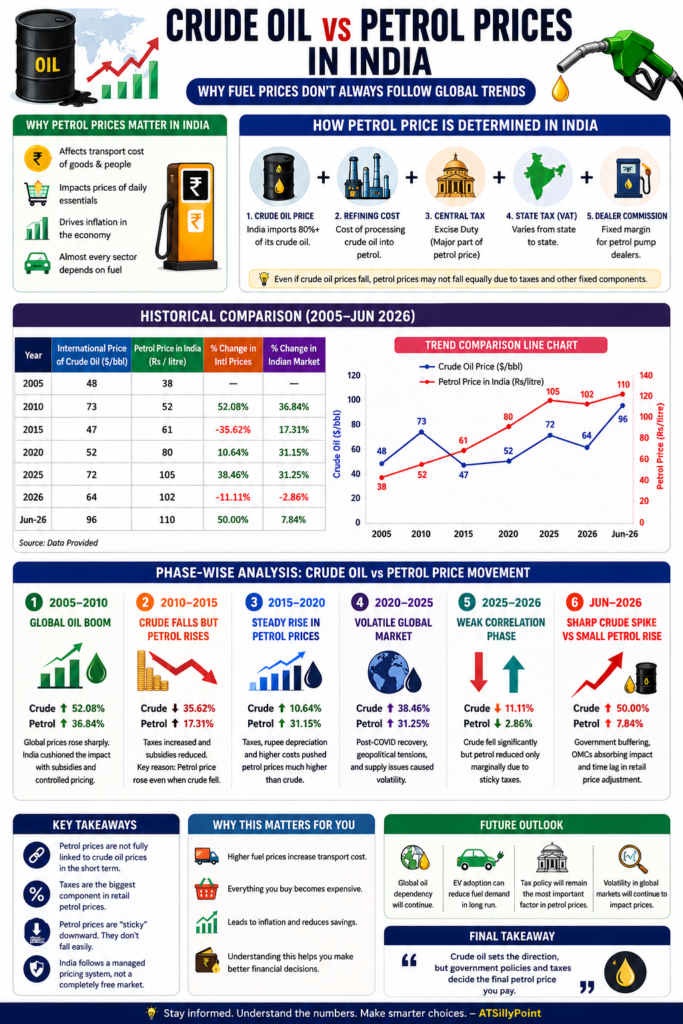
It is difficult call for the Government as petrol prices are basic price for many other commodities and its increase results in inflation and specially food inflation. It has already burdened the customers by around 189% increase since 2005 as against 100% increase in international prices. This makes a strong case for the consumers that Government should not increase the prices at least now, however it will be a very tough rope for the policy makers to take a hit at the budget or any other node of the chain of petrol prices. We can conclude that the International Crude Price may determine the direction but the magnitude depends upon the policy measures adopted by the Government of India.
Sources: Crude Oil Prices | Historical Chart | Data | 1946-2026
Petrol Price in India: Year-Wise History From 1947 to 2026
Readers can also refer to the blog at sillypoint on Strait of Hormuz and fall in rupees. Both these factors are affecting the prices of petrol in India : Strait of Hormuz – At Silly Point Falling Currency – At Silly Point
FREQUENTLY ASKED QUESTIONS
About the Auhor: The author of the Blog, Sayed Azhar Hasan, is a CFA (ICFAI), MBA, PGDIBF (Islamic Banking and Finance), ex banker with 29 years of banking experience and a management educator.
On social media:
LinkedIn : Sayed Azhar Hasan | LinkedIn
You Tube: Sayed Azhar Hasan – YouTube
Disclaimer: This blog is for informational and educational purposes only. The data regarding prices of crude oil and petrol prices in India is obtained from market available sources. This content does not constitute financial, investment, or legal advice. Readers should conduct their own research or consult a certified professional before making any decisions..
Discover more from At Silly Point
Subscribe to get the latest posts sent to your email.