
BLOG 42/2026 DATED 26TH JUNE 2026
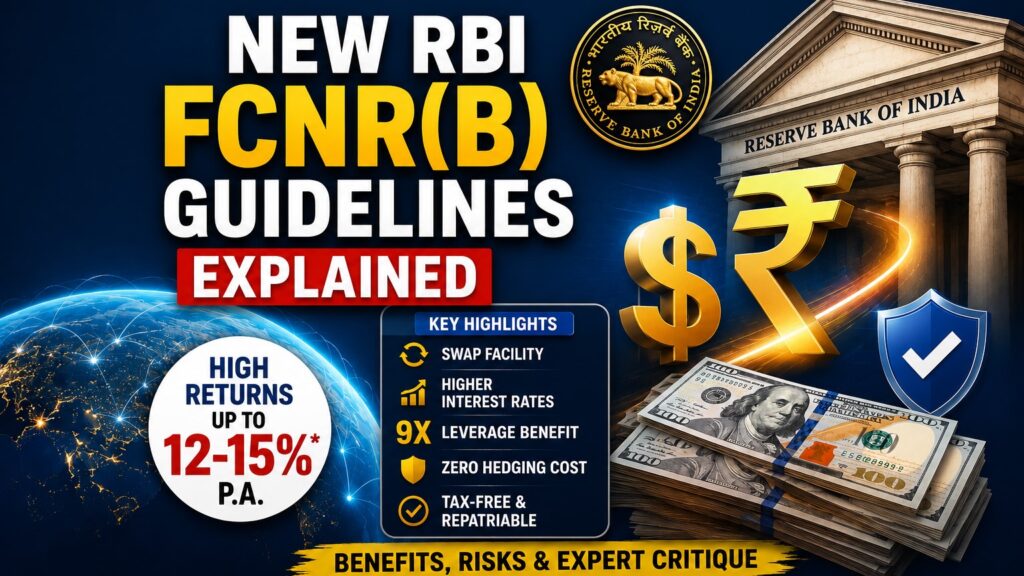
The Reserve Bank of India (RBI) has recently issued significant, time-sensitive updates to the Foreign Currency Non-Resident Bank — FCNR(B) deposit guidelines. To defend the rupee and attract stable, long-term foreign capital, the RBI has temporarily brought back interventions that change the entire working of these deposits. Let us examine the updates in FCNR (B) deposit guidelines and its impact on Indian banks as well as NRI depositors.
The Core RBI Guideline Changes
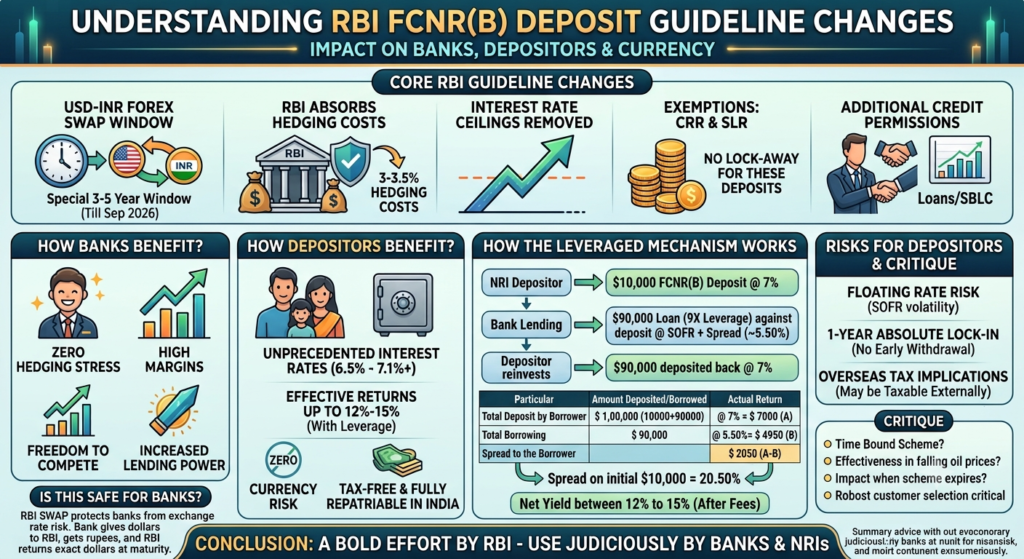
- The USD-INR Forex Swap Window: For fresh FCNR(B) deposits with a maturity of 3 to 5 years, the RBI has opened a special swap window. Under this, banks can sell the foreign currency (USD) they collect from non-residents to the RBI and simultaneously contract to buy it back at maturity at par.
- RBI Absorbs Hedging Costs: Normally, banks must pay a market-linked “hedging cost” (usually around 3% to 3.5% per annum) to protect themselves against rupee depreciation. Under this special scheme, the RBI fully bears the exchange rate risk, removing the hedging cost burden from the banks.
- Removal of Interest Rate Ceilings: Previously, banks were strictly capped on how much interest they could offer (based on benchmark rates like SOFR plus a fixed spread). The RBI has temporarily scrapped the upper limit on interest rates for these 3-to-5-year fresh deposits.
- Exemptions from CRR and SLR: The fresh deposits mobilised under this window are exempt from Cash Reserve Ratio (CRR) and Statutory Liquidity Ratio (SLR) requirements, hence banks can utilize 100% of the inflows under these deposits.
- Additional Credit Permissions: Indian banks (including their overseas branches) are now permitted to extend loans to the non-resident account holders or issue Standby Letters of Credit (SBLC) in favor of overseas lenders against these specific FCNR(B) deposits. This permits depositors to leverage their funds.
- Timeline: This window is strictly a limited-period opportunity, applicable to deposits mobilised until September 30, 2026.
How Banks Benefit?
- Zero Hedging Stress & High Margins: Because the RBI is absorbing the currency risk, banks save 3–3.5% in hedging costs. Combined with the CRR/SLR exemptions, their cost of funds drops dramatically.
- Freedom to Compete: With the interest rate caps temporarily removed, banks have the flexibility to price these deposits aggressively to outbid competitors and pull in massive foreign currency liquidity.
- Increased Lending Power: The credit relaxation allows banks to structure lucrative “leverage products.” They can encourage depositors to open an account, borrow against it at global benchmark rates (like SOFR), and reinvest it right back into India, expanding the bank’s book.
How Depositors Benefit?
- Unprecedented Interest Rates: Because banks save on hedging, they can pass those savings directly to consumers. FCNR(B) dollar interest rates have surged significantly across major Indian banks, with several offering 6.5% to over 7.1% per annum. Along with the hedging and 9X availability of the forex funds the effective returns may go as high as 12% to 15%.(9X depends upon bank to bank. Normally banks would like to keep minimum 10% margin and hence 9X)
- Zero Currency Risk: Since FCNR(B) accounts are held entirely in foreign currency (like USD, GBP, or EUR), depositors are completely insulated from any sudden depreciation of the Indian Rupee.
- 100% Tax-Free & Fully Repatriable: Both the principal amount and the interest earned remain completely exempt from income tax in India, and funds can be seamlessly transferred back overseas whenever needed.
How the Leveraged Mechanism Works for the depositor?
- NRI depositor deposits $10,000 as FCNR (B) at a rate of 7% (as hedging cost of approx. 3.50% is absorbed by RBI, banks can offer higher rates)
- Bank lends the depositor $ 90,000 as against the deposit of $ 10,000 (keeping 10% as margin) as SOFR (Secured Overnight Financing Rate) + a small spread at a net rate of say @ 5.50%.
- Depositor again deposits $ 90,000 with us at an attractive rate of 7%.
The math works as under:
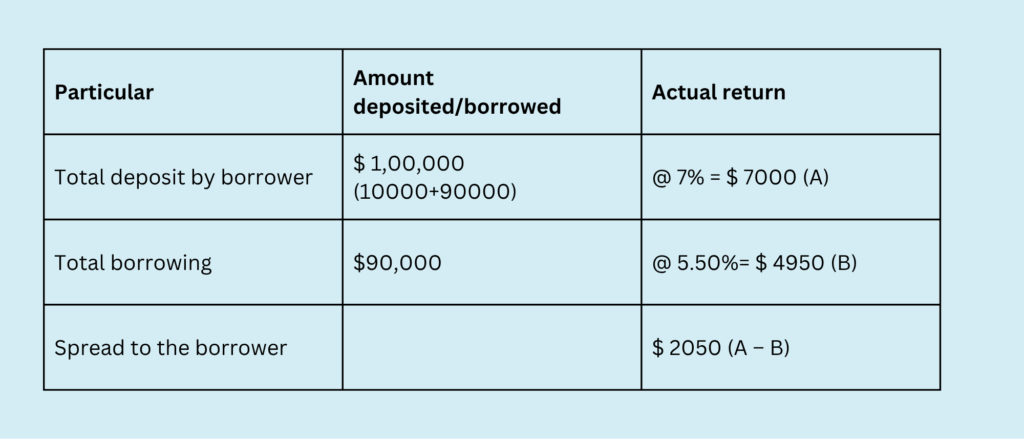
This spread has worked out on a initial deposit of $10,000 i.e 20.50%. Reducing some processing fee, some other minor charges also the deposit will stand to get between 12% to 15%.
Is This Safe for Banks? (The Role of the Swap)
- In the RBI SWAP facility, the bank gives the $100,000 to the RBI, gets rupees to lend domestically at high Indian interest rates. The RBI will return the exact $100,000 at maturity regardless of what happens to the exchange rate. Because there is no hedging cost, the bank can comfortably afford to offer a high rate to depositors say 7.0%.
- However, banks need to be robust on their customer selection as high leverage and low margin can hurt at the time of repayments.
Risks for the Depositors
While is works out mathematically, financial experts issue a few critical warnings for NRIs to look into certain risks before entering into such leveraged structure:
- Floating Rate Risk: The global borrowing rate (SOFR) is usually floating. If central banks globally raise interest rates during the next three years, the cost of the $90,000 loan will rise, compressing or destroying the profit spread.
- The 1-Year Absolute Lock-In: Under the new RBI rules, these swap-linked deposits have a mandatory 1-year minimum lock-in. If an emergency strikes, the funds cannot be pulled early.
- Overseas Tax Implications: While FCNR(B) interest is 100% tax-free in India, it may be fully taxable in their countries of present residence like the United States. Because taxes are levied on the gross interest earned ($7,000) rather than just the net profit ($2,050), the tax bill in the home country can drastically cut into the final 15% net yield.
Critique:
- The basic reasons for giving such concessions and bearing the entire hedging cost is to attract foreign exchange for an interim period. However, when the crude oil prices have already fallen down considerably, does this step actually required?
- The scheme is time bound and when the old scheme comes back, will that not result in outflow of forex once again, bringing us back to square one?
- India is already having forex reserve of USD 670 bn and is this necessary, to bring in such costly forex despite these robust reserves?
- What are the steps that need to be taken to ensure the smooth repayments due to high leverages? Specially if banks fail to handle the product and offer high leverage to undesirable customers resulting into repayment issues.
Conclusion:
FCNR (B) policy modifications have definitely opened a new window for banks to play around their ability to raise forex funds. It also gives a huge benefit to NRI customers to earn smart returns on their foreign funds. However, all three viz RBI, Banks and customers need to be cautious. RBI to check as to what extent they can bear the cost of these transactions as they are taking the hit of entire hedging cost which is quite huge. Banks to see that while leveraging, the selection of customers is robust so that repayment problems are not faced at a later date, they must not expect any sort of rollover of facilities. Customers on the other hand to be careful on the tax implications, 1 year mandatory lock in and also floating nature of the benchmark rate to assess their returns. Finally, if everything falls in line, this must be considered a bold effort by Reserve Bank to be used by banks and NRIs judicially.
References:
https://www.rbi.org.in/Commonman/English/Scripts/FAQs.aspx?Id=3917
https://www.rbi.org.in/Scripts/NotificationUser.aspx?Id=13471&Mode=0
https://www.rbi.org.in/Scripts/NotificationUser.aspx?Id=13468&Mode=0
Update on 11th Sept 2026
Read about the early closure of scheme, inflow and impact, at sillypoint: RBI FCNR Swap Window: The $136.4 Billion Windfall—Success, Cost, and the Road Ahead – At Silly Point
Frequently Asked questions
About the Auhor: The author of the Blog, Sayed Azhar Hasan, is a CFA (ICFAI), MBA, PGDIBF (Islamic Banking and Finance), ex banker with 29 years of banking experience and a management educator.
On social media:
LinkedIn : Sayed Azhar Hasan | LinkedIn
You Tube: Sayed Azhar Hasan – YouTube
Disclaimer: This blog is for informational and educational purposes only. The data and information is obtained from market available sources. This content does not constitute financial, investment, or legal advice. Readers should conduct their own research or consult a certified professional before making any decisions. The views expressed in the blog are personal and from a purely economic perspective.
Discover more from At Silly Point
Subscribe to get the latest posts sent to your email.